
Presenting Our UAS Research at the UFS Science Team Meeting

Presenting Our UAS Research at the UFS Science Team Meeting

m

December 4, 2025

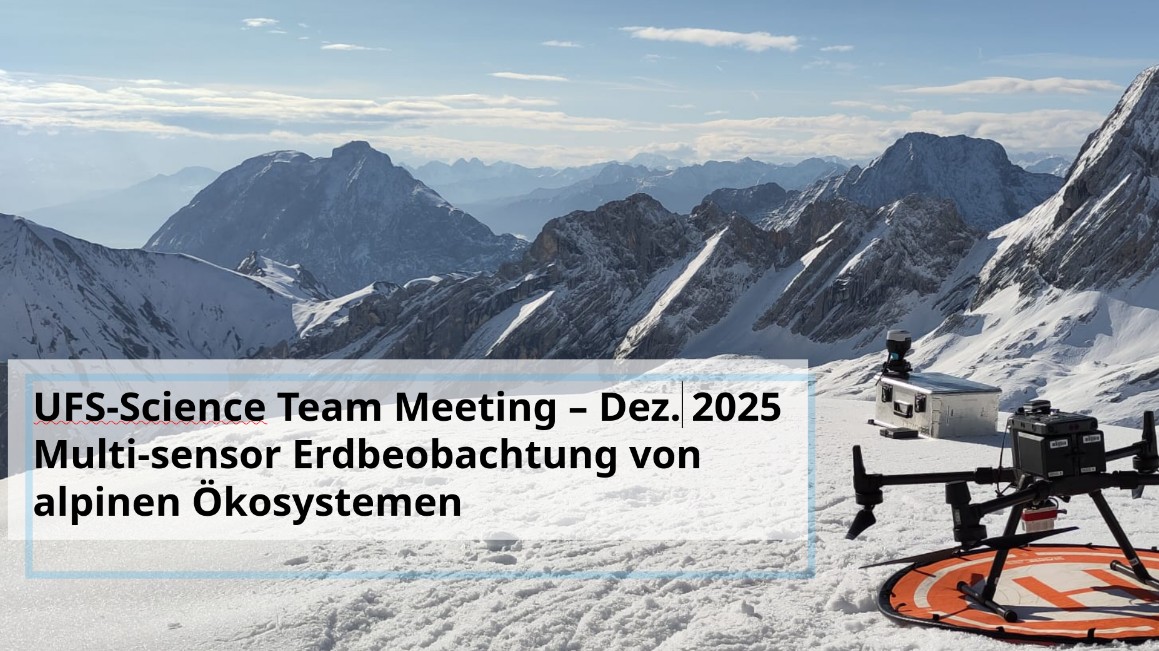
At the recent UFS (Umweltforschungsstation Schneefernerhaus) science team meeting, our group had the opportunity to present current and planned UAS-based research activities in the high-mountain environment surrounding the Zugspitze. The meeting offered an ideal setting to share our progress, discuss technical challenges, and explore collaborative perspectives with colleagues working across a wide range of alpine research topics.

Our presentation focused on the use of LiDAR, thermal, and multispectral UAS sensors to investigate snow properties, as well as applications in geomorphology, biology, and informatics. A central highlight was our first set of LiDAR-based snow height results from a 2000 × 250 m transect on the Zugspitzplatt, surveyed using UAS in combination with in-situ snow measurements.

The initial outcomes are promising:

  • We can map snow surface properties at a spatial resolution of 2 cm, and

  • Achieve vertical snow-height accuracy of approximately ±2 cm using UAS LiDAR..

We also discussed current challenges, particularly the limited validation of snow depth above 2.5 m, as our snow probes only reach this length. As a result, measurements for deeper snowpacks could not be validated during this campaign — a clear point for improvement in future fieldwork.

Beyond the technical insights, the meeting revealed many shared research interests with other UFS partners, including teams working on glacier dynamics, permafrost monitoring, and snow science. These overlaps open encouraging possibilities for future collaboration, both within the UFS science team and across the broader alpine research community.

We look forward to continuing these conversations and strengthening our contributions to high-mountain environmental research.

follow us and share it on:

you may also like:

Geometric calibration study of our thermal UAS sensor

Geometric calibration study of our thermal UAS sensor

At the EORC we deploy a range of space-borne and UAS-based sensors for environmental research. While many systems come with established calibration procedures, some of our UAS sensors require dedicated validation and characterization to ensure scientifically reliable...

EORC researchers teaching drone remote sensing at UNIS, Svalbard

EORC researchers teaching drone remote sensing at UNIS, Svalbard

During their current visit to Svalbard, EORC researchers have been teaching UNIS students from all over Europe on how drones can be used for remote sensing in the high Arctic. Invited by our UNIS collaborators Prof. Dr. Simone Lang (UNIS) and Prof. Dr. Eero Rinne...

Upcoming PhD Defense by Sebastian Buchelt on 11th February

Upcoming PhD Defense by Sebastian Buchelt on 11th February

We are happy to announce that our colleague Sebastian Buchelt will defend his PhD thesis "Potential of Synthetic Aperture Radar time series for mapping and monitoring of small-scale periglacial processes in alpine environments" on February 11th at 12 pm at...

Talk by Dr. Philipp on AI at Airbus

Talk by Dr. Philipp on AI at Airbus

Our former EAGLE M.Sc. graduate and EORC PhD graduate Dr. Marius Philipp will give talk about AI, ML and NLP within his current work at Airbus. The talk will take place next Wednesday, 11th of Feb., at 2pm in John-Skilton Str. 4a. It will take place either in seminar...

Urban Earth Observation Lecture: Understanding Cities from Above

Urban Earth Observation Lecture: Understanding Cities from Above

As part of the EAGLE M.Sc. programme, our international students attended this winter term the Urban Earth Observation lecture by EORC professor Hannes Taubenböck. The session offered a comprehensive overview of how remote sensing has evolved into a central tool for...

Privacy Policy

Lehrstuhl für Fernerkundung & Lehrstuhl für Urbane Fernerkundung

Erdbeobachtung an der Universität Würzburg

Share This