
New Publication by University of Halle and EORC on crop-specific signatures in Sentinel-1 time series. From the abstract:
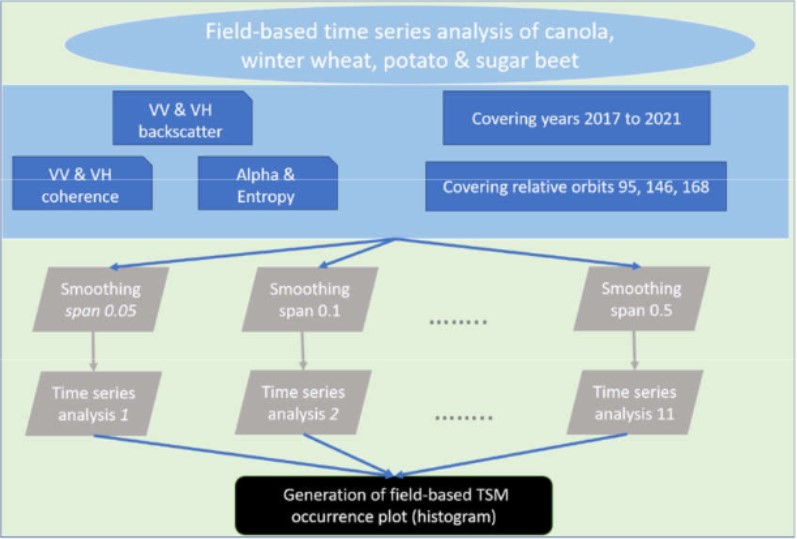
Spatial information about plant health and productivity are essential when assessing the progress towards Sustainable Development Goals such as life on land and zero hunger. Plant health and productivity are strongly linked to a plant’s phenological progress. Remote sensing, and since the launch of Sentinel-1 (S1), specifically, radar-based frameworks have been studied for the purpose of monitoring phenological development. This study produces insights into how crop phenology shapes S1 signatures of PolSAR features and InSAR coherence of wheat, canola, sugar beet. and potato across multiple years and orbits. Hereby, differently smoothed time series and a base line of growing degree days are stacked to estimate the patterns of occurrence of extreme values and break points. These patterns are then linked to in situ observations of phenological developments. The comparison of patterns across multiple orbits and years reveals that a single optimized fit hampers the tracking capacities of an entire season monitoring framework, as does the sole reliance on extreme values. VV and VH backscatter intensities outperform all other features, but certain combinations of phenological stage and crop type are better covered by a complementary set of PolSAR features and coherence. With regard to PolSAR features, alpha and entropy can be replaced by the cross-polarization ratio for tracking certain stages. Moreover, a range of moderate incidence angles is better suited for monitoring crop phenology. Also, wheat and canola are favored by a late afternoon overpass. In sum, this study provides insights into phenological developments at the landscape level that can be of further use when investigating spatial and temporal variations within the landscape.