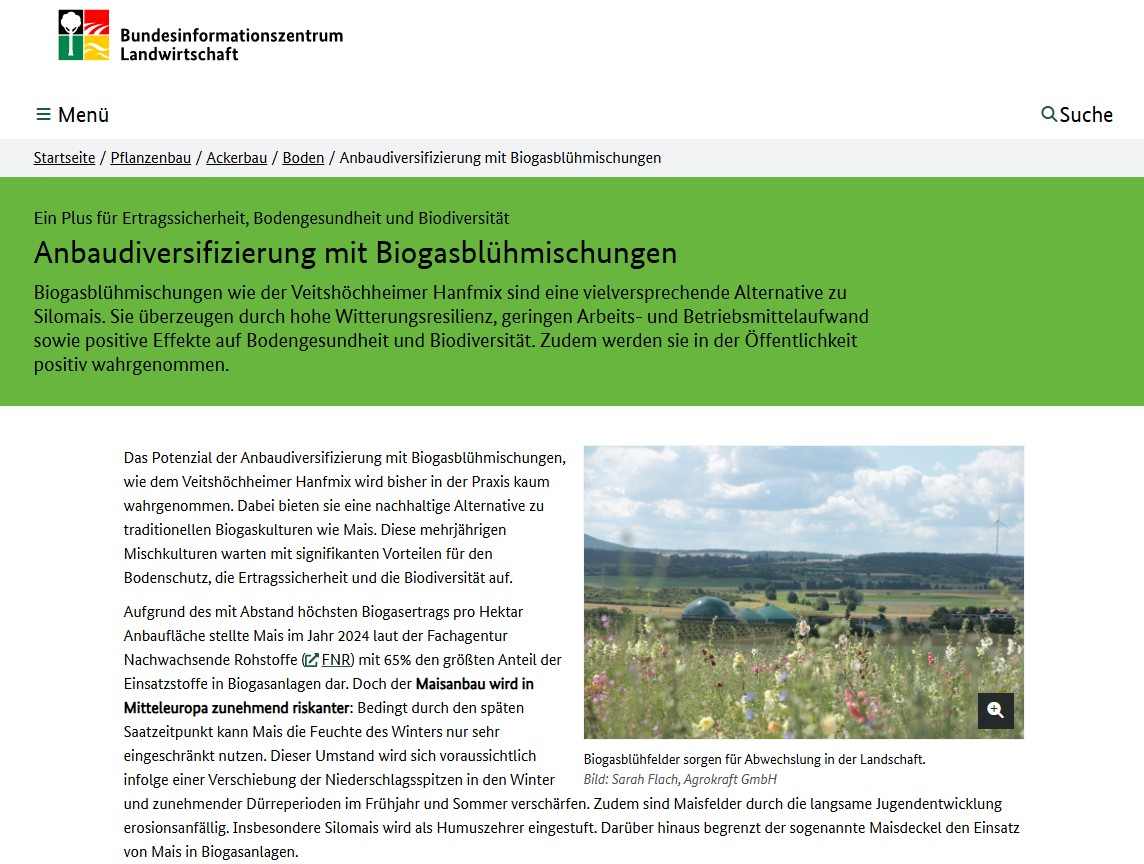

Perennial wildflower mixtures are gaining importance as an alternative to maize in biogas production. As highlighted in the praxis-agrar article on crop diversification with biogas flowering mixtures, they combine agricultural use with clear ecological benefits. Complementing this practice-oriented perspective, a joint contribution by Sofia Haag and Sarah Schönbrodt-Stitt from the Earth Observation Research Cluster (EORC) demonstrates the added value of remote sensing for assessing these cropping systems. The work was carried out in collaboration with Sarah Flach from Agrokraft GmbH and the Federal Information Centre for Agriculture (BZL).
Using multi-year Sentinel-2 time series (2017–2023), biogas flowering fields with wild plant mixtures were systematically compared to maize fields in a heterogeneous agricultural landscape in northern Bavaria. Satellite-based vegetation indices — NDVI to capture plant vitality, NDWI as an indicator of vegetation water content, and NMDI to assess drought stress — enable an objective, spatially explicit and long-term analysis of vegetation development.
The results consistently show higher vitality of biogas flowering mixtures compared to maize. Especially during dry years such as 2022 and 2023, flowering mixtures exhibited more stable NDVI values, indicating a higher resilience to climatic extremes. Differences in water stress were less pronounced but highlighted the influence of soil and site conditions — factors that can be spatially differentiated and monitored using Earth observation data.
By linking the agronomic insights presented in praxis-agrar with a data-driven perspective from space, the contribution illustrates how satellite-based analyses can support a robust assessment of both ecological and production-related effects of biogas flowering mixtures. In doing so, it provides a scientific basis for better integrating agriculture, biodiversity conservation, and renewable energy production.