
A Special Issue titled “Multi-risk assessment in the Andes region” has just been completed and published in the journal “Natural Hazards and Earth System Sciences (NHESS)”.
Elisabeth Schoepfer, Torsten Riedlinger and Hannes Taubenböck from the Earth Observation Center (EOC) of the German Aerospace Center (DLR) in Oberpfaffenhofen and our Earth Observation Research Cluster (EORC) of the University of Würzburg have edited this issue over the last few years together with Rodrigo Cienfuegos from the Pontifical Catholic University of Chile, Jörn Lauterjung from GFZ Helmholtz Centre for Geosciences, and Bruce D. Malamud from the Institute of Hazard, Risk and Resilience (IHRR), Durham University.
The Special Issue aimed at making a significant contribution to single-hazard and multi-hazard risk assessment, including exposure and dynamic vulnerability, and progressing towards the analysis of cascading effects. The Special Issue addressed countries of the Andes region which are particularly exposed to natural hazards like earthquakes, tsunamis, flooding, landslides, volcanic activity, forest fires, and others. To mitigate these threats, effective risk management is indispensable, for which reliable and up-to-date information is essential. The complex relationships between multiple and consecutive natural hazards, the exposed population, a dynamic vulnerability, and critical infrastructures lead to cascading effects which are often not considered. Furthermore, the assessment, quantification, and propagation of intrinsic and epistemic uncertainty are mostly not considered. This can lead to inadequate or even misleading risk management strategies, thus hindering efficient prevention and mitigation measures, and ultimately undermining the resilience of societies.
The Special issue consists of 11 scientific papers and a Preface. Please see the entire Special Issue here: https://nhess.copernicus.org/articles/special_issue1172.html
Please see also here: https://www.dlr.de/de/eoc/aktuelles/nachrichten/2025/sonderausgabe-zur-multi-risiko-bewertung
The initiative for this Special Issue was taken within the RIESGOS project (https://www.riesgos.de/de/) which was supported by the German Federal Ministry of Education and Research (BMBF) between November 2017 and February 2024 as part of the CLIENT II funding measure. In this project, experts in Germany from various disciplines worked together with institutions from science and civil society as well as authorities in the partner countries Chile, Ecuador, and Peru to improve the information needed to proactively prepare for complex disasters.
This particular Special Issue just published is thematically related to another Special Issue published in 2023 in the journal “Natural Hazards” titled “Multimodal Characterization of Built and Natural Environments for Multi-Risk Assessment”: https://remote-sensing.org/our-special-issue-in-natural-hazards-published-in-printed-form/
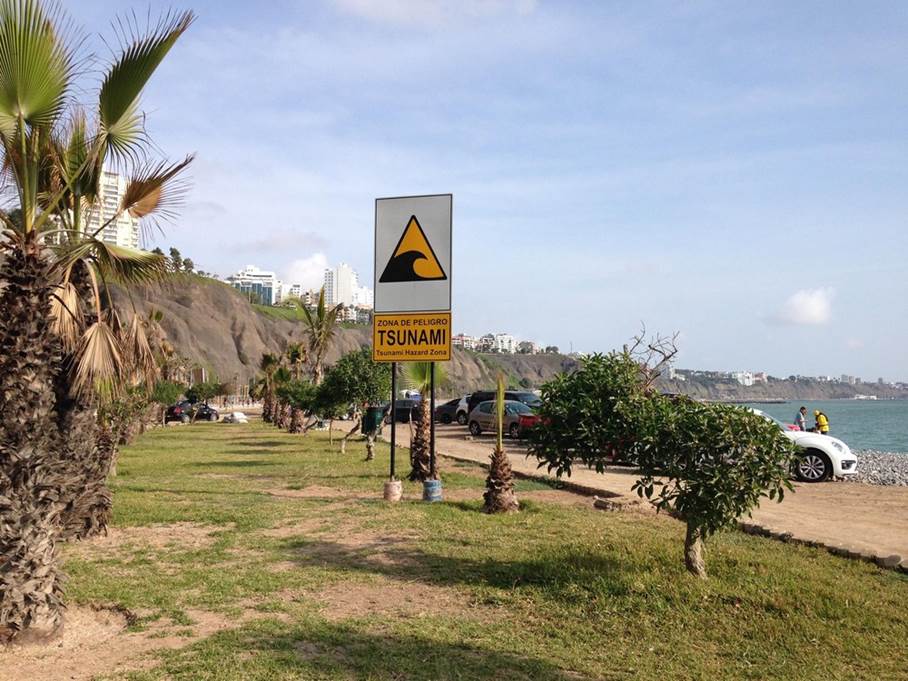
Info on the picture: Tsunami warning sign on the coast near Lima, Peru
Every year, earthquakes endanger the people in Peru’s capital Lima and the port city of Callao. With almost 10 million inhabitants, almost a third of the total population of the country lives here. Settlements and infrastructures extend right to the coast. Earthquakes and tsunamis pose a particularly high risk for the people in this region.