
Successful MSc Defense: Advancing Synthetic High-Resolution Remote Sensing

Successful MSc Defense: Advancing Synthetic High-Resolution Remote Sensing

m

March 26, 2026

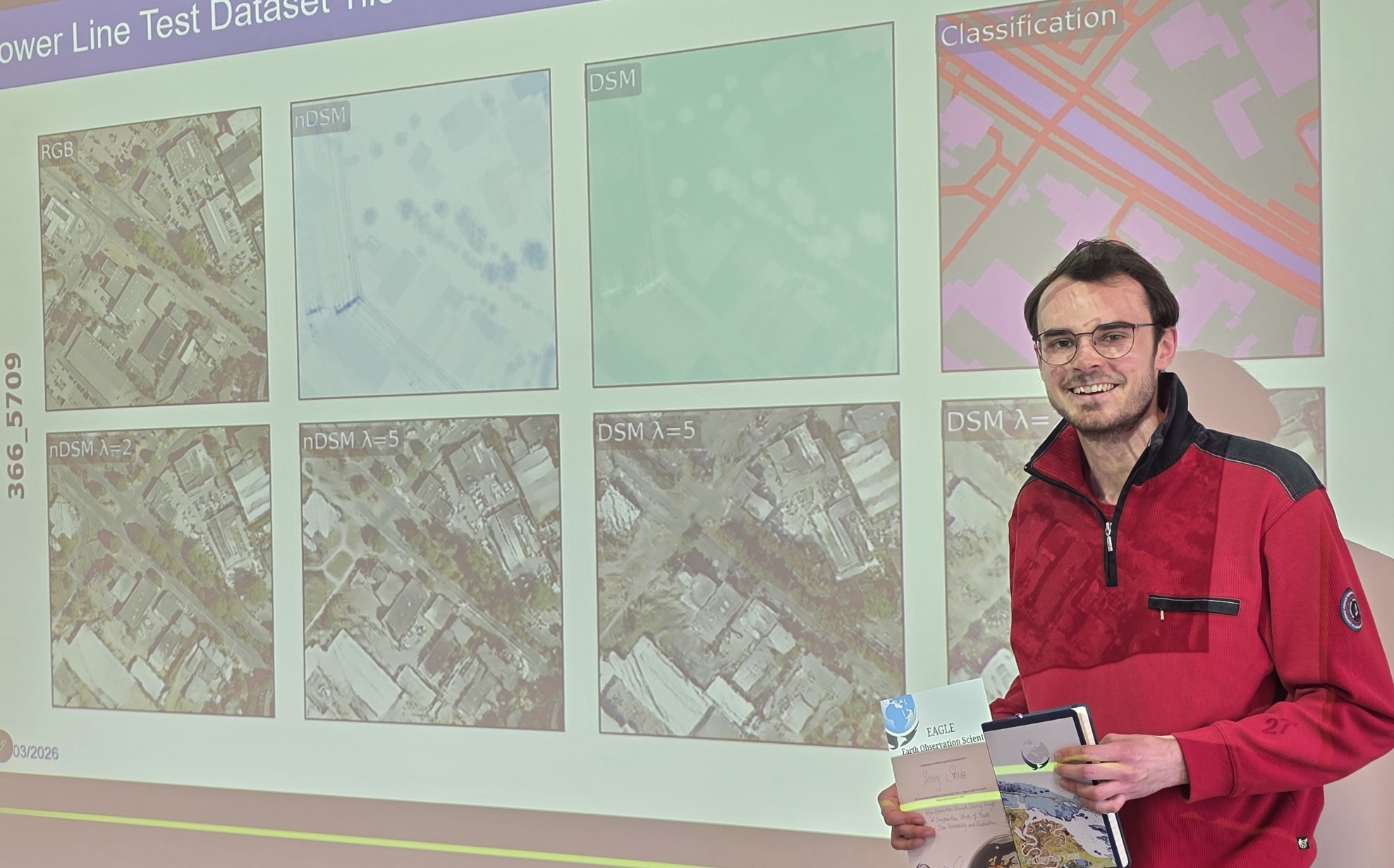
We are pleased to congratulate Georg Starz on the successful defense of his MSc thesis within the EAGLE programme. His work, titled “Synthetic High-Resolution Remote Sensing Image Generation – A Comparative Study of Model Training, Surface Data Variability and Evaluation Metrics,” represents a timely and relevant contribution to the evolving field of data-driven Earth observation.

In his thesis, Georg explored the potential of Generative Adversarial Networks (GANs) to create high-resolution RGB remote sensing imagery from surface models and land use/land cover (LULC) data. Using the German GeoNRW dataset, he implemented and compared four GAN variants, systematically analyzing how different training strategies and input data characteristics influence the quality of generated images. ()

A key strength of the study lies in its comprehensive evaluation framework. By combining expert-based visual ranking with eight quantitative metrics across multiple categories, Georg assessed not only overall model performance but also class-specific behavior across LULC types. Statistical analysis, including Spearman rank correlation, provided deeper insights into the consistency and reliability of commonly used evaluation approaches. ()

The results highlight important challenges and opportunities in synthetic data generation for remote sensing. In particular, the work addresses gaps related to model selection, parameterization, and the transferability of evaluation metrics—issues that are critical for scaling deep learning applications in Earth observation. By systematically comparing approaches, the study contributes to a more robust understanding of how synthetic datasets can support downstream tasks such as classification and mapping.

Supervised by Prof. Dr. Tobias Ullmann and Dr. Thorsten Höser (DLR), the thesis reflects the interdisciplinary and application-oriented spirit of the EAGLE programme. It also underscores the growing importance of synthetic data as a means to overcome limitations in training data availability.

We congratulate Georg on this achievement and wish him all the best for his future endeavors in remote sensing and geospatial data science.

follow us and share it on:

you may also like:

EORC at Space Summit Munich

EORC at Space Summit Munich

Yesterday, the space tech incl the remote sensing community gathered in the historic halls of Neues Rathaus München for the annual Space Summit Munich - an event that brought together scientists, industry leaders, and policymakers to discuss the future of Earth...

Empowering Biology Students with Open-Source Spatial Data Skills

Empowering Biology Students with Open-Source Spatial Data Skills

At EORC, we believe that spatial thinking and geodata literacy are becoming essential skills across scientific disciplines. This semester, we had the pleasure of contributing to the Biology MSc programs MERGE and other study tracks at the Biology Institute through a...

EAGLE M.Sc. Students doing Arctic Internship

EAGLE M.Sc. Students doing Arctic Internship

This spring, Marlene and Aoibhin, two students from our EAGLE M.Sc. program have started their research internship in the high Arctic on Svalbard. Hosted by Prof. Larissa Beumer at the University Centre in Svalbard (UNIS), the students are gaining hands-on experience...

EORC at the Smart Forest Conference: Research meets Practive

EORC at the Smart Forest Conference: Research meets Practive

This week, our EO4CAM staff Sonja and Julian attended the Smart Forest Conference in Freising, a meeting that brings together researchers, forestry practitioners, and technology developers working at the interface of forest science and digital innovation. Over two...

EO4CAM Data Portal Launched to Support Climate Adaptation in Bavaria

EO4CAM Data Portal Launched to Support Climate Adaptation in Bavaria

New Earth observation platform provides satellite-based information for public authorities and planners A new Earth observation data portal is bringing satellite-derived environmental information closer to climate adaptation planning. On 9 March 2026, the EO4CAM data...

Demography Meets Spatial Analysis: Insights from today’s EORC Talk

Demography Meets Spatial Analysis: Insights from today’s EORC Talk

A recent EORC Talk at the Earth Observation Research Cluster (EORC) at the University of Würzburg brought together perspectives from demography, geography, and spatial analysis. Sebastian Klüsener and Tamilwai Kolowa from the Federal Institute for Population Research...

Privacy Policy

Lehrstuhl für Fernerkundung & Lehrstuhl für Urbane Fernerkundung

Erdbeobachtung an der Universität Würzburg

Share This