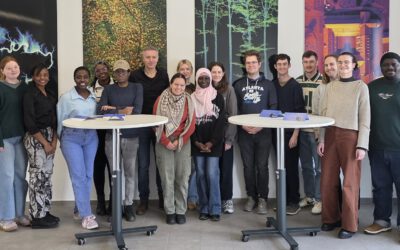


We congratulate our PhD student Patrick Sogno on his successful defense of his PhD thesis.
The thesis is titled „Remote Sensing of Water Surface Dynamics in Africa“,
from the abstract:
Africa presently faces multiple escalating challenges. While contributing comparatively little to global climate change, people in Africa already experience its negative impacts. Through increasing temperatures and precipitation events becoming variable to a degree of unpredictability, agricultural productivity and ecosystem services are threatened. This, in turn, puts local livelihoods in jeopardy. Additionally, Africa faces one of the most dynamic population trends globally. Until the end of the century, the population on the continent is projected to surpass three billion people. This population pressure additionally forces agricultural intensification and has the potential to negatively impact governance and security, especially when livelihoods are at risk and competing interests over scarce resources are not mediated. While there are regional differences, much of the agricultural and drinking water needs in Africa are satisfied by surface water, making it one of the most valuable resources. Ongoing global change is affecting surface water resources and the variability of water availability. Parts of Africa are already characterized by long dry seasons, irregular rainfalls, and bad governance. It stands to reason that unmitigated climate change without sustainable development and management schemes in place could have disastrous outcomes that impact billions of people in Africa as well as worldwide. To be effective, adaptation efforts must be based on a solid understanding of what drives surface water and how its availability impacts other societally relevant topics.
Against this backdrop, this dissertation investigates the potential of remote sensing for analyzing trends, patterns, and drivers of African surface water, specifically in the context of global change. It reviews how, based on remote sensing, surface water delineations and the monitoring of surface water dynamics have developed over the last decades, highlighting research hotspots, thematic foci, sensors and methods utilized, and popular analysis-ready products along with their respective strengths and limitations. This review shows an increase in publication numbers up to the year 2020. Most studies concentrate on parts of China and the Asian southeast. Studies mostly rely on either threshold-based methods for surface water delineation or machine learning algorithms. Optical satellite sensors are used far more frequently than other sensor types; specifically, Landsat data is often considered in studies that investigate surface water dynamics. However, a duality between high spatial resolution and low temporal resolution on the one hand and high temporal resolution and low spatial resolution on the other hand exists. Studies that investigate intra-annual surface water dynamics tend to prioritize sensors with high temporal resolution over high spatial resolution. Regarding their thematic focus, over half of the reviewed studies mainly work on typical hydrosphere-oriented topics. About 45\% of studies work on biosphere-oriented or anthroposphere-oriented subjects. Such focus topics cover, for example, wetland monitoring or flood and drought assessments, respectively.
Further, this thesis presents a methodology to investigate dynamic similarities and causal drivers of major lakes and reservoirs across the African continent in a multivariate setting that is exclusively based on Earth observation datasets. Characterizing surface water extent and height, the DLR Global WaterPack (GWP) is utilized for the surface water areas along with altimetry-based water level products. Apart from surface water products, meteorological variables, specifically air temperature, dew point temperature, precipitation, potential and total evapotranspiration, and solar irradiation, are included based on ERA5-Land. Characterizing the impact of natural vegetation as well as human intervention through water abstraction for agriculture, FluxSat gross primary productivity (GPP) data is included in the analysis. Subsurface water is accounted for using GLWS2.0 soil moisture and groundwater anomaly estimates. Lastly, time series on the Indian Ocean Dipole and the North Atlantic Oscillation are included, representing large-scale oscillations that may impact surface water dynamics. Based on this set of variables, this study investigates the timeframe from 2003 to 2020. Surface water trends for the entire continent, as well as main dynamic similarities and causal drivers for all major lakes and reservoirs, are presented. It is shown that surface water trends are declining in over half of all African countries. However, most of these declines are not statistically significant. Aggregating surface water to ecoregion levels shows a more dramatic picture. Over a third of African ecoregions face significant decreases in surface water area. Many of these ecoregions are concentrated in the African southeast and Madagascar. Similarly, many of the major lakes and reservoirs in Africa that face significantly decreasing trends are located in the east and southeast of the continent. The driver analysis additionally shows that many lakes and reservoirs are mainly driven by inflowing surface water. The second most important driver often is GPP in agriculturally used areas. Driver impacts are complex; upstream surface water is mostly identified as a positive causal impact, but GPP, especially in agricultural areas, can have positive or negative causal relationships, which seem to depend on local agricultural schemes, phenological cycles, and (in the case of reservoirs) dam management. Findings are interpreted and contextualized using scientific literature investigating potential drivers of individual lakes in Africa.
Showcasing the usefulness of remote sensing on multiple spatial and thematic scales, this thesis further features a case study example that investigates the impact of environmental factors on conflict occurrences in the Lake Chad Basin. Within this study, conflicts are modeled using a random forest regression model trained on socioeconomic and environmental data. The importance of the considered factors is derived from the trained model. This allows for a quantitative assessment of potential conflict drivers, focusing on an objective study setup. In line with the rest of the applied part of the dissertation, the investigated timeframe extends from 2003 to 2020. Environmental factors considered encompass surface water (GWP), meteorological parameters (ERA5-Land), GPP (FluxSat), and soil moisture (via the GSSM1km product). Socioeconomic factors considered span the Subnational Human Development Index, competing ethnic claims for areas within the Lake Chad Basin, population density estimates, and previous conflict occurrences that represent the overall instability of regions within the basin. Findings from this case study suggest that previous conflicts are the most important factor to consider. However, environmental factors, especially trends and anomalies in temperature, evapotranspiration, and precipitation, also play significant parts. Further, results indicate a seasonal variation in the importance of biosphere- and hydrosphere-specific features that aligns well with the main agricultural season. This fits well with the prevailing consensus of previous studies, which largely agree that environmental factors may have a part to play in conflict occurrence but should not be considered the main driver.
By providing continent-wide surface water trends, identifying causal drivers for all major lakes and reservoirs of Africa, and offering quantitative findings and season-specific insights relevant to conflict research in the Lake Chad Basin, this dissertation showcases the potential of Earth observation data on multiple thematic and spatial levels. It adds to the existing works and complements them by addressing key research gaps. At the same time, it also outlines the main challenges encountered and highlights potential for future studies to enhance and expand on the analyses done within this work.