
We welcome two guest scientists from the WASCAL Doctoral Studies Programme

We welcome two guest scientists from the WASCAL Doctoral Studies Programme

May 12, 2022

We are happy to welcome two guest scientists from the WASCAL Doctoral Studies Programme at our Department of Remote Sensing at the Institute of Geography and Geology, University of Würzburg.

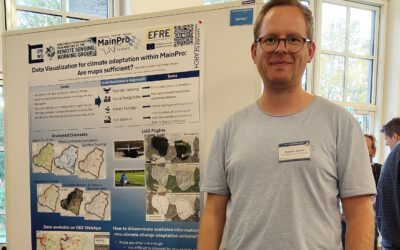
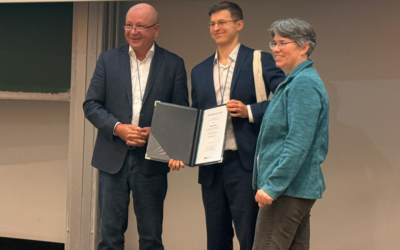
Richard Adade (above picture left) from the WASCAL Graduate School on Climate Change and Human Habitat at the Federal University of Minna, Nigeria, is researching the sea-level rise and related risk and adaptation strategies in rural coastal communities in Ghana.

George Dordah (above picture right) from the WASCAL Graduate School on Climate Change and Land Use at the Kwame Nkrumah University of Science and Technology (KNUST) in Kumasi/Ghana analyses the relationship between climate variability, land use,  land cover change, and migration in Northern Ghana.

We are looking forward to fruitful cooperation with them!

follow us and share it on:

you may also like:

EAGLE Goes Bouldering: Getting to Know the New Cohort

EAGLE Goes Bouldering: Getting to Know the New Cohort

Some of the best conversations don’t happen in a seminar room but outside during a hike or - in this case - a climb. This week, the new EAGLE students got a chance to prove it, swapping lecture slides for climbing shoes at our bouldering social. We booked the Rock-In...

Welcome, new EAGLEs!

Welcome, new EAGLEs!

The newest group of EAGLE students arrived in Würzburg! They come from different countries, with different backgrounds and different skills, and that’s exactly what makes this program special. Remote sensing is a big field, and it gets better when people look at it...

bzgl. Art. 50 Verordnung (EU) 2024/1689 (AI Act):

Überwiegend werden eigene originäre Texte und Bilder des EORC genutzt, jedoch sind einige Inhalte von blog post Texten teilweise mit Hilfe von KI überarbeitet worden und einige Bilder sind ganz mit KI erstellt, die jedoch deutlich keine photorealistische Darstellungen abbilden. Aussnahmen sind KI generierte fernerkundliche Datensätze, die explizit für Forschungszwecke mit KI erstellt wurden, hier wird aber durch den assoziierten Text der wissenschaftliche Grund der KI generierten Bilder erläutert.

Share This