
MSc defense (MA2) by Dilara Kim
On Monday, September 18, 2023 Dilara Kim will present her Msc Thesis at 13:00
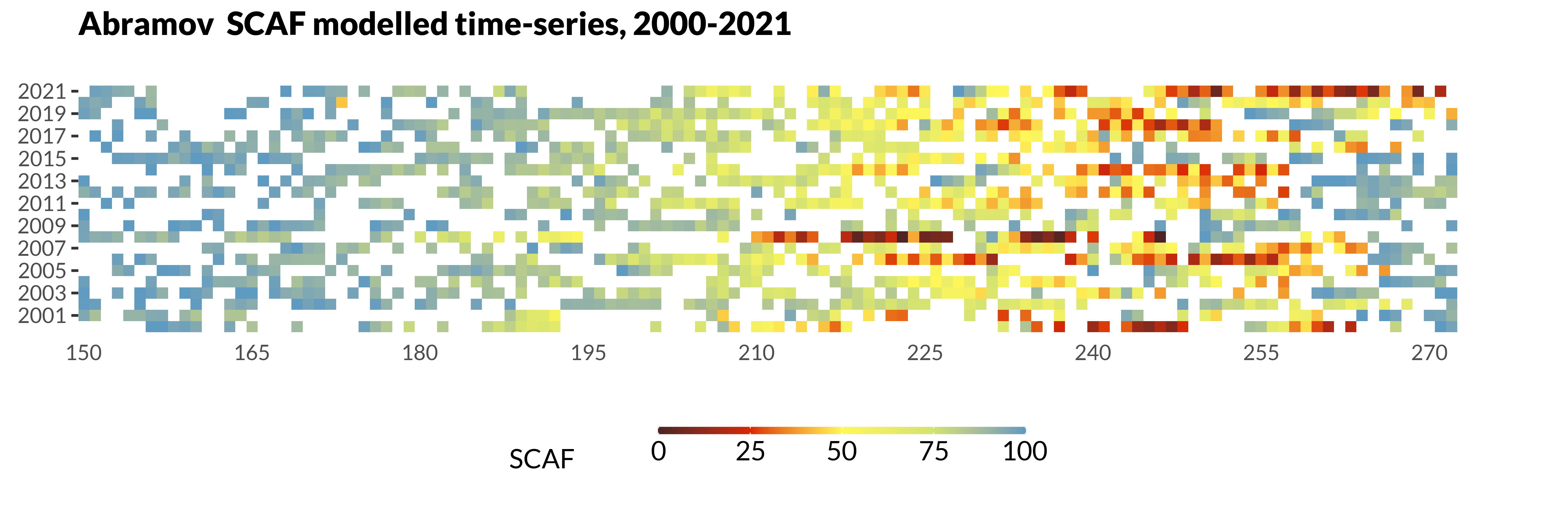
“Sub-seasonal snowline dynamics of glaciers in Central Asia from multi-sensor satellite observations, 2000-2021”
From the abstract:
Glaciers are an important contributor to the freshwater supply in the Central Asian region. Their response to climate change has profound consequences for the land-use applications, and is thus essential to understand. The collapse of the Soviet Union has interrupted the vast majority of the conducted glacier mass balance observations, which began to re-establish in 2010. The existing data gap, limited spatial resolution of glaciological measurements, and the high heterogeneity of the region limits the use of in-situ data. Mass balance models rely on observation-based calibration and validation data, such as transient snowlines (TSLs), a transition between snow and ice-covered surfaces on a glacier at a given point in time. At the end of the ablation season TSL approximates the equilibrium line. From TSL we can calculate the snow-covered area fraction (SCAF), the area on the glacier surface that is snow covered in relation to the total glacier area. The TSL and SCAF can be mapped from satellite imagery due to the distinctive spectral and structural signature of snow over time. Our approach presented in this contribution is based on the MODIS time-series, harnessing the advantage of long and close-to-daily observations records for the period before high-resolution satellites became available. To resolve the issue of MODIS coarse spatial resolution, we retrieved SCAF from multispectral Sentinel-2 and cloud-independent Sentinel-1 SAR imagery using established workflow. The automatic classification and calculation of SCAF is performed using the cloud computing service of the Google Earth Engine, which makes the entire approach easily applicable on a large number of remote glaciers worldwide. We validated the results independently with Landsat data over selected glaciers in Central Asia. From the SCAF time-series we analysed changes in various parameters indicative for the atmospheric conditions and its changes (amongst others the length of ablation period, the minimum SCAF, and the seasonal SCAF changes ) as well as their 20-year trends. Our results provide a unique time series of temporally and spatially high-resolved SCAF estimates giving observation-based information on the heterogeneity of the region’s climatic setting as well as its changes on subseasonal scale.
1st supervisor MSc:
Prof. Dr. Tobias Ullmann
2nd supervisor MSc:
Martina Barandun