
New Publication on Automated building characterization

New Publication on Automated building characterization

September 15, 2021

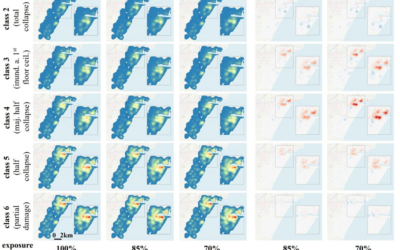
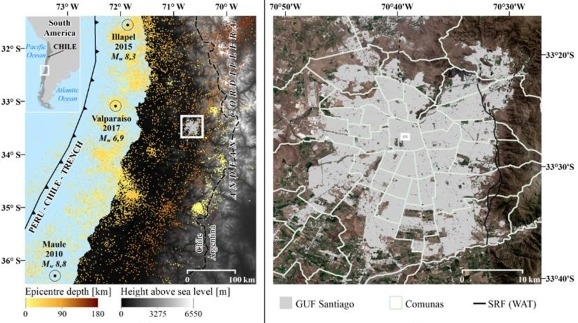
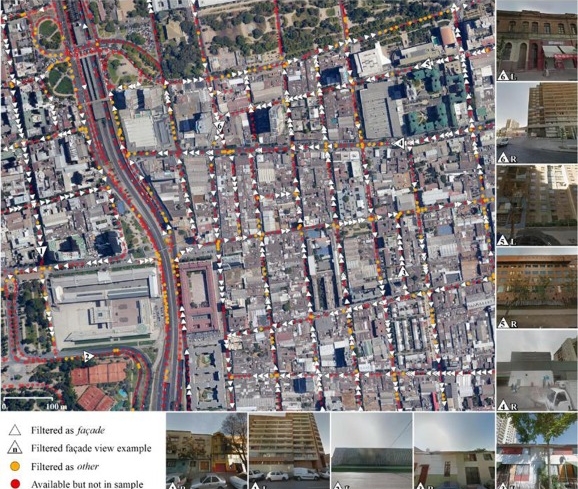
A new publication by Hannes Taubenböck and colleagues is online about “Automated building characterization for seismic risk assessment using street-level imagery and deep learning”. From the abstract: “Accurate seismic risk modeling requires knowledge of key structural characteristics of buildings. However, to date, the collection of such data is highly expensive in terms of labor, time and money and thus prohibitive for a spatially continuous large-area monitoring. This study quantitatively evaluates the potential of an automated and thus more efficient collection of vulnerability-related structural building characteristics based on Deep Convolutional Neural Networks (DCNNs) and street-level imagery such as provided by Google Street View. The proposed approach involves a tailored hierarchical categorization workflow to structure the highly heterogeneous street-level imagery in an application-oriented fashion. Thereupon, we use state-of-the-art DCNNs to explore the automated inference of Seismic Building Structural Types. These reflect the main-load bearing structure of a building, and thus its resistance to seismic forces. Additionally, we assess the independent retrieval of two key building structural parameters, i.e., the material of the lateral-load-resisting system and building height to investigate the applicability for a more generic structural characterization of buildings. Experimental results obtained for the earthquake-prone Chilean capital Santiago show accuracies beyond κ = 0.81 for all addressed classification tasks. This underlines the potential of the proposed methodology for an efficient in-situ data collection on large spatial scales with the purpose of risk assessments related to earthquakes, but also other natural hazards (e.g., tsunamis, or floods).”

read full article here:
P. Aravena Pelizari, C. Geiß, P. Aguirre, H. Santa María, Y. Merino Peña, and H. Taubenböck (2021) Automated building characterization for seismic risk assessment using street-level imagery and deep learning. ISPRS Journal of Photogrammetry and Remote Sensing

follow us and share it on:

you may also like:

How We Learned to Fly: The Story Behind UAS Research at EORC

How We Learned to Fly: The Story Behind UAS Research at EORC

Every research group that's ever bought a drone has a story about the first one it lost. We're no different. So let's just get that out of the way up front: this is the inside story of how UAS (Unoccupied Aerial System) research grew up at the Earth Observation...

MainPro workshop on TLS and LiDAR UAS

MainPro workshop on TLS and LiDAR UAS

This week, a workshop organized by Sebastian Buchelt within our EFRE project MainPro brought together students, researchers, and interested project partners to explore modern UAV technologies. The workshop took place in vineyards close to Würzburg and gave the...

25 Years of Remote Sensing in Würzburg

25 Years of Remote Sensing in Würzburg

Our chair of remote sensing, Professor Stefan Dech, likes to say "science is rarely a sprint, it's a marathon". And if you look at what's grown out of Würzburg over the last 25 years, you'll see exactly what he means. In 2026 the Julius-Maximilians-Universität...

Starkregen in Bayern: Beobachtungen und Dokumentation zählen

Starkregen in Bayern: Beobachtungen und Dokumentation zählen

Starkregenereignisse treten immer häufiger lokal, kurzfristig und mit hoher Intensität auf. Innerhalb weniger Stunden können sie erhebliche Überschwemmungen und Schäden verursachen. Um solche Ereignisse künftig besser zu verstehen und die wissenschaftliche Grundlage...

Seeing the World in Points: Lidar Course for the EAGLEs

Seeing the World in Points: Lidar Course for the EAGLEs

Lidar has a funny way of sneaking up on you. You think you know what it is, a laser that measures distance, fine, but then someone shows you a point cloud of a forest canopy with individual branches floating in 3D space and suddenly you realize there's a whole...

TV Crew Films EORC at MONID Habitrack Fieldwork

TV Crew Films EORC at MONID Habitrack Fieldwork

A bit of extra excitement at EORC recently: A television crew showed up to film a segment on the MONID Habitrack project financed by the BMFTR, and Dr. Ariane Droin was right in the middle of it, walking them through what Earth...

Share This