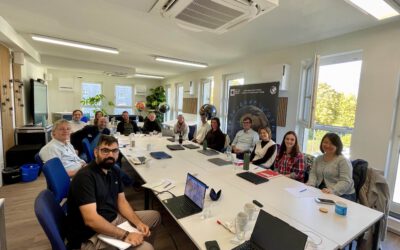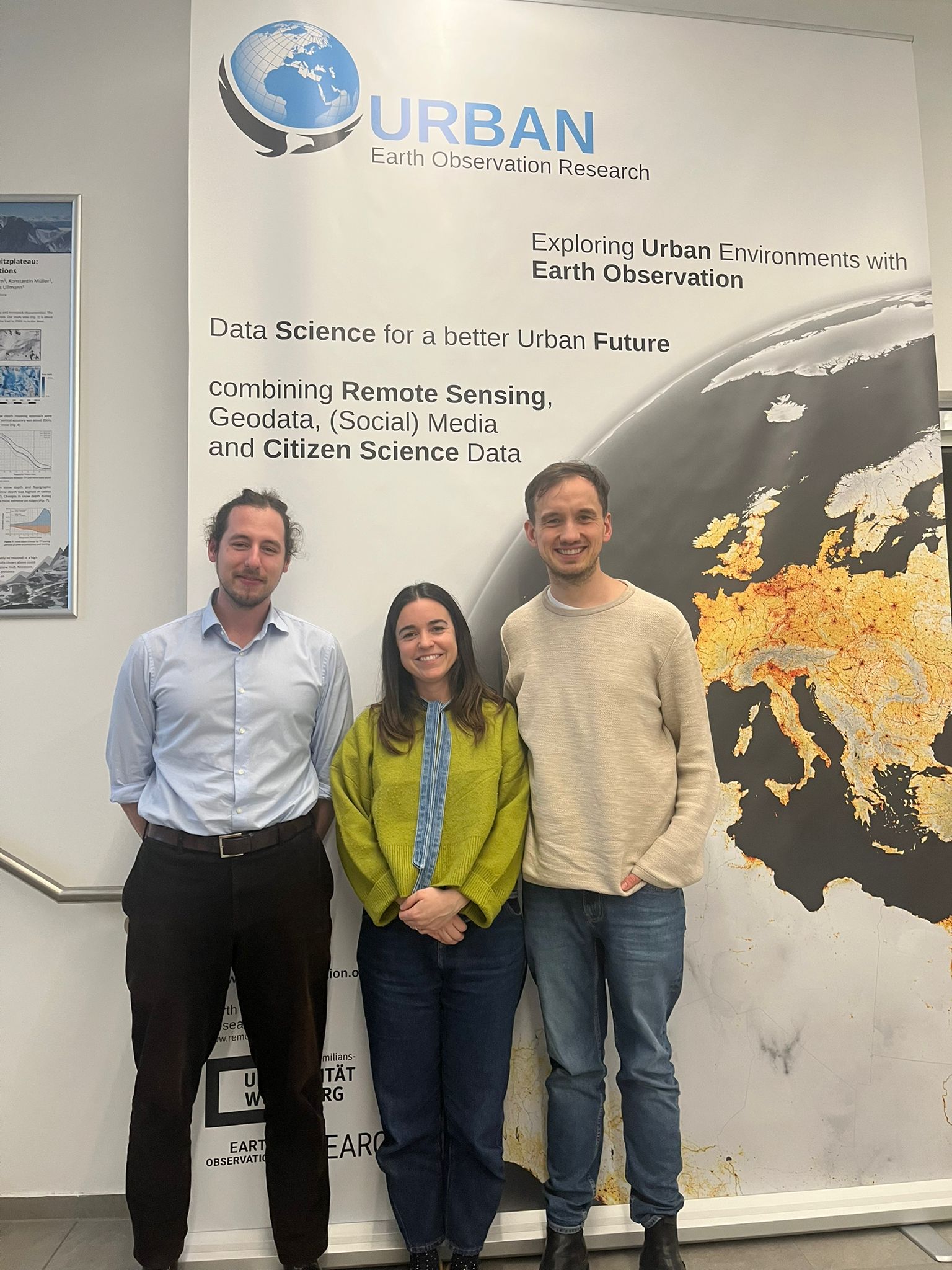

Yesterday, we had the pleasure of welcoming Angela Abascal from the Public University of Navarra (Pamplona, Spain) to the EORC Talk series. In her presentation, “Mapping Intra-urban Inequalities with Earth Observation and Citizen Science,” she guided us through a research agenda that could hardly be timelier: how Earth observation (EO) can help to identify, quantify, and ultimately address inequalities within cities.
At the heart of her work lies a challenge many of us know well from activities at the science–policy interface. Conventional statistics in rapidly changing or informal urban areas are often sparse, outdated, or spatially inaccurate. Angela demonstrated how these gaps can be reduced through the integration of EO data.
Multisensor EO meets lived realities
Optical, radar, thermal and nighttime light data are combined within AI-based frameworks to derive grid-level indicators related to dimensions of deprivation such as urban morphology, accessibility, environmental exposure, heat, and energy services.
A particularly strong element of the talk was the move beyond what can be physically observed from space. By integrating participatory and citizen-generated information for calibration and validation, the resulting models reflect locally meaningful definitions of liveability and deprivation.
This connection between pixels and lived experience resonated strongly with the audience. It served as a reminder that methodological sophistication alone is not enough; relevance emerges when results become actionable for planning, governance, and societal debate.
Transferability, uncertainty, and measurable impact
Angela further emphasized the importance of designing approaches that are transferable across cities, explicit about uncertainties, and capable of capturing dynamics over time. Particularly exciting was her discussion of causal inference frameworks aimed at assessing whether urban interventions reduce deprivation in measurable ways.
In this perspective, EO-based analytics evolve from monitoring instruments into tools for evaluating impact and supporting evidence-based decision-making.
Why this talk will stay with us
What remains after this afternoon? Certainly, fresh methodological inspiration. But also, the impression of how powerful it is when expertise from remote sensing, data science, and participatory research truly meets. The discussions afterwards quickly turned to opportunities for collaboration, comparative studies, and the transfer of similar approaches to other regional contexts.
Dear Angela, thank you very much for this thoughtful, well-structured, and highly relevant contribution.
A brief look ahead …
The EORC Talks repeatedly demonstrate how valuable such spaces of exchange are for our scientific community. They allow us to discover new methods, challenge perspectives, and initiate future cooperation. It would be a pity to miss what is coming next.