
new publication: Phenological Developments on Interferometric and Polarimetric Crop Signatures

new publication: Phenological Developments on Interferometric and Polarimetric Crop Signatures

August 1, 2021

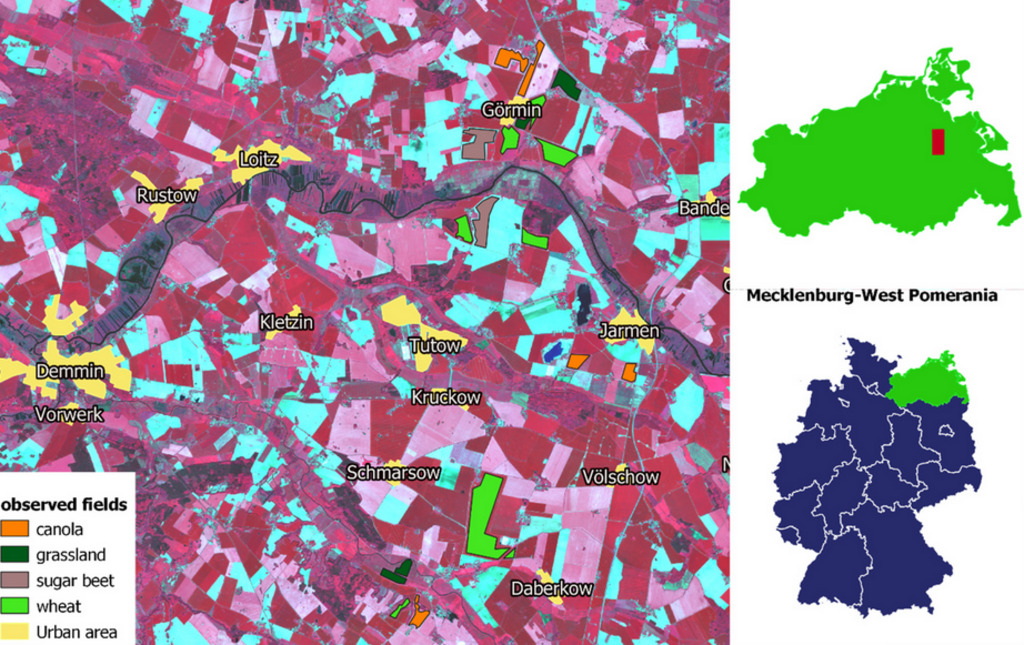
Our staff member Johannes Löw published his EAGLE MSc. thesis results “The Impact of Phenological Developments on Interferometric and Polarimetric Crop Signatures Derived from Sentinel-1: Examples from the DEMMIN Study Site (Germany)” in Remote Sensing.

From the abtract: “This study explores the potential of Sentinel-1 Synthetic Aperture Radar (SAR) to identify phenological phases of wheat, sugar beet, and canola. Breakpoint and extreme value analyses were applied to a dense time series of interferometric (InSAR) and polarimetric (PolSAR) features recorded during the growing season of 2017 at the JECAM site DEMMIN (Germany). The analyses of breakpoints and extrema allowed for the distinction of vegetative and reproductive stages for wheat and canola. Certain phenological stages, measured in situ using the BBCH-scale, such as leaf development and rosette growth of sugar beet or stem elongation and ripening of wheat, were detectable by a combination of InSAR coherence, polarimetric Alpha and Entropy, and backscatter (VV/VH). Except for some fringe cases, the temporal difference between in situ observations and breakpoints or extrema ranged from zero to five days. Backscatter produced the signature that generated the most breakpoints and extrema. However, certain micro stadia, such as leaf development of BBCH 10 of sugar beet or flowering BBCH 69 of wheat, were only identifiable by the InSAR coherence and Alpha. Hence, it is concluded that combining PolSAR and InSAR features increases the number of detectable phenological events in the phenological cycles of crops.”

more details here: https://www.mdpi.com/2072-4292/13/15/2951

follow us and share it on:

you may also like:

PhD submitted by Julia Rieder

PhD submitted by Julia Rieder

We are pleased to share that our PhD student Julia Rieder has successfully submitted her doctoral thesis! Her dissertation, entitled “Abiotic and biotic drivers of drought responses in European beech (Fagus sylvatica L.) inferred from field and LiDAR data”,...

New Funded Project on Automated Detection of Mining Areas

New Funded Project on Automated Detection of Mining Areas

In a newly launched research project funded by the KSB Foundation, we focus on the automated identification of mining areas based on remote sensing data. The aim is to systematically detect large-scale mining activities and to track their spatial and temporal...

New Earth Observation Project on Thermal Satellite Data

New Earth Observation Project on Thermal Satellite Data

We are honored that we are part of a new research and development project, focusing on the development of a satellite constellation capable of delivering high-resolution thermal data with a high revisit rate. The observations aim to make an important contribution to...

Season’s Greetings from the University of Würzburg

Season’s Greetings from the University of Würzburg

As the year draws to a close, we would like to also share the warm season’s greetings from the University of Würzburg to our partners and friends beyond the university. The past months have been marked by commitment, collaboration, and a shared dedication to academic...

New Publication on Agri-Photovoltaics Potential across entire India

New Publication on Agri-Photovoltaics Potential across entire India

For this study, Ingolstadt Technical University (THI) and Earth Observation Research Cluster at the University of Würzburg teamed up to map the potential for agri-photovoltaic across entire India. This technology has the potential to jointly adress Indias rising...

Share This