New RapidEye datasets granted from RESA platform of DLR/Black Bridge

New RapidEye datasets granted from RESA platform of DLR/Black Bridge

October 21, 2015

The Dept. of Remote Sensing recently applied for a time series of 12 RapidEye scenes to support a PhD thesis by Siddhartha Khare (Indian Institute of Technology Roorkee, India). The proposal is now accepted, and th PhD work will be supported by a dense time series of RapidEye scenes acquired in 2013 over dry forests in Lesser Himalayan region of India.

The PhD thesis which will use these processed datasets is entitled  “Object Based approaches for remote sensing-assisted assessment of forest biodiversity focusing on invasive species”, supervised and advised by Prof. S.K. Ghosh (IIT Roorkee) and Dr. Hooman Latifi (University of Würzburg). Additional multisource datasets to be used within the work include time series of Landsat 8 data and Cartosat 2-derived terrain model.

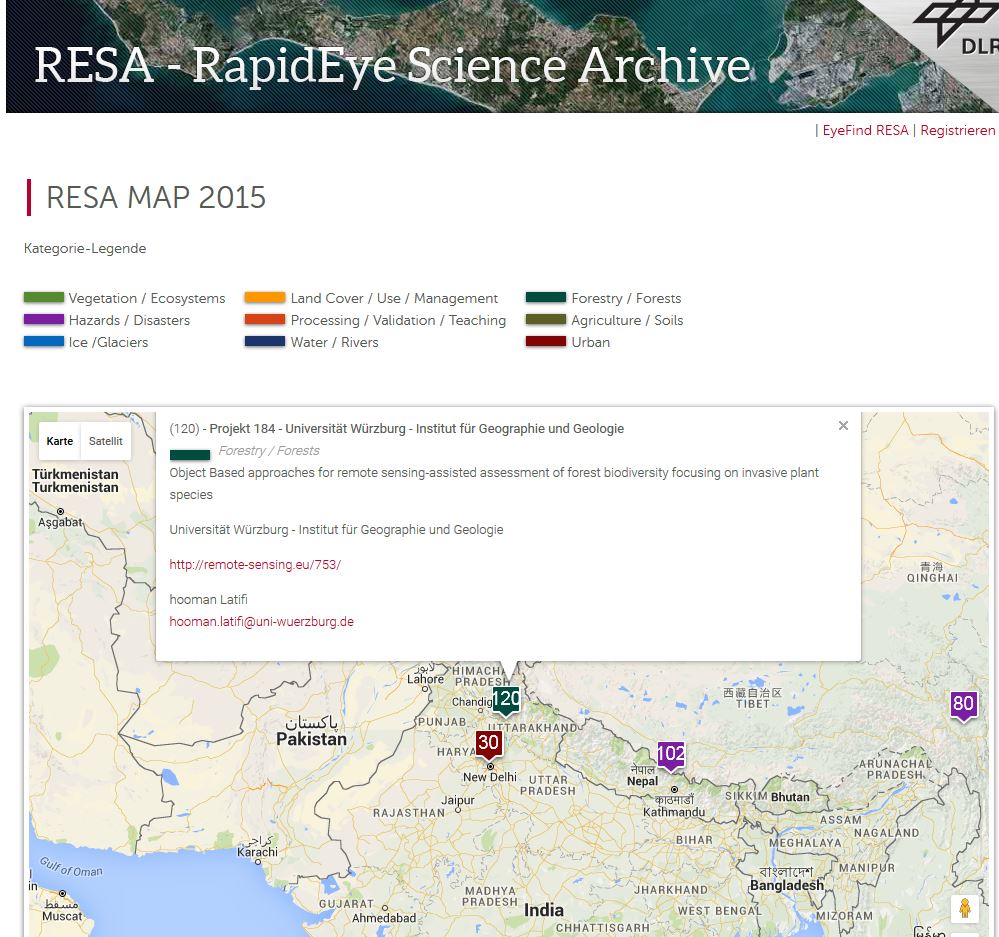
RESA already published this project in RESA project map 2015 which can be found online HERE. The project area is flagged under No. 120 (project number 184) in the map.
resa_india

follow us and share it on:

you may also like:

Successful defence of Agnes Zwick’s Master’s thesis

Successful defence of Agnes Zwick’s Master’s thesis

We are pleased to congratulate Agnes Zwick on the successful defense of her MSc thesis within the EAGLE programme. Her work, titled "New Housing Development Areas: Assessing Structural Types and Environmental Effects," was carried out as part of the EO4CAM...

EORC at City Festival

EORC at City Festival

The Stadtfest Würzburg took over the city this weekend, and any many organisations, local initiatives, like DLRG and all other kinds of groups had booths, and we joined in with our own little corner on Earth observation beside various other University tents by...

bzgl. Art. 50 Verordnung (EU) 2024/1689 (AI Act):

Überwiegend werden eigene originäre Texte und Bilder des EORC genutzt, jedoch sind einige Inhalte von blog post Texten teilweise mit Hilfe von KI überarbeitet worden und einige Bilder sind ganz mit KI erstellt, die jedoch deutlich keine photorealistische Darstellungen abbilden. Aussnahmen sind KI generierte fernerkundliche Datensätze, die explizit für Forschungszwecke mit KI erstellt wurden, hier wird aber durch den assoziierten Text der wissenschaftliche Grund der KI generierten Bilder erläutert.

Share This