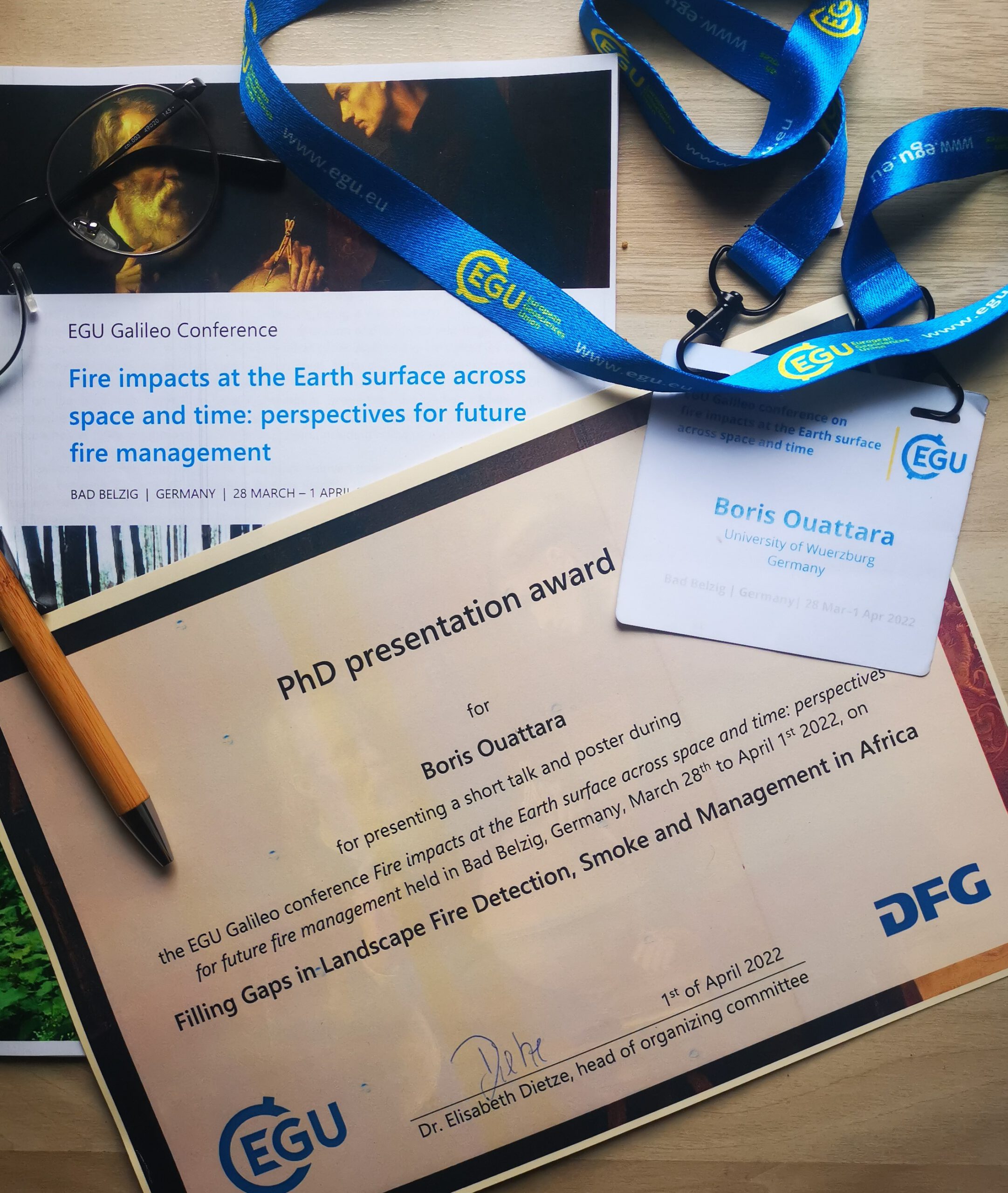

Ph.D. student was awarded for his short talk and poster during the EGU Galileo Conference “Fire impacts at the Earth Surface Across space and time”

Ph.D. student was awarded for his short talk and poster during the EGU Galileo Conference “Fire impacts at the Earth Surface Across space and time”

April 4, 2022

Boris Ouattara (Physical Geography and part of the WASCAL-DE-Coop project) presented his research on West African vegetation fire and its induced emission at the EGU Galileo Conference “Fire impacts at the Earth surface across space and time: perspectives for future fire management”. This conference was held in Bad Belzig, Germany, from 28th of March to 1st of April 2022, and aimed at providing a discussion-driven meeting to facilitate knowledge transfer between fire science disciplines and to identify research needs to support fire management in the future.
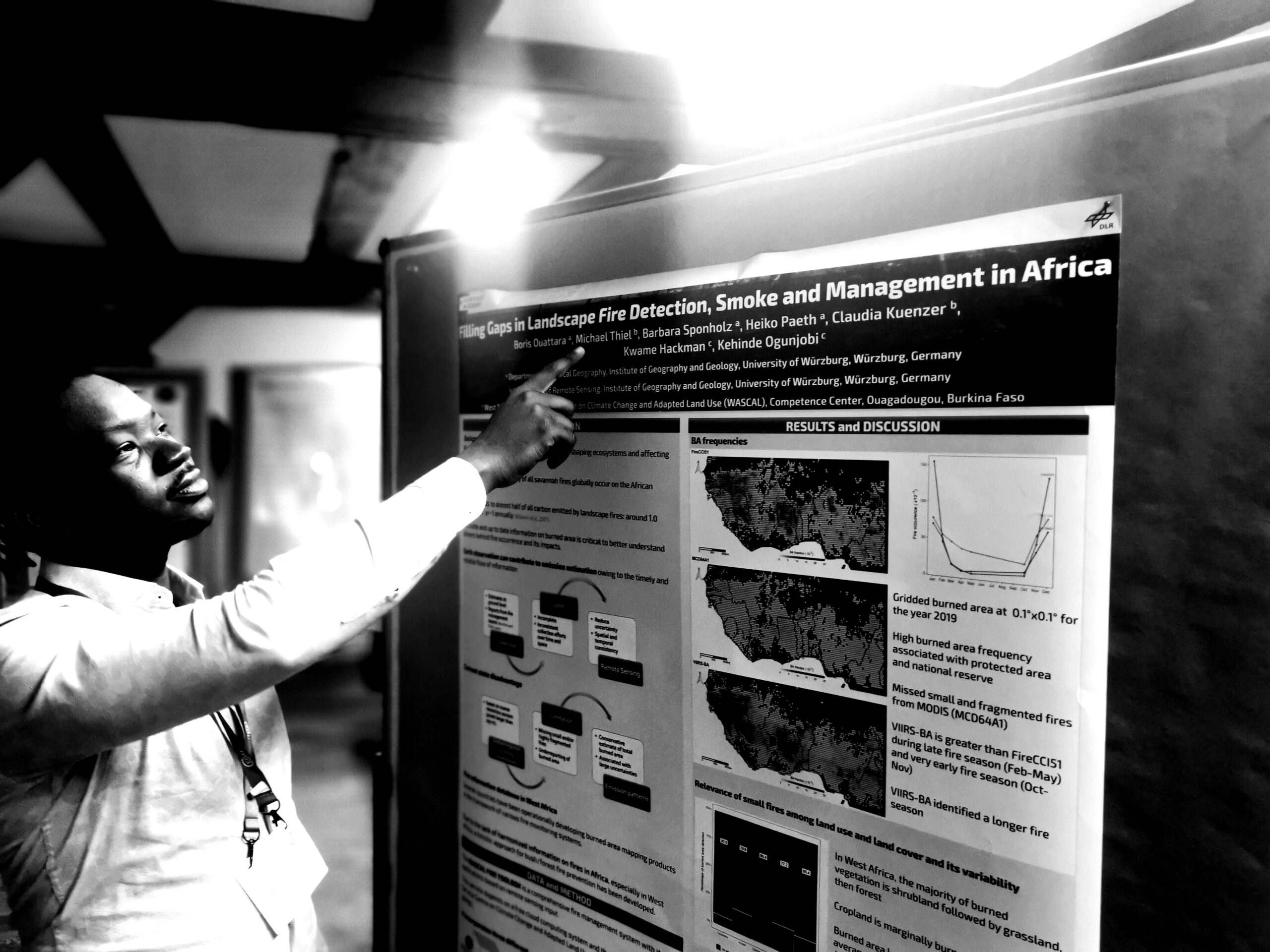
Boris Ouattara in front of his research poster at the EGU Galileo Conference “Fire impacts at the Earth surface across space and time: perspectives for future fire management”

Boris presented on the WASCAL Fire Toolbox aiming at Filling Gaps in Landscape Fire Detection, Smoke, and Management in Africa. With his study conducted in the context of the BMBF-funded WASCAL-DE-Coop project, Boris contributes to the scientific landscape of WASCAL in West Africa.

We congratulate him on being awarded the best Ph.D. candidate presentation for the Early Career Scientists short talk and poster competition.

follow us and share it on:

you may also like:

EAGLEs at SANParks – Kruger National Park

EAGLEs at SANParks – Kruger National Park

Our EAGLEs Sebastian Rothaug and Clemens Schömig just finished their 2+ months for the internship/InnoLab in Kruger National Park. The work was done with SANparks, Dr. Coetsee and Dr. Wigley within a year-long collaboration of EORC researcher Dr. Bevanda. The...

Fieldwork in Focus: Our New “Hex Wall” Installation

Fieldwork in Focus: Our New “Hex Wall” Installation

At EORC, the transition from physical reality to digital analysis is a core part of our methodology. While our primary output consists of Earth Observation data the foundation of this work is laid in the field. To document this essential aspect of our research, we...

Super-Test-Site Würzburg consortium meeting

Super-Test-Site Würzburg consortium meeting

The team of our "Super-Test-Site Würzburg" consortium (University of Würzburg, the Karlsruhe Institute of Technology, the Friedrich-Alexander-University Erlangen-Nürnberg, Leibniz-Institute for Länderkunde in Leipzig  and the German Aerospace...

EORC collaborations: Nature and Conservation with Remote Sensing

EORC collaborations: Nature and Conservation with Remote Sensing

Our Earth Observation Research Centre (EORC) at the University of Würzburg is involved in many collaborations applying remote sensing to environmental monitoring, conservation, and ecosystem research. Our work spans mountain ranges, forests, savannahs, and protected...

Share This