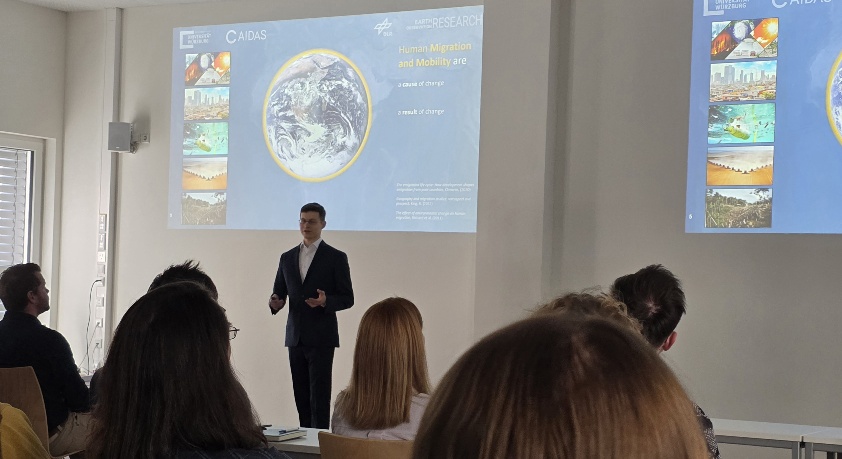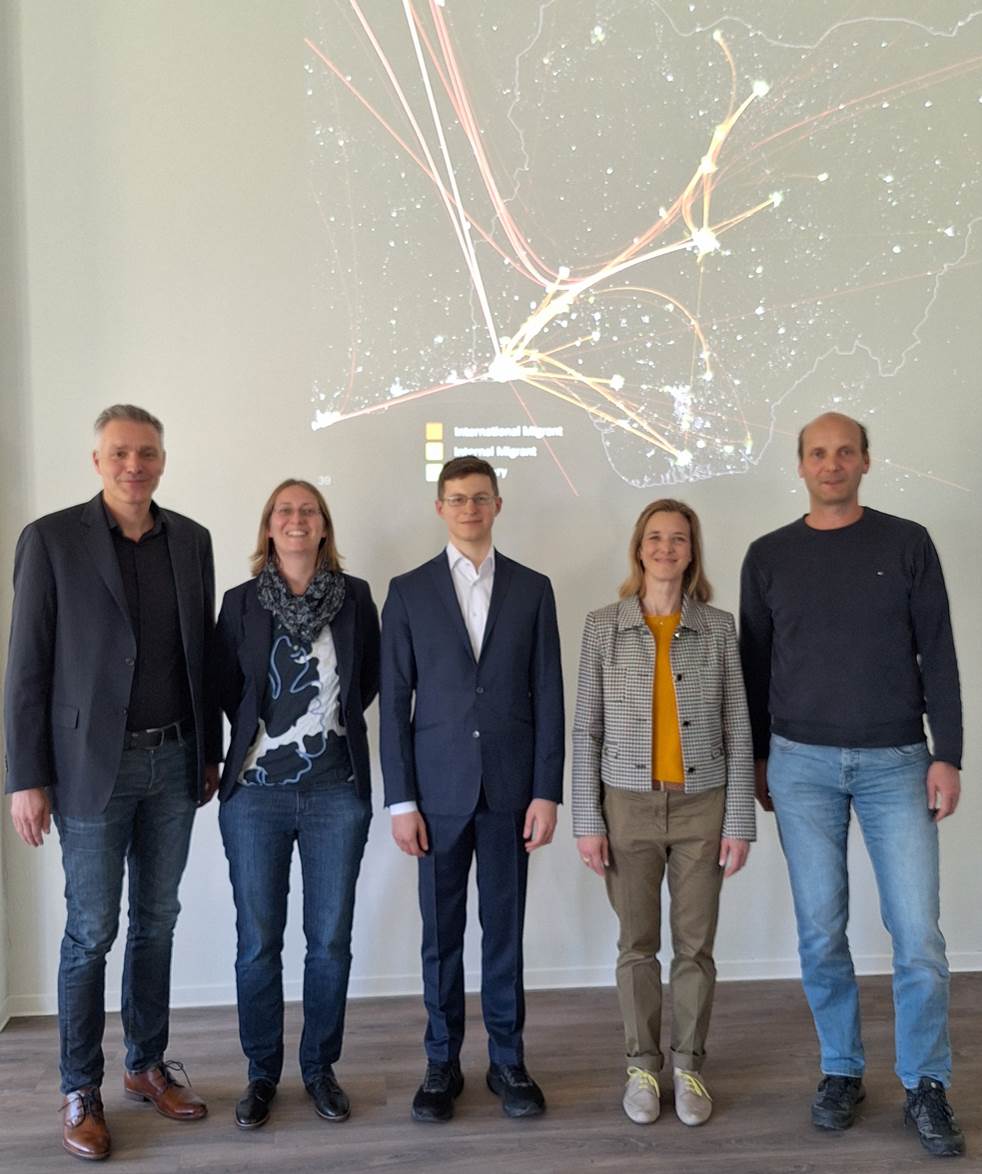
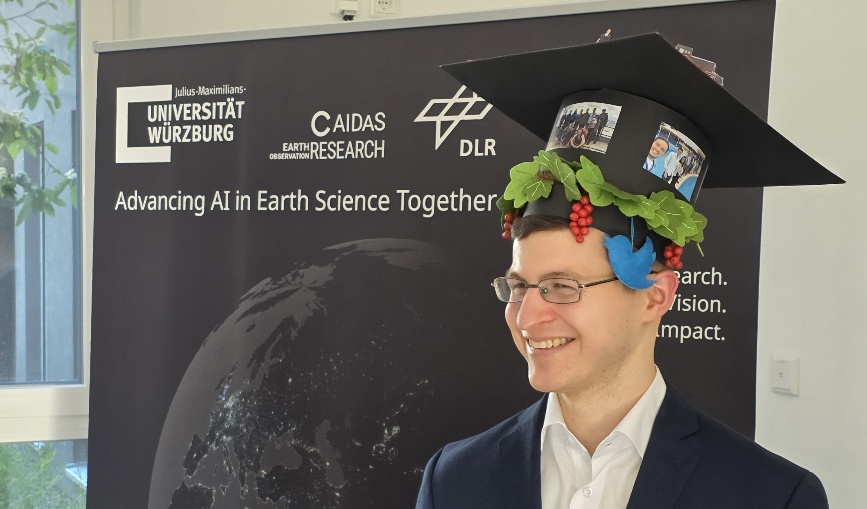

Johannes Mast defended his PhD Thesis titled “Geographical Migration Research using Remote Sensing and Social Media Data” at the Julius-Maximilians-University Würzburg successfully on the 29th of April 2026.
We congratulate him very much for his great achievements in connecting the research fields of remote sensing, linguistics and computational science for geographic research on the topic of migration. His works are embedded at the department of “georisks and civil security” at the EOC of the DLR in close collaboration with our Earth Observation Research Cluster, with Geolingual Studies and the Center for Artificial Intelligence and Data Science (CAIDAS). Prof. Kirsten Sandrock presided over the defense. Johannes was supervised by Prof. Hannes Taubenböck (DLR/JMU), Prof. Carolin Biewer (JMU) and Prof. Andreas Hotho (JMU). His mentor at the German Remote Sensing Data Center (DFD) of the German Aerospace Center (DLR) was Prof. Christian Geiß. We were very happy to welcome a large audience from the German Aerospace Center (DLR), the University of Würzburg and friends and family of the PhD candidate.
Here is the abstract of the thesis: The dissertation investigates the potential of integrating remote sensing and geo-referenced social media (GSM) data to provide a more comprehensive analysis of global human migration and the associated urban growth. While traditional remote sensing effectively maps physical migration factors, it remains limited in capturing the intricate socio-economic and cultural factors that drive human mobility.
By combining natural language processing and spatial analysis, the research demonstrates how digital traces from platforms such as Twitter can supplement satellite data to identify digital disparities, mobility patterns, and migrants’ affinities. The work establishes a flexible, modular framework that allows for the joint analysis of semantic and lexical text features, geodata, and spatial mobility, offering a more nuanced understanding of settlement structures and human migration factors. Further, the research work critically evaluates the inherent geographical and content-based biases within GSM data, emphasizing that these digital methods serve as a valuable complement to, rather than a replacement for, traditional census and qualitative surveys. Ultimately, the studies indicate that the combination of the different data types significantly enhances geographical research by providing a multi-dimensional overview on the complexities of contemporary migration.
For more information on Johannes’ research, we refer to his papers that are part of the PhD thesis:
- The Digital Urban Frontier: Disparities in Social Media Activity between Consolidated and Newly Urbanized Areas in Africa, published in Applied Geography https://doi.org/10.1016/j.apgeog.2025.103687
- Spatial delineations of cities based on web content and built-up age – a case study on North African growth poles from 2010 to 2020, published at the 17th International Conference on Joint Urban Remote Sensing (JURSE 2025), Tunis. https://ieeexplore.ieee.org/abstract/document/11076073
- The Migrant Perspective: Measuring Migrants’ Movements and Interests Using Geolocated Tweets, published in Population, Space and Place https://doi.org/10.1002/psp.2732
- Using geolocated social media data for understanding the relationships between language, topic and mobility: A case study on a local use of English in Nigeria, in print at “Geolingual Studies on Urban Space: Global Identities and Local Connectedness, in New Directions in World Englishes Research. Edinburgh: Edinburgh University Press.
- Geospatiality: The Effect of Topics on the Presence of Geolocation in English Text Data, published in International Journal of Geographical Information Science http://dx.doi.org/10.1080/13658816.2025.2460051
- Comparing Geospatiality of Topics between Geotag- and Geoparsing-based Geolocations, published at the 3rd International Workshop on Geographic Information Extraction from Texts Workshop, GeoExT 2025 https://elib.dlr.de/214374/
Johannes also engaged in different projects. Here are some research papers Johannes was involved:
- Do-it-yourself: urban expansion cloud-based mapping in African cities using Sentinel-1 and Sentinel-2 imagery https://www.sciencedirect.com/science/article/pii/S1569843226000695
- Was global urbanization from 1985 to 2015 efficient in terms of land consumption? https://www.sciencedirect.com/science/article/pii/S0197397525001134
- Global differences in urbanization dynamics from 1985 to 2015 and outlook considering IPCC climate scenarios https://www.sciencedirect.com/science/article/pii/S0264275124003317
- The voices of the displaced: mobility and Twitter conversation of migrants of the 2022 Ukraine war https://www.sciencedirect.com/science/article/pii/S030645732400030X?via%3Dihub
- Dynamics of intra-urban employment geographies: A comparative study of U.S. and German metropolitan areas https://www.tandfonline.com/doi/full/10.1080/07352166.2022.2122833
- In the tension between large-scale analysis and accuracy – Identifying and analysing intra-urban (sub-)centre structures comparing official 3D-building models and TanDEM-X nDSMs https://www.sciencedirect.com/science/article/pii/S0198971523000169
- A new ranking of the world’s largest cities – Do administrative units obscure morphological realities? https://www.sciencedirect.com/science/article/pii/S0034425719303724
- and more .…..