Topic for M.Sc thesis: Application of multi-seasonal RapidEye satellite imagery for inventory of private and municipal forests in the northern Black Forest

Topic for M.Sc thesis: Application of multi-seasonal RapidEye satellite imagery for inventory of private and municipal forests in the northern Black Forest

February 20, 2015

In this M.Sc thesis, a set of multi-seasonal satellite imagery from RapidEye will be applied to develop algorithms and improve the existing ones in tree species mapping across a portion of mixed forest stands in northern Black Forests in the state of Baden-Württemberg in Germany. The focus of the research will be on small private forest patches, for which conducting regular forest inventories has always been a major challenge. For most private forests (i.e. more than 30% of the forest area in Baden-Württemberg) there is a shortage of accurate and up-to-date forest inventory data.

To this aim, a set of multi seasonal RapidEye satellite imagery with a spatial resolution of about 5m are obtained from the Black Bridge company. The data cover 4 seasonally different times of the year, including March 2014, May 2013, July 2014, September 2013, and October 2012. Based on the fact that the tree species show phonological (and in turn spectral) differences during the year, these comprehensive dataset will be used here to map different tree species and other important forest characteristics, such as needle fall, storm effects or effects caused by bark beetles.
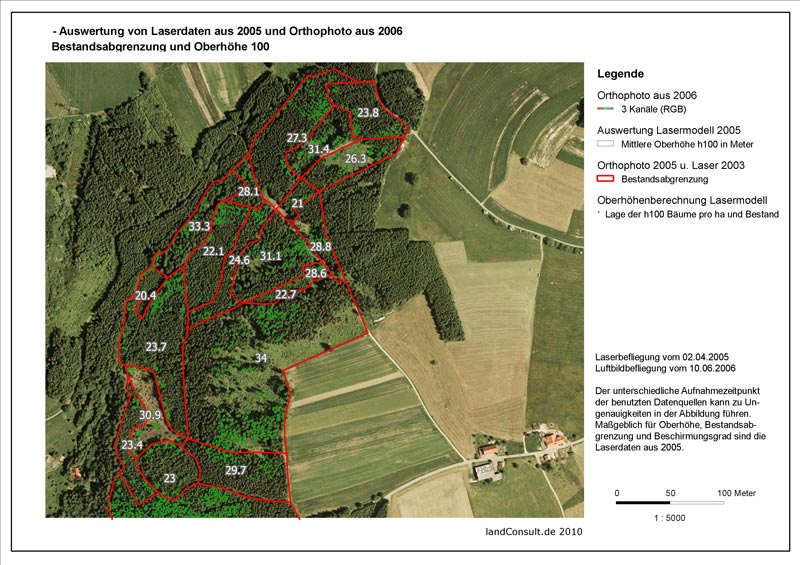
WebDemo-Bestandsabgrenzg-Oberhoehe-top100trees-rgb

Both the results of the single tree-based aerial photo interpretation as well as those from a small area in which all pine trees have been mapped will be used as reference data. In addition, validation data can also be achieved from a number of aerial photo-interpreted stands dominated by Scots pine. The data for the neighboring public forests can also be accessed via the local forest enterprises.

The work will be carried out in close cooperation between University of Würzburg and the LandConsult company (Dr Markus Weidenbach). A Visit to the study area in the northern Black Forest is supported by the LandConsult company.

Moreover, Dr. Piotr Tompalski from the University of British Columbia (Canada) will give advices as an external supervisor.

For questions on this topic, please contact Dr. Hooman Latifi at the Dept. of remote sensing of the University of Würzburg (hooman.latifi@uni-wuerzburg.de).  A more comprehensive description of this topic can be found at following address:

http://www.geographie.uni-wuerzburg.de/fileadmin/04140500/Dokumente/Stellenausschreibungen/Abschlussarbeiten/masterarbeit1_13022015_EN.pdf.


follow us and share it on:

you may also like:

A First Get-Together with the New EAGLE Generation 🦅

A First Get-Together with the New EAGLE Generation 🦅

A new EAGLE generation means new faces, new ideas, and the start of another journey in Earth Observation. And what better way to kick things off than with a relaxed evening at the pub? Our first social event brought together the new students, older EAGLE generations,...

An Evening with Professor Jarugu Narasimha Moorthy

An Evening with Professor Jarugu Narasimha Moorthy

It was a pleasure to have dinner with Professor Jarugu Narasimha Moorthy, who received an honorary doctorate from the Faculty of Chemistry and Pharmacy in recognition of his achievements. The ceremony took place on 29 September 2026 in the Chemistry Central Building....

Welcome, new EAGLEs!

Welcome, new EAGLEs!

The newest group of EAGLE students arrived in Würzburg! They come from different countries, with different backgrounds and different skills, and that’s exactly what makes this program special. Remote sensing is a big field, and it gets better when people look at it...

Ecology or Sampling Bias? A Roadside Perspective on Invasion Risk

Ecology or Sampling Bias? A Roadside Perspective on Invasion Risk

At the 2026 annual meeting of the AK Fernerkundung (German Working Group on Remote Sensing), which was hosted by the Thünen Institute in Braunschweig, our EORC team member Dr. Insa Otte presented research results on sampling bias in species distribution models in...

bzgl. Art. 50 Verordnung (EU) 2024/1689 (AI Act):

Überwiegend werden eigene originäre Texte und Bilder des EORC genutzt, jedoch sind einige Inhalte von blog post Texten teilweise mit Hilfe von KI überarbeitet worden und einige Bilder sind ganz mit KI erstellt, die jedoch deutlich keine photorealistische Darstellungen abbilden. Aussnahmen sind KI generierte fernerkundliche Datensätze, die explizit für Forschungszwecke mit KI erstellt wurden, hier wird aber durch den assoziierten Text der wissenschaftliche Grund der KI generierten Bilder erläutert.

Share This