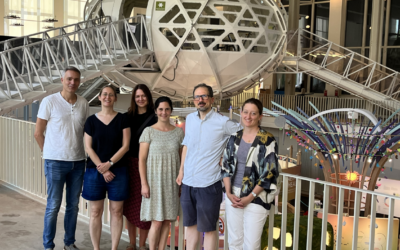

Since beginning of the year, the Earth Observation Research Cluster has a new BMBF-funded project “NetCDA: European Academic Network for Capacity Development in Climate Change Adaptations in Africa”. The project is coordinated by the Department of Remote Sensing at the University of Würzburg and is conducted in a consortium of nine German project partners. Besides the University of Würzburg, the consortium includes the University of Bonn, University of Rostock, United Nations University EHS Bonn, Hamburg University of Applied Sciences, Karlsruhe Institute for Technology, Technische Hochschule Neubrandenburg, University Hohenheim and the International Centre for Water Resources and Global Change at the Federal Institute of Hydrology (BfG).
NetCDA aims at strengthening academic education on climate change adaptation strategies in Africa in close collaboration with the graduate school programme of the West African Science Service Centre on Climate Change and Adapted Land Use (WASCAL). Since 2010, WASCAL is dedicated to capacity development and to strengthening the research infrastructure related to climate change. The academic education of young professionals in association with the German counterparts is also a pivotal competent of their work. Since 2017, the Department of Remote Sensing has played a main role in strengthening these existing cooperations with West African countries and in expanding the network.
This work shall now be expanded and intensified: Over the next two years, the NetCDA project consortium will strengthen the implementation of a Germany network of WASCAL graduate schools. A long-term goal of the project is to initiate an academic network that brings together climate change researchers from Europe and Africa who are active in education. Further, PhD students at graduate schools of WASCAL will be supported in their research, such as through supervision by German partners and research visits at the German partner institutions for up to six months. One of the first milestones of the project consortium is the development of a guideline to further strengthen the integration of German institutes in the WASCAL Graduate Schools.
Stay tuned for updates, which will follow here and soon also on our own project website!