
M.Sc. handed in on UAV-based monitoring of post-disturbed forest sites.

M.Sc. handed in on UAV-based monitoring of post-disturbed forest sites.

March 22, 2017

The M.Sc thesis by Marius Röder (Hochschule für Technik Stuttgart) was handed in. The thesis was supervised by Dr. Hooman Latifi and Prof. Eberhard Gülch and focuses on monitoring post-disturbed and heterogenuous forest sites by cost-effective methods from Unmaned Aerial Vehicle (UAV) domain. The advantage of normalized digital surface models extracted from UAV dta was initially compared to the products derived from standard aerial photography. Subsequently, the suitability of UAV-based inventory was compared to traditional eld methods . For this purpose, reference and UAV data were compared in terms of quality, quantity and cost eectiveness. In addition, an algorithm for automatic tree detection was compared to the manual detection on the UAV-imagery. The extent to which the results differ for certain forest heterogeneity as well as for single and grouped tree individuals was addressed., followed by a cost and benefit analysis of UAV-based forest inventory compared to traditional field-based methods.
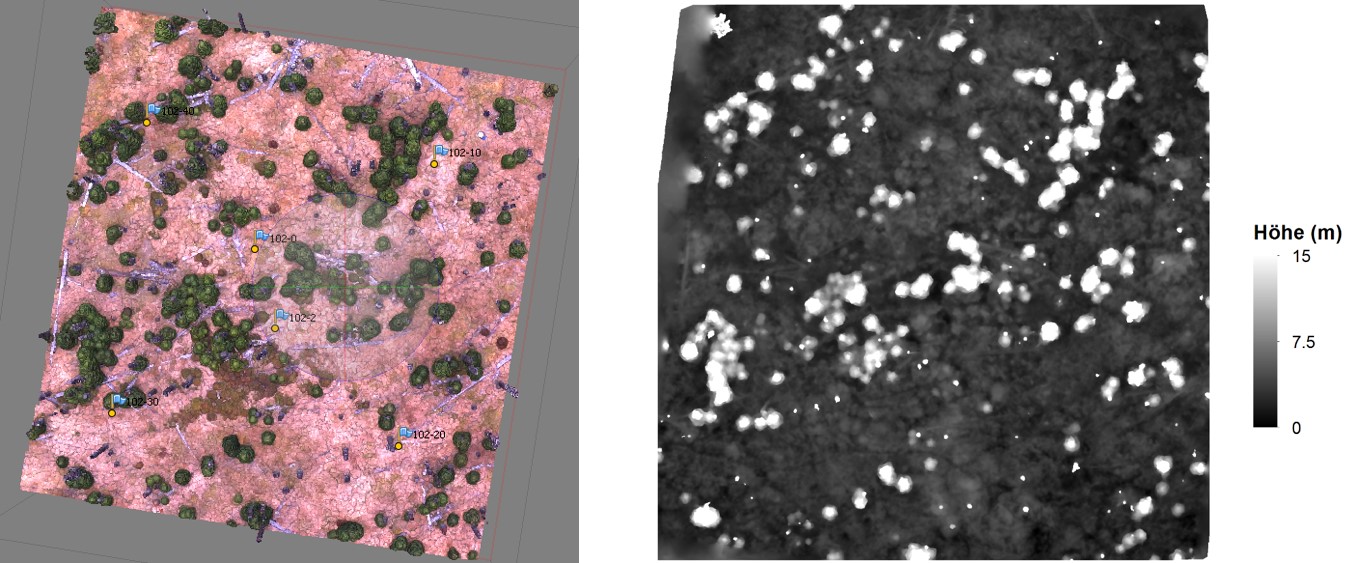
 

UAV-based point cloud (left) and UAV-based nDSM (right) of an examplified sample plot in Bavarian Forest National Park


the results showed that the UAV inventory can not fully replace the eld methods in terms of quality and quantity due to the general disadvantages of photogrammetric methods in the small-scale forest sites consisting of dense rejuvenation stocks. However, from a purely economic point of view, the advantages over the eld method predominate. Improvements could be achieved by combining field and UAV-methods or a simulteanous use of digital camera and laser scanner mounted on UAV.

follow us and share it on:

you may also like:

From Data to Impact: Viktoria Veith’s Internship at WWF

From Data to Impact: Viktoria Veith’s Internship at WWF

Understanding the environmental consequences of conflict is one of the most pressing challenges in contemporary Earth observation. During her internship at WWF, EAGLE MSc student Viktoria Veith has been working at the intersection of remote sensing, policy, and...

Empowering Biology Students with Open-Source Spatial Data Skills

Empowering Biology Students with Open-Source Spatial Data Skills

At EORC, we believe that spatial thinking and geodata literacy are becoming essential skills across scientific disciplines. This semester, we had the pleasure of contributing to the Biology MSc programs MERGE and other study tracks at the Biology Institute through a...

Farewell to Our Second Cohort of ERASMUS+ Scholars

Farewell to Our Second Cohort of ERASMUS+ Scholars

This winter semester, we had the pleasure of hosting the second cohort of eight ERASMUS+ scholars from Ghana, Rwanda, and South Africa. As their semester at our university comes to an end, we are delighted to celebrate their achievements and bid them a warm farewell....

EAGLE Students in Kruger National Park: Internship at SANParks

EAGLE Students in Kruger National Park: Internship at SANParks

EAGLE MSc students Sebastian Rothaug and Clemens Schömig are currently completing an internship/InnoLab with SANParks in Kruger National Park, South Africa. During their stay, they are contributing to a project on fire and drought dynamics in savanna ecosystems. Their...

EAGLE M.Sc. Students doing Arctic Internship

EAGLE M.Sc. Students doing Arctic Internship

This spring, Marlene and Aoibhin, two students from our EAGLE M.Sc. program have started their research internship in the high Arctic on Svalbard. Hosted by Prof. Larissa Beumer at the University Centre in Svalbard (UNIS), the students are gaining hands-on experience...

Share This