
New publication co-authored by our PD Hannes Taubenboeck on “Data-driven prediction of COVID-19 cases in Germany for decision making” in BMC Medical Research Methodology. From the abstract: ”
The COVID-19 pandemic has led to a high interest in mathematical models describing and predicting the diverse aspects and implications of the virus outbreak. Model results represent an important part of the information base for the decision process on different administrative levels. The Robert-Koch-Institute (RKI) initiated a project whose main goal is to predict COVID-19-specific occupation of beds in intensive care units: Steuerungs-Prognose von Intensivmedizinischen COVID-19 Kapazitäten (SPoCK). The incidence of COVID-19 cases is a crucial predictor for this occupation.
Methods
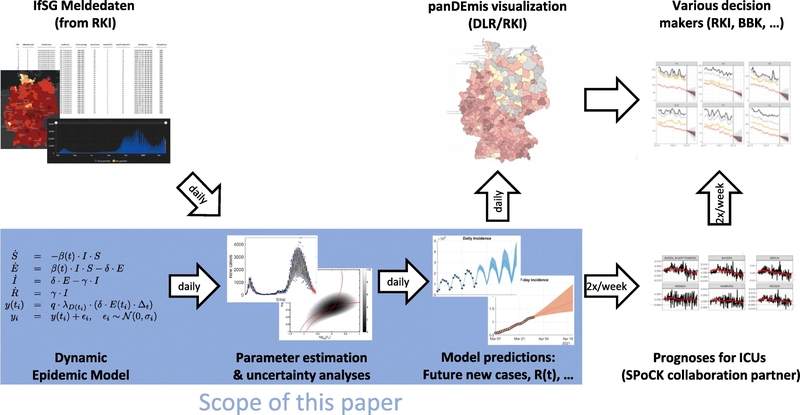
We developed a model based on ordinary differential equations for the COVID-19 spread with a time-dependent infection rate described by a spline. Furthermore, the model explicitly accounts for weekday-specific reporting and adjusts for reporting delay. The model is calibrated in a purely data-driven manner by a maximum likelihood approach. Uncertainties are evaluated using the profile likelihood method. The uncertainty about the appropriate modeling assumptions can be accounted for by including and merging results of different modelling approaches. The analysis uses data from Germany describing the COVID-19 spread from early 2020 until March 31st, 2021.
Results
The model is calibrated based on incident cases on a daily basis and provides daily predictions of incident COVID-19 cases for the upcoming three weeks including uncertainty estimates for Germany and its subregions. Derived quantities such as cumulative counts and 7-day incidences with corresponding uncertainties can be computed. The estimation of the time-dependent infection rate leads to an estimated reproduction factor that is oscillating around one. Data-driven estimation of the dark figure purely from incident cases is not feasible.
Conclusions
We successfully implemented a procedure to forecast near future COVID-19 incidences for diverse subregions in Germany which are made available to various decision makers via an interactive web application. Results of the incidence modeling are also used as a predictor for forecasting the need of intensive care units.
read the full article here:
https://bmcmedresmethodol.biomedcentral.com/articles/10.1186/s12874-022-01579-9