
New publication on the dynamics of intra-urban employment geographies: A comparative study of U.S. and German metropolitan areas
Researchers from the Research Institute for Regional and Urban Development (ILS) in Dortmund, the Earth Observation Center (EOC) of the German Aerospace Center (DLR) in Oberpfaffenhofen and the University of Würzburg in Würzburg teamed up for analyzing changes in the intra-urban spatial distribution of employment across U.S. and German city regions between 2002 and 2015. The paper titled “Dynamics of intra-urban employment geographies: A comparative study of U.S. and German metropolitan areas” was just published in the Journal of Urban Affairs by Bastian Heider, Johannes Mast, Duncan Roth, Ines Standfuß, Stefan Siedentop & Hannes Taubenböck. This research is one of a series of works in the domain of polycentricity research on urban landscapes (see e.g. https://remote-sensing.org/new-publication-on-the-quantitative-assessment-and-comparison-of-urban-patterns-in-germany-and-the-usa/ or https://www.sciencedirect.com/science/article/pii/S0198971517300479 ).
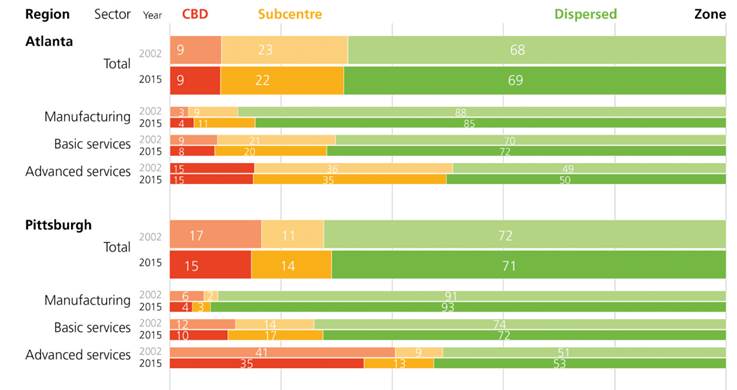
From the Abstract: In this paper we analyze changes in the intra-urban spatial distribution of employment across six U.S. and German city regions between 2002 and 2015. Our methodological approach allows for a systematic and spatially consistent comparison of urban spatial structures across the two different countries. The empirical results show major national, regional, and sectoral differences in the spatial distribution of employment. In the German case studies traditional core cities play a more important role for the regional labor market than in the U.S. Only relatively small shares of metropolitan employment are concentrated in subcenters. While employment concentrations are spatially less persistent in the U.S. case study regions, we did not find any evidence of common or country-specific trends toward increased polycentricity or employment dispersal. Changes in the spatial concentration of employment seem to be highly context-specific and influenced by the individual geographic and institutional frameworks of the analyzed metropolitan areas.
Read the full article here: https://www.tandfonline.com/doi/full/10.1080/07352166.2022.2122833