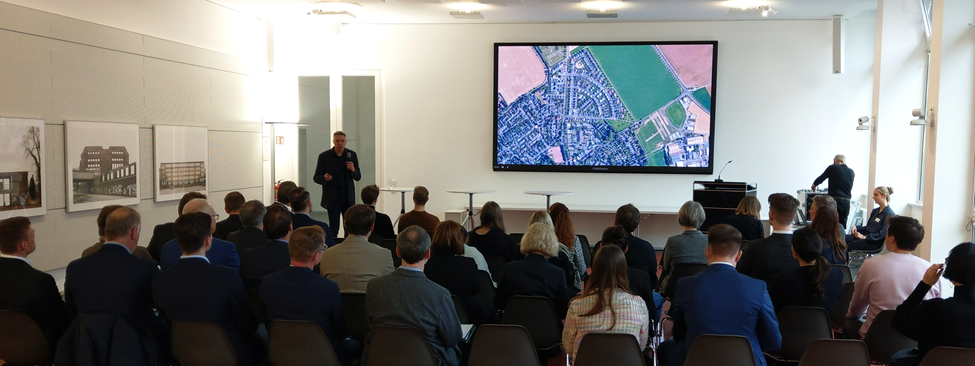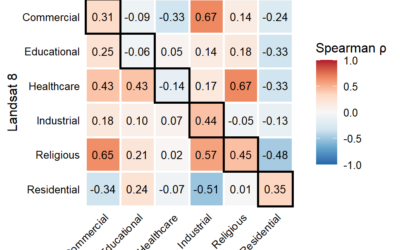
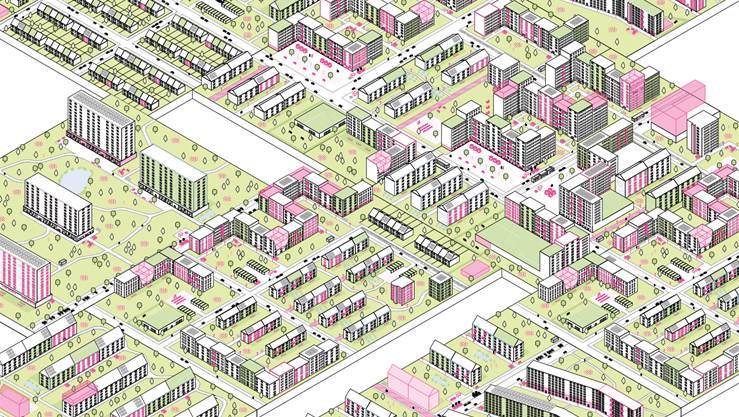

The project “Large Housing Estates of the Future” focused on the type of large housing estates and examined its potential as a building block of sustainable and future-oriented urban development. The project team of the RWTH Aachen, Reicher Haase Assozierte, the Sachverständigen Büro für Luftbildauswertung- und Umweltfragen (SLU) and the German Remote Sensing Data Center (DFD) of the DLR presented the findings of the study at the final workshop on March 21, 2023 in the Baukunstarchiv in Dortmund. Prof. Reicher from RWTH Aachen moderated the program, Prof. Dr. Hannes Taubenböck gave a talk on housing in Germany, Vanessa Ziegler from Reicher Haase Assozierte and Henrike Hochgürtel from the Vonovia GmbH presented the study in detail, and Prof. Neugebauer from RWTH Aachen chaired the discussion rounds with representatives from politics, authorities, business and science.
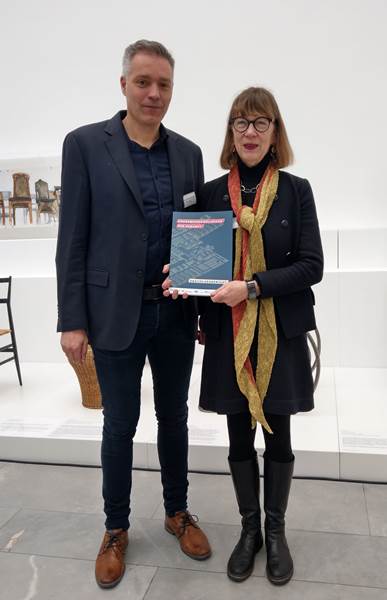
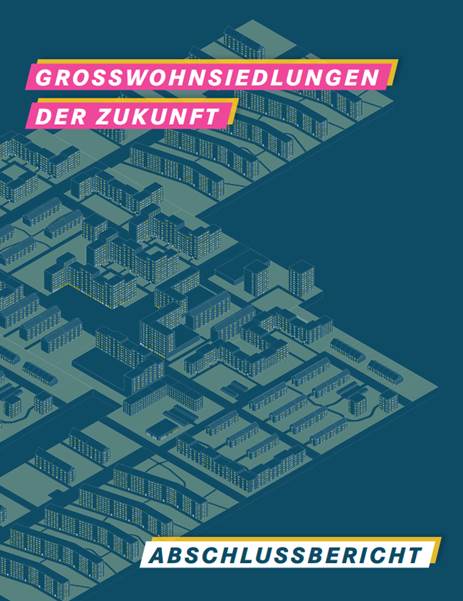
The final report (in German) of the study is available at the following link: https://cloud.rha-planer.eu/s/gT63xgZazZwbiB9/download/547_230224_Abschlussbericht_digital.pdf
Please find the project homepage here: https://www.rha-planer.eu/projekte/grosswohnsiedlungen-der-zukunft/
Here is a brief overview of the study: The increasing pressure on housing and skyrocketing rents and purchase prices in Germany’s cities, as well as the current energy and worsening climate crisis, make it necessary to rethink the construction and housing of the future: According to a recent study commissioned, every second respondent in Germany is affected by a strong or very strong increase in housing expenses. To alleviate this housing pressure in the long term, the current government is pursuing the goal of building 400,000 new homes per year. The high construction costs are to be limited with the help of the promotion of serial and modular construction methods.
At the same time, the political goals of sustainable and climate-compatible urban development require significant efforts to save land: According to the German government’s climate protection plan, land consumption is to be reduced to “net zero” by 2050 and the transition to a so-called circular land economy is to be completed. This means that by 2050, no more new settlement and traffic areas are to be taken up, but rather constructional developments are to take place in particular on already impervious or brownfield sites. Other political objectives such as the mobility and energy turnaround in the sense of a climate-friendly transformation and the strengthening of social participation and justice in our cities also require new urban development approaches and concepts, both with regard to the further development of existing buildings and for new buildings and neighborhoods. Against this background, not only the issue of climate and socially appropriate development of existing buildings, but also that of “large-scale building of the future,” originally a child of the mid- and late 20th century, is gaining renewed importance today.
This study, “Large Housing Estates of the Future” therefore took a look at the neighborhood type of large housing estates and examined it for its potential as a building block of sustainable and future-oriented urban development. To this end, the project explored the question of what makes large housing estates attractive and how they can be transformed with a view to achieving the aforementioned objectives. To this end, existing housing estates from the 1960s, 70s and 80s were examined and, above all, the proven discrepancy between internal and external perceptions of the neighborhoods was investigated: Why are the settlements often perceived negatively by outsiders, while they are predominantly held in high esteem by their residents? What are the qualities of the large housing estates, and what factors contribute to residential satisfaction? What deficits and development potentials can be identified? Based on this, insights were gained into how existing housing estates can be sustainably developed and transformed, or which urban planning, open space planning or urban development policy guidelines a new large housing estate should follow in order to generate attractive and sustainable living space. This final report brings together the findings and provides an overview of possible approaches.