
On Tuesday, November 28 at 12:00 a.m., 2023 Moritz Rösch will present his MSc defense
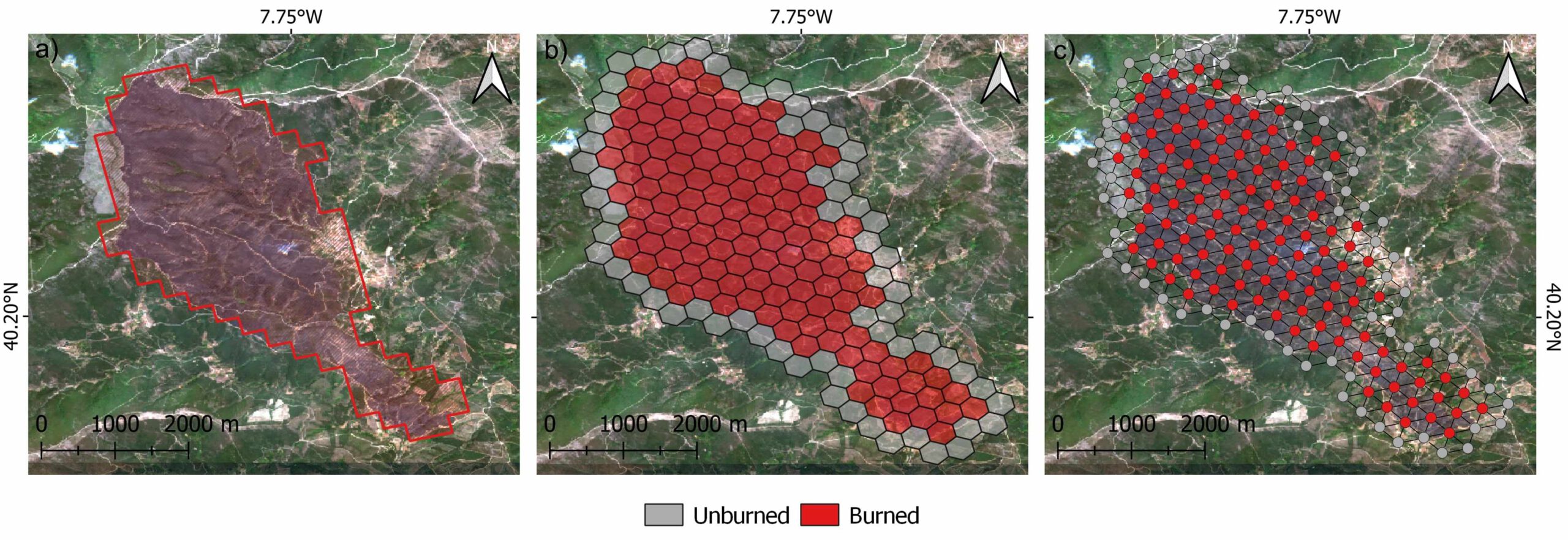
“Daily spread prediction of European wildfires based on historical burned area time series from Earth observation data using spatio-temporal graph neural networks”
in the seminar room 3 in John-Skilton-Str. 4a/ground floor
From the abstract:
Wildfires are natural disasters that shape ecosystems and have adverse effects on the environment, economy, infrastructure, and human lives. Anthropogenic climate change is intensifying global fire activity, with a particularly alarming outlook for the fire-prone Mediterranean. To mitigate catastrophic wildfires, wildfire spread models play an essential role in estimating fire propagation during emergency response. Existing operational models rely on semi-empirical assumptions, suffering from substantial uncertainties and limited transferability. Additionally, the scarcity of high-quality reference data restricts the use of data-driven modeling approaches. This thesis constructed a comprehensive dataset incorporating the historical daily burned area time series of all European wildfires between 2016 and 2022, along with associated wildfire driver variables. Using this dataset, a novel Deep Learning (DL) wildfire spread modeling approach, employing a Spatio-Temporal Graph Neural Network (STGNN), was developed on a regional scale for the country of Portugal and on a continental scale for the entire Mediterranean. The Portugal and Mediterranean models did not achieve satisfactory results in the delineation of the wildfire spread perimeters, largely due to an overprediction bias, but are consistent with the results of other data-driven modeling approaches. General spread trends were correctly predicted and could still be of use for operational decision-making. The model performances improved with larger daily fire spread sizes and ongoing prediction days, highlighting the importance of spatio-temporal dependencies for wildfire spread modeling. The Mediterranean model demonstrated similar accuracies to the Portugal model and showed strong generalization across fire-prone Mediterranean countries and fire seasons, indicating the suitability of DL models for creating transferable, large-scale wildfire spread models. Noise in the reference dataset can explain the models’ low overall performance, highlighting the current constraints of data-driven wildfire spread models.
Hosting Institution: DLR
1st Supervisor: Prof. Dr. Tobias Ullmann
2nd supervisor MSc: Dr. Michael Nolde, DLR