
On November 12, 2026, Christina Krause will present her Master Thesis on ” Active Learning and Parameter-Efficient Feature Adaptation for Cross-City Seismic Building Type Transfer Using DINOv2 and Street-Level Imagery” at 14:00 at the EORC Meeting Room (1st floor) in John-Skilton-Str. 4a.
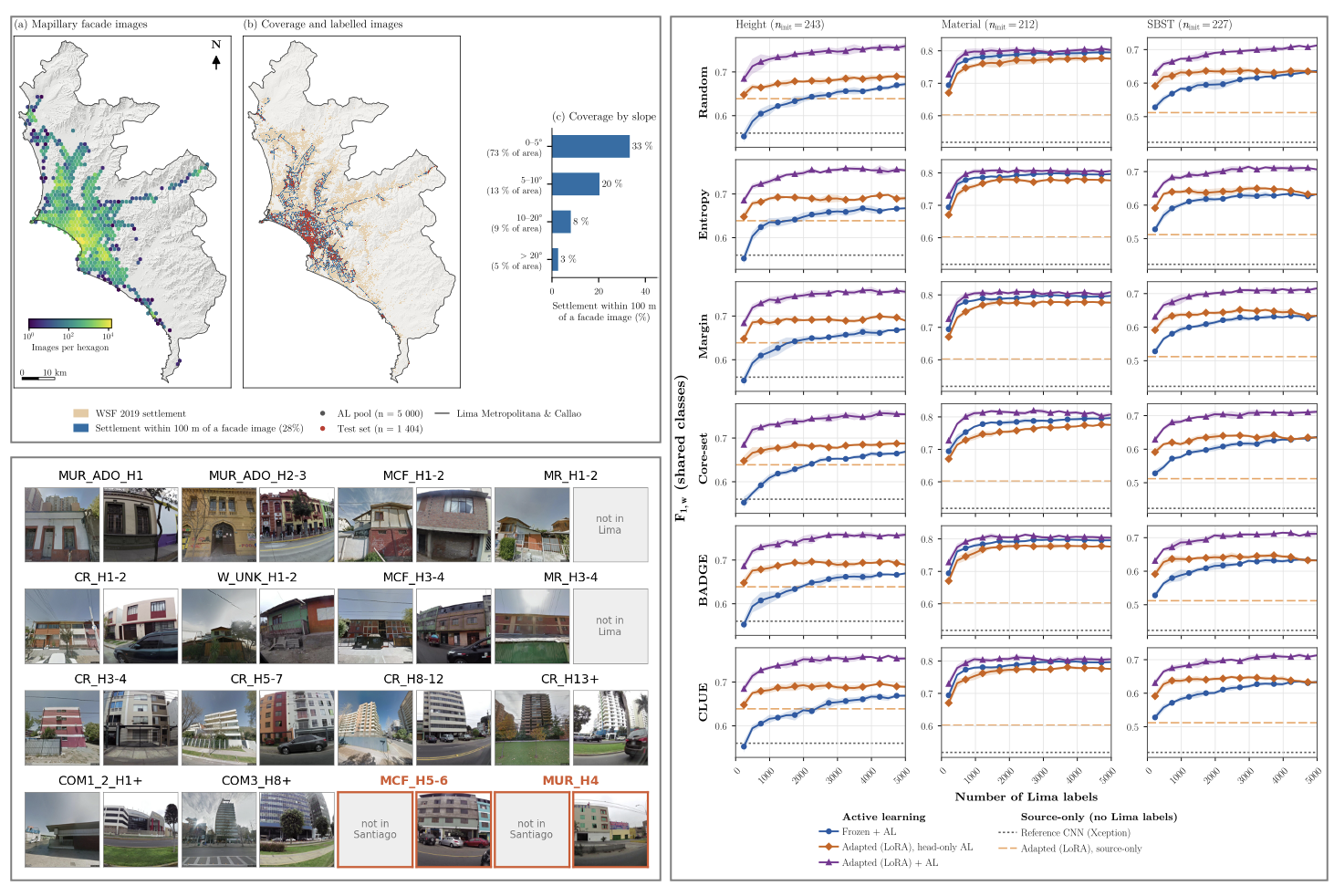
From the abstract: Reliable seismic risk assessment depends on knowing how buildings are constructed, yet for most cities of the world, such exposure information is not available at the level of individual buildings. Street-level imagery offers a scalable source for characterising buildings, but models trained in one city lose much of their accuracy when applied to another, and labelling data for every new city is costly. This thesis investigates how a vision foundation model can close this gap. Using Santiago de Chile as source and Lima as target city, which differ in building stock as well as in imaging platform, it systematically compares two levers for cross-city transfer, parameter-efficient adaptation with low-rank adaptation (LoRA) on the source city and active learning (AL) of target-city labels, starting from frozen DINOv2 features. All configurations are evaluated against a task-specific Reference convolutional neural network (CNN) for construction material, building height and the seismic building structural type (SBST) in a controlled design in which all stochastic configurations are repeated with five seeds. The results reveal that the most effective lever depends on the attribute. For building height, source-side adaptation achieves a performance gain that frozen-feature annotation matches only after approximately 1,750–2,500 target labels, depending on the acquisition strategy. For construction material, by contrast, source-side adaptation alone is insufficient, and only target labels improve performance substantially. Without target labels, the LoRA-adapted model reaches a weighted F1 of 0.51 for the SBST on the classes shared by both cities, compared with 0.42 for the Reference CNN. Combining source-side adaptation with target-side annotation yields the highest performance for all three attributes and reaches 0.71 on the shared classes for the SBST attribute. The choice of acquisition function, in contrast, proves secondary to the learning regime in this setup.
1st supervisor: Prof. Dr. Hannes Taubenböck
2nd supervisor: Prof. Dr. Christian Geiß