
Researchers from the Earth Observation Center (EOC) of the German Aerospace Center (DLR) in Oberpfaffenhofen and our Earth Observation Research Cluster of the University of Würzburg teamed up for a study on the influence of commuting on population exposure to air pollution. The paper titled “The influence of commuting on population exposure to air pollution: Toward global application with a proxy on the degree of urbanization” was just published in the IEEE Journal of Selected Topics in Applied Earth Observations and Remote Sensing by Lorenza Gilardi, Thilo Erbertseder, Frank Baier, Heiko Paeth, Tobias Ullmann and Hannes Taubenböck.
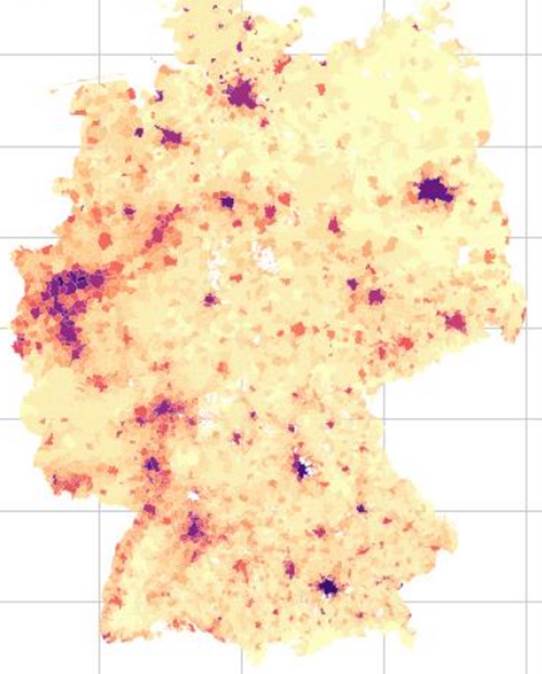
Here is the abstract of the paper: Urban populations are significantly affected by air pollution, which poses a major threat to public health. However, standardized and public mobility data, essential for an exposure assessment, are frequently unavailable. Earth Observation[1]derived and model datasets can support large-scale health studies especially in remote areas with limited data availability. This study investigates the use of a globally-derivable variable from remote sensing data to estimate the static versus dynamic population exposure difference. A health risk assessment using a higher and a lower-resolution air pollution data was performed. This was achieved by examining air pollution concentrations in two European regions, Lombardy, in Italy, and Germany, incorporating commuting datasets. Accordingly, a retrospective long-term exposure assessment to particulate matter less than 2.5 microns (PM2.5), nitrogen dioxide (NO2), and ozone (O3) was performed from 2013 to 2022. The study evaluates the difference between the resident and the dynamic population exposed to concentrations exceeding the new limits set by the World Health Organization (WHO). The relation between pollutants concentration and the Fraction of Settlement Area (FSA), a proxy of urbanization levels, derived from the global World Settlement Footprint dataset was explored. Two pollution datasets were used: with European, and global coverage. The analysis decouples daytime and nighttime hours. For each region and pollutant specific FSA thresholds were identified, that maximize the population exposure gap. Our findings highlight the impact of air pollution on population
health, revealing widespread exposure exceeding WHO limits, particularly for PM2.5, and emphasizing the importance of considering diurnal exposure variations in health risk assessments.
Here is the early access link to the full article: https://ieeexplore.ieee.org/abstract/document/10579815
This paper is related to a recently published study on NO2 air pollution trends and settlement growth in megacities – we have reported on this: https://remote-sensing.org/new-publication-on-no2-air-pollution-trends-and-settlement-growth-in-megacities/
Beyond this one, this study fits in with many studies on air quality in our lab:
https://www.sciencedirect.com/science/article/pii/S0034425721005599
https://link.springer.com/chapter/10.1007/978-3-662-44841-0_20
https://link.springer.com/article/10.1007/s00103-020-03177-w
https://ieeexplore.ieee.org/document/10572220
https://www.sciencedirect.com/science/article/pii/S0264275124003317