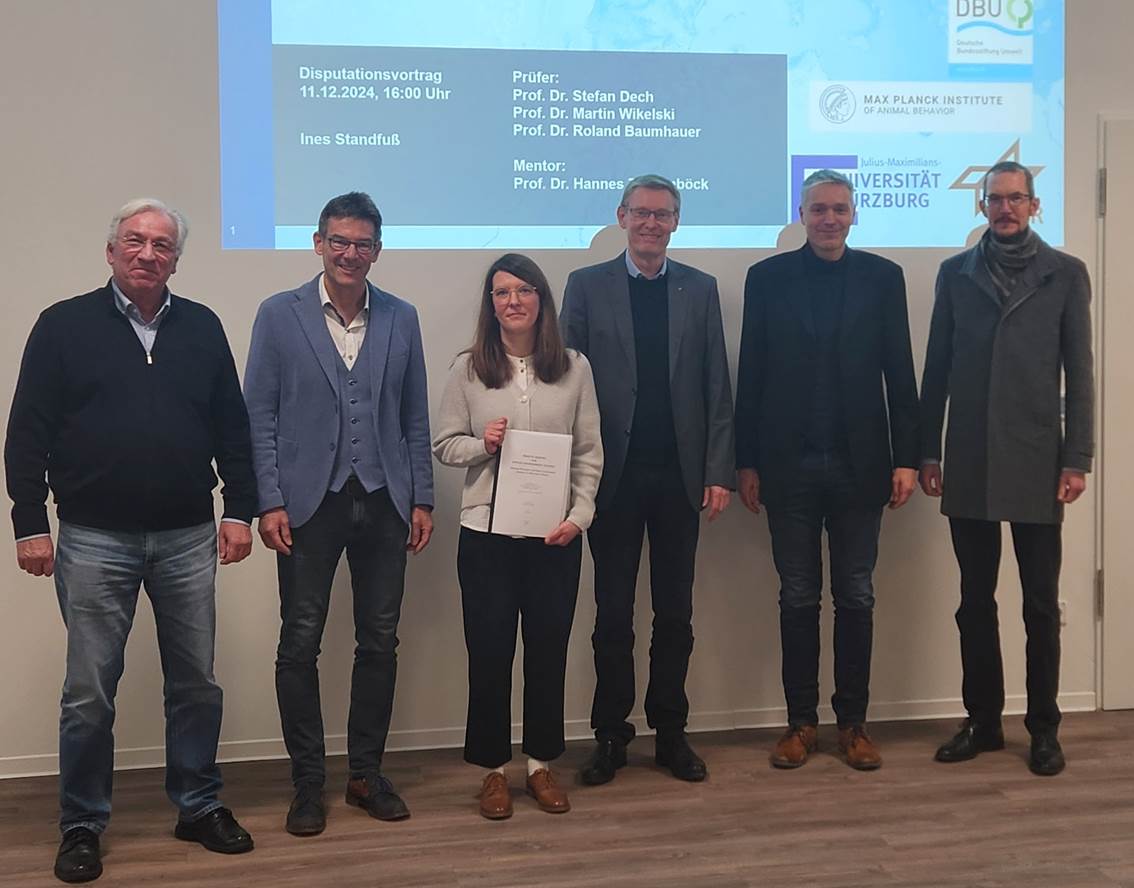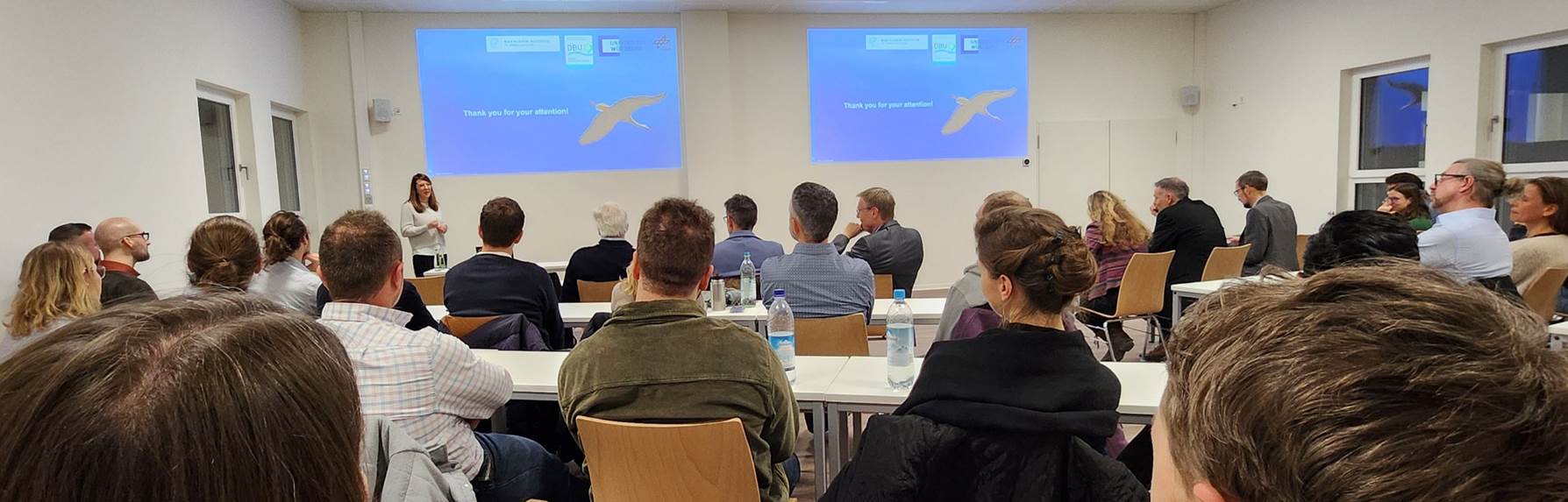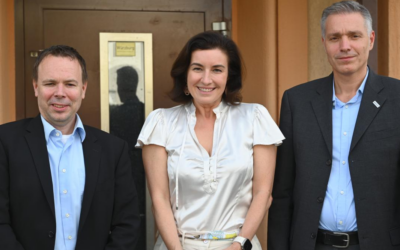


Ines Standfuß defended her PhD Thesis titled “REMOTE SENSING FOR SPECIES-ENVIRONMENT STUDIES – Obtaining Meaningful and Robust Environmental Variables for White Stork Habitats” at the Julius-Maximilians-University Würzburg successfully on the 11th of December 2024.
The Earth Observation Research Cluster congratulates her very much for her great achievements in the interdisciplinary research fields of remote sensing and ecology. The defense was led by Prof. Jan Stenger and Ines was supervised by Prof. Stefan Dech (DLR/JMU), Prof. Martin Wikelski (MPI) and Prof. Roland Baumhauer (JMU). Her mentor was Prof. Hannes Taubenböck (DLR/JMU).
We were very happy to welcome a large audience from the German Aerospace Center (DLR), the University of Würzburg and friends of the PhD candidate.
Here is the abstract of the thesis:
Human activities are transforming the Earth’s natural environments, leading to profound changes in the habitats that animals rely on for their daily needs and survival. Consequently, studying species-environment relationships has become an active area of research. The goal is to understand how animals depend on, or respond to, environmental characteristics, and how they might be affected by their modifications. Over time, bio-logging sensors and satellite-based remote sensing have become the backbone of modern species-environment research. Bio-logging data can provide information on animal movements, animal habitat use and related factors. This data can then be linked to environmental variables from remote sensing to investigate associations. Although current remote sensing data and methods offer considerable possibilities for deriving meaningful environmental variables for wildlife habitats, much of this potential remains underutilised. Additionally, errors and uncertainties in remote sensing data can bias environmental variables and study results, but these issues have not yet been adequately addressed.
The objective of this dissertation is therefore to explore how remote sensing can be more effectively integrated into species-environment research to provide meaningful and robust environmental variables for animal habitats. This interdisciplinary work bridges the fields of remote sensing, geo-information science, and ecology. Recognising that the relevance of environmental factors varies between taxa, the focus is set on one study species: the white stork. By examining the needs of this bird at different life stages, the thesis illustrates how established remote sensing data and methods can be used to design novel and meaningful environmental variables. It also explores in a practical way how to account for uncertainties in remote sensing data in species-environment analyses. The outlined objectives are addressed in three studies:
The first study evaluates the effectiveness of an established remote sensing technique, the half-maximum (HM) approach, in identifying periods of early vegetation growth and postharvest/mowing phases in stork foraging habitats. It is hypothesised that these periods offer favourable prey accessibility, characterised by short vegetation, for the birds during their breeding season. Conversely, periods outside of these times are expected to have poor prey accessibility due to tall vegetation. The relevance of these variations in prey accessibility for storks is assessed by studying the birds’ habitat use, habitat preference/avoidance, and by modelling habitat selection. The results show that storks tend to prefer foraging habitats with favourable prey accessibility over those with poor prey accessibility. Furthermore, they are more likely to select foraging habitats with favourable prey accessibility conditions, as indicated by the new HM-amplitude variable which numerically captures the variations in prey accessibility. This suggests that established remote sensing techniques offer promising avenues for designing meaningful environmental variables, e.g., related to habitat dynamics in agricultural landscapes.
The second study assesses the impact of input data uncertainties on the variations in prey accessibility for storks identified in the first study. A novel bootstrapping approach is proposed to estimate uncertainties in remote sensing time series (RSTS). This approach, together
with established methods from movement ecology, allows an assessment of whether input data uncertainties from RSTS and GNSS telemetry data affect the identified variation in prey accessibility. After accounting for input data uncertainties, it is confirmed that storks prefer/select favourable prey accessibility conditions over poor conditions. However, it is also shown that more temporal samples are needed to reliably identify prey accessibility variations in grassland compared to cropland habitats. Additionally, the results suggest that NDVI is not a robust predictor of stork habitat selection. This highlights the importance of considering input data uncertainties in species-environment research to validate study results and identify shortcomings.
The third study explores whether land surface temperature (LST) data allows for deriving meaningful environmental variables (LST features) to characterise the thermal uplift suitability of landscapes. It is also tested whether the LST features enhance the performance of variables previously used for this purpose (static features). Thermal uplift is particularly important for storks during migration. The presence and absence of thermal uplift, observed through storks’ soaring or flapping flight locations, is modelled based on the LST and/or static features. These models are used to predict thermal uplift suitability, and the predictions are compared with the storks’ energy expenditure. The results suggest that LST features effectively identify areas conducive to thermal uplift occurrence and improve the performance of static features in modelling thermal uplift suitability and predicting storks’ energy costs. This proof-of-concept study suggests that LST data hold promise for deriving meaningful environmental variables to study the flight behavior of soaring birds.
In summary, this dissertation presents practical examples that illustrate the value of remote sensing in deriving novel, meaningful and robust environmental variables for species-environment research. Furthermore, these examples highlight the potential for species-environment studies to become a new research focus for remote sensing. In this field, remote sensing scientists can make valuable contributions through and benefit from the development of targeted methods and environmental variables. Establishing collaborations between remote sensing scientists and ecologists is a key step that can promote the realisation of this potential, enriching both disciplines and advancing species-environment research. The latter is particularly important in the current context of the ‘Anthropocene’.