
Permafrost research presented at the 15th DACH Permafrost Conference in Davos, Switzerland

Permafrost research presented at the 15th DACH Permafrost Conference in Davos, Switzerland

February 3, 2025

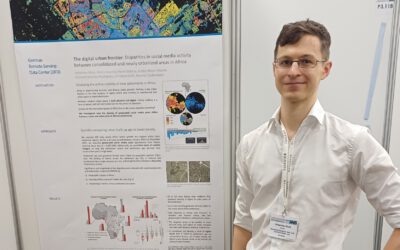
Last month, Sebastian Buchelt went together with our colleagues and students from the Physical Geography department to the 15th DACH Permafrost Conference held in Davos, Switzerland. They presented their ongoing research on mountain and alpine permafrost (see recent publications below), had fruitful discussions during the coffee breaks and poster sessions as well as attended nice networking events organized by the Permafrost Young Researchers Network (PYRN) and the organizing committee at SLF Davos such as a cheese fondue at a mountain hut and a joint sledge ride afterwards.


Recent Publications:


Buchelt, S., Kunz, J., Wiegand, T. & Kneisel, C. (2024) Dynamics and internal structure of a rock glacier: Inferring relationships from the combined use of differential synthetic aperture radar interferometry, electrical resistivity tomography and ground-penetrating radar. Earth Surface Processes and Landforms, 49(14), 4743–4758.

DOI: https://doi.org/10.1002/esp.5993


Kunz, J., Ullmann, T., Kneisel, C., & Baumhauer, R. (2023). Three-dimensional subsurface architecture and its influence on the spatiotemporal development of a retrogressive thaw slump in the Richardson Mountains, Northwest Territories, Canada. Arctic, Antarctic, and Alpine Research, 55(1).

DOI: https://doi.org/10.1080/15230430.2023.2167358


Buchelt, S.; Blöthe, J.H.; Kuenzer, C.; Schmitt, A.; Ullmann, T.; Philipp, M.; Kneisel, C. (2023) Deciphering Small-Scale Seasonal Surface Dynamics of Rock Glaciers in the Central European Alps Using DInSAR Time Series. Remote Sens., 15, 2982.

DOI: https://doi.org/10.3390/rs15122982


follow us and share it on:

you may also like:

Contributions to the Urban Transitions Conference 2026

Contributions to the Urban Transitions Conference 2026

This month, our researcher Johannes Mast attended the Urban Transitions Conference 2026 (https://www.elsevier.com/events/conferences/all/urban-transitions) in Sitges, Spain, one of the most interdisciplinary conferences on...

Contributions to the “Future City Regions” conference

Contributions to the “Future City Regions” conference

This week, the "Future City Regions – Urbanism and Architecture in Times of Uncertainty" conference took place in Aachen, Germany. The German Aerospace Center (DLR) and our Earth Observation Research Cluster (EORC) contributed with two presentations....

Guest lecture at London School of Economics

Guest lecture at London School of Economics

A few years ago, our Professor Hannes Taubenböck was a visiting scholar at the London School of Economics (LSE) in the department ‘cities’ (https://www.lse.ac.uk/Cities). This led to a long-standing...

Earth Observation at the DFG BETAFOR workshop

Earth Observation at the DFG BETAFOR workshop

Jakob Schwalb-Willmann represented our team at the DFG BETAFOR workshop in the Bavarian Forest National Park. The room was full of biologists, which is the whole point of an interdisciplinary project, and our UAS multisensor time series drew a lot of interest from the...

Würzburger Förderpreis awarded to our URBAN:Pulse project

Würzburger Förderpreis awarded to our URBAN:Pulse project

“A remote sensing scientist, a social geographer, an informatics researcher, a sports researcher, a psychologist, a linguist and an economist meet ... what sounds like the start of a joke, was the start of a great interdisciplinary research project.” That’s how Hannes...

bzgl. Art. 50 Verordnung (EU) 2024/1689 (AI Act):

Überwiegend werden eigene originäre Texte und Bilder des EORC genutzt, jedoch sind einige Inhalte von blog post Texten teilweise mit Hilfe von KI überarbeitet worden und einige Bilder sind ganz mit KI erstellt, die jedoch deutlich keine photorealistische Darstellungen abbilden. Aussnahmen sind KI generierte fernerkundliche Datensätze, die explizit für Forschungszwecke mit KI erstellt wurden, hier wird aber durch den assoziierten Text der wissenschaftliche Grund der KI generierten Bilder erläutert.

Share This