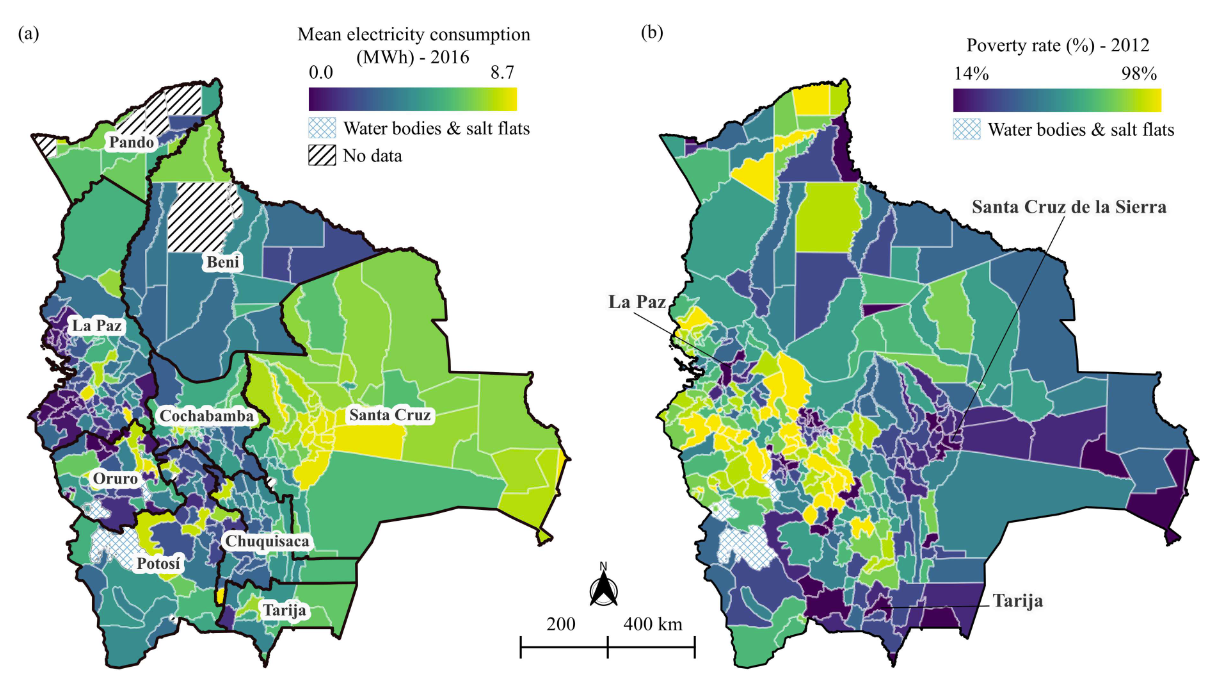

Researchers from the ifo Institute – Leibniz Institute for Economic Research at the University of Munich in Germany, the Sustainable Development Solutions Network (SDSN Bolivia) of the Universidad Privada Boliviana (UPB), the Postgraduate Center in Development Sciences of the Major University of San Andres (CIDES-UMSA) and the Universidad Privada Boliviana (UPB) in La Paz, Bolivia, the Earth Observation Center (EOC) of the German Aerospace Center (DLR) in Oberpfaffenhofen and our Earth Observation Research Cluster of the University of Würzburg teamed up for a study on the spatio-temporal estimation of electricity consumption using nighttime lights. The paper titled “Spatio-temporal estimation of electricity consumption in Bolivian municipalities using nighttime lights” was just published in the journal GEOCARTO INTERNATIONAL by Oana M. Garbasevschi, Andrea Sofia Garcia de León, Lykke E. Andersen, Guillermo Guzmán Prudencio, Michael Wurm and Hannes Taubenböck.
Here is the abstract of the paper: Few research studies have focused on the nature of the relationship between nighttime-lights and electricity consumption at subnational levels in South America, a region with heterogeneous geography and urbanization levels and complex socioeconomic dynamics. This study shows that it is possible to estimate, for Bolivia, a wide range of indicators of electricity consumption at the municipality level and two temporal scales using features derived from nighttime lights and other spatial data sources, in combination with readily available municipality characteristics. The prediction errors for annual electricity consumption range between 13% MAPE for average residential consumption and 59% MAPE for average commercial consumption. Similar accuracies are obtained when predicting monthly values. For both annual and monthly electricity consumption, we highlight the variation in estimation accuracy for various municipality subsets and show that prediction can be significantly improved when selecting municipalities based on population size, energy poverty, or levels of sustainable development.
Here is the link to the full paper: https://www.tandfonline.com/doi/full/10.1080/10106049.2026.2657705
This research was one result of our long-standing co-operation with the ifo Institute Munich and is thematically linked to other joint works:
- Learning Income Levels and Inequality from Spatial and Sociodemographic Data in Germany https://www.sciencedirect.com/science/article/pii/S0143622823001893
- EU cohesion policy on the ground: Analyzing small-scale effects using satellite data https://www.sciencedirect.com/science/article/pii/S0166046223000893
- Evaluating EU cohesion policy using satellite data https://www.bertelsmann-stiftung.de/en/publications/publication/did/evaluating-eu-cohesion-policy-using-satellite-data-en
- Liveability in large housing estates in Germany – Identifying differences based on a novel concept for a walkable city https://www.sciencedirect.com/science/article/pii/S016920462400149X
- https://remote-sensing.org/talks-at-dlr-ifo-workshop-in-oberpfaffenhofen/
- https://remote-sensing.org/ifo-conference-on-understanding-socio-economic-inequalities-with-novel-data-and-methods/
- https://remote-sensing.org/dlr-and-eorc-contibutions-to-the-ifo-conference-on-understanding-socio-economic-inequalities-with-novel-data-and-methods-day-1/
- https://remote-sensing.org/dlr-and-eorc-contibutions-to-the-ifo-conference-on-understanding-socio-economic-inequalities-with-novel-data-and-methods-day-2/