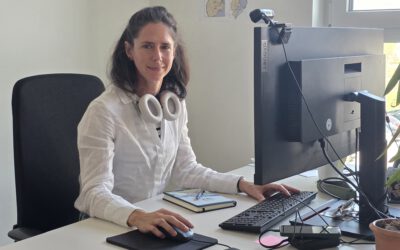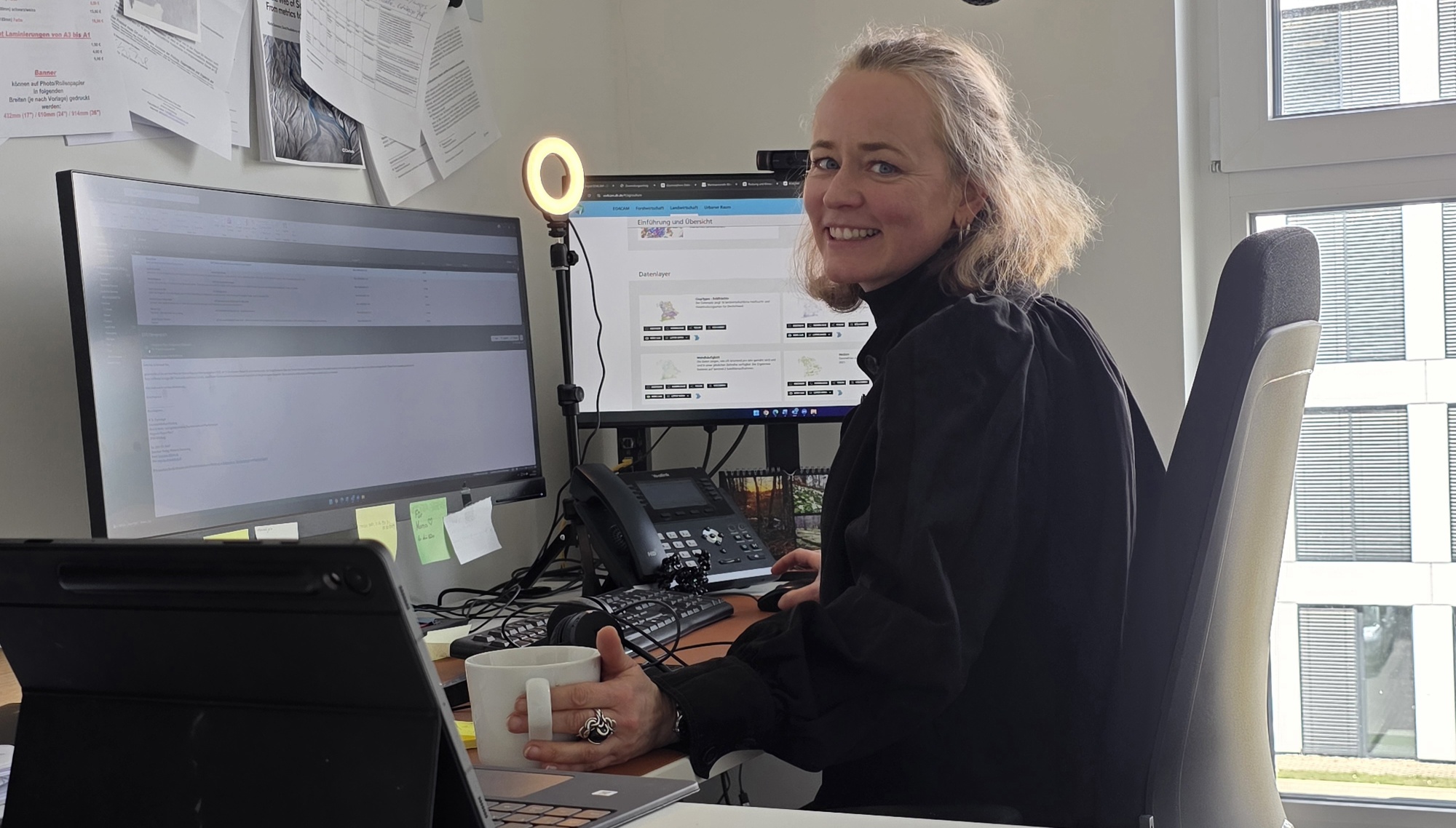

At the Earth Observation Research Cluster, our researchers combine cutting-edge remote sensing science with real-world environmental challenges. At the center of this effort is Sarah Schönbrodt-Stitt, a senior postdoctoral researcher whose role extends well beyond individual studies. She is a key scientific driver at EORC – shaping research directions, initiating new thematic areas, and maintaining strategic oversight across a complex and rapidly evolving project landscape.
Sarah joined the Department of Remote Sensing at the University of Würzburg in 2016. Since then, she has contributed to a wide range of international research initiatives addressing environmental change, land degradation, and sustainable resource management. Over time, she has developed into a central figure within the group, operating at the interface of research, coordination, and strategy. In this role, she guides interdisciplinary collaborations while continuously developing new project ideas and competitive research proposals. As a senior postdoctoral researcher, she plays an imporant role in both initiating and advancing scientific themes. She has been instrumental in developing innovative approaches for agricultural monitoring using Earth observation data, opening new application domains within the research cluster. At the same time, she maintains a high-level overview of large collaborative frameworks – most notably the EO4CAM project – while balancing multiple side projects, ongoing partnerships, and future proposal development. This dual responsibility – driving innovation while ensuring coherence across projects – defines her position within the cluster.
Her scientific work integrates remote sensing, geographic information systems (GIS), and ecological modelling to analyze how landscapes respond to climate change, land-use pressures, and environmental degradation. A central focus of her research is the development of spatial indicators and monitoring approaches that support sustainable land and water management across diverse environmental contexts. A significant part of her work focuses on arid and semi-arid regions, where natural resources are under pressure. Within the Central Asian Waters (CAWa) network, she contributed to the development of indicators for monitoring land and water use and played a leading role in coordinating the WebGIS platform WUEMoCA, which supports sustainable water management across Central Asia. Another long-standing pillar of her research is her involvement in the West African Science Service Center on Climate Change and Adapted Land Use (WASCAL). In close collaboration with African and European partners, she contributes to research on climate change impacts on agriculture and land use, while also supporting capacity development and strengthening international scientific networks. Beyond her thematic contributions, Sarah has established herself as an experienced coordinator of large, interdisciplinary projects. She facilitates collaboration across institutions and disciplines, ensuring alignment of scientific objectives, data integration, and communication strategies. This role requires not only scientific expertise, but also strong leadership, organizational skills, and the ability to manage multiple parallel processes – key competencies in today’s complex Earth observation projects.
Her interdisciplinary perspective is grounded in a strong academic background. She studied geography and geology at the University of Greifswald and the University of Göttingen, and completed her PhD at the University of Tübingen. Her doctoral research examined soil erosion dynamics in terraced landscapes influenced by the Three Gorges Dam in China, combining fieldwork, modelling, and spatial analysis to better understand human–environment interactions. In addition to her research and coordination roles, she is actively involved in teaching and mentoring in remote sensing and geoinformatics. She supports students and early-career researchers across topics such as sustainable land management, soil erosion, landscape ecology, climate change impacts, and environmental risk assessment – contributing to the development of the next generation of Earth observation scientists. By combining scientific innovation with strategic coordination, Sarah exemplifies the role of a senior postdoctoral researcher in modern Earth observation science: advancing new research directions, maintaining oversight across complex project environments, and ensuring that cutting-edge methods translate into meaningful contributions to sustainable environmental management worldwide. Beyond her scientific work, Sarah is a passionate nature and landscape lover who enjoys exploring the outdoors with her dog, is actively engaged in her community through initiatives such as urban gardening and environmental conservation, contributes to the local environmental advisory board, and – whenever possible – immerses herself in her enduring love for music.