

Guest lecture at London School of Economics

Guest lecture at London School of Economics

November 23, 2026

A few years ago, our Professor Hannes Taubenböck was a visiting scholar at the London School of Economics (LSE) in the department ‘cities’ (https://www.lse.ac.uk/Cities).

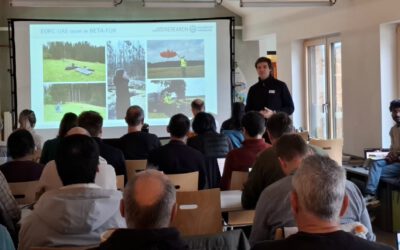
This led to a long-standing collaboration – involving reciprocal visits (e.g. https://remote-sensing.org/visit-to-london-school-of-economics-in-london/), cooperation at conferences (e.g. https://remote-sensing.org/geolingual-studies-workshop-day-1/) and lectures (e.g. https://remote-sensing.org/guest-lecture-by-dr-alexandra-gomes-from-lse-cities-london-school-of-economics/), a joint academic paper due to be published shortly, and now also a guest lecture at LSE. Today, Hannes taught on the module “Urban Analytics: Data, Insight and Evidence”, covering “Geographic Information Systems: mapping, remote sensing, earth observation”. Moderated by Prof. Philipp Rode and Dr. Alexandra Gomes, he showed the methodological capabilities of remote sensing, the synergies with other geodata such as web text data and applications from urban growth to informal settlements and climate adaptation.

follow us and share it on:

you may also like:

Earth Observation at the DFG BETAFOR workshop

Earth Observation at the DFG BETAFOR workshop

Jakob Schwalb-Willmann represented our team at the DFG BETAFOR workshop in the Bavarian Forest National Park. The room was full of biologists, which is the whole point of an interdisciplinary project, and our UAS multisensor time series drew a lot of interest from the...

Würzburger Förderpreis awarded to our URBAN:Pulse project

Würzburger Förderpreis awarded to our URBAN:Pulse project

“A remote sensing scientist, a social geographer, an informatics researcher, a sports researcher, a psychologist, a linguist and an economist meet ... what sounds like the start of a joke, was the start of a great interdisciplinary research project.” That’s how Hannes...

bzgl. Art. 50 Verordnung (EU) 2024/1689 (AI Act):

Überwiegend werden eigene originäre Texte und Bilder des EORC genutzt, jedoch sind einige Inhalte von blog post Texten teilweise mit Hilfe von KI überarbeitet worden und einige Bilder sind ganz mit KI erstellt, die jedoch deutlich keine photorealistische Darstellungen abbilden. Aussnahmen sind KI generierte fernerkundliche Datensätze, die explizit für Forschungszwecke mit KI erstellt wurden, hier wird aber durch den assoziierten Text der wissenschaftliche Grund der KI generierten Bilder erläutert.

Share This