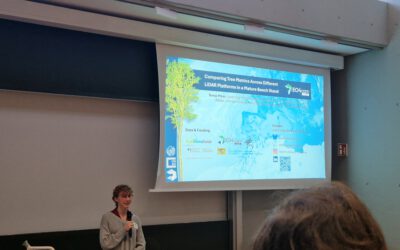

On February 24, 2026, Lena Jäger will present her Master Thesis on “Assessing the potential of thermal UAS for spatio-temporal Arctic snow monitoring – A pilot study in Bjørndalen, Svalbard” at 12:00 in seminar room 3, John-Skilton-Str. 4a.
From the abstract:
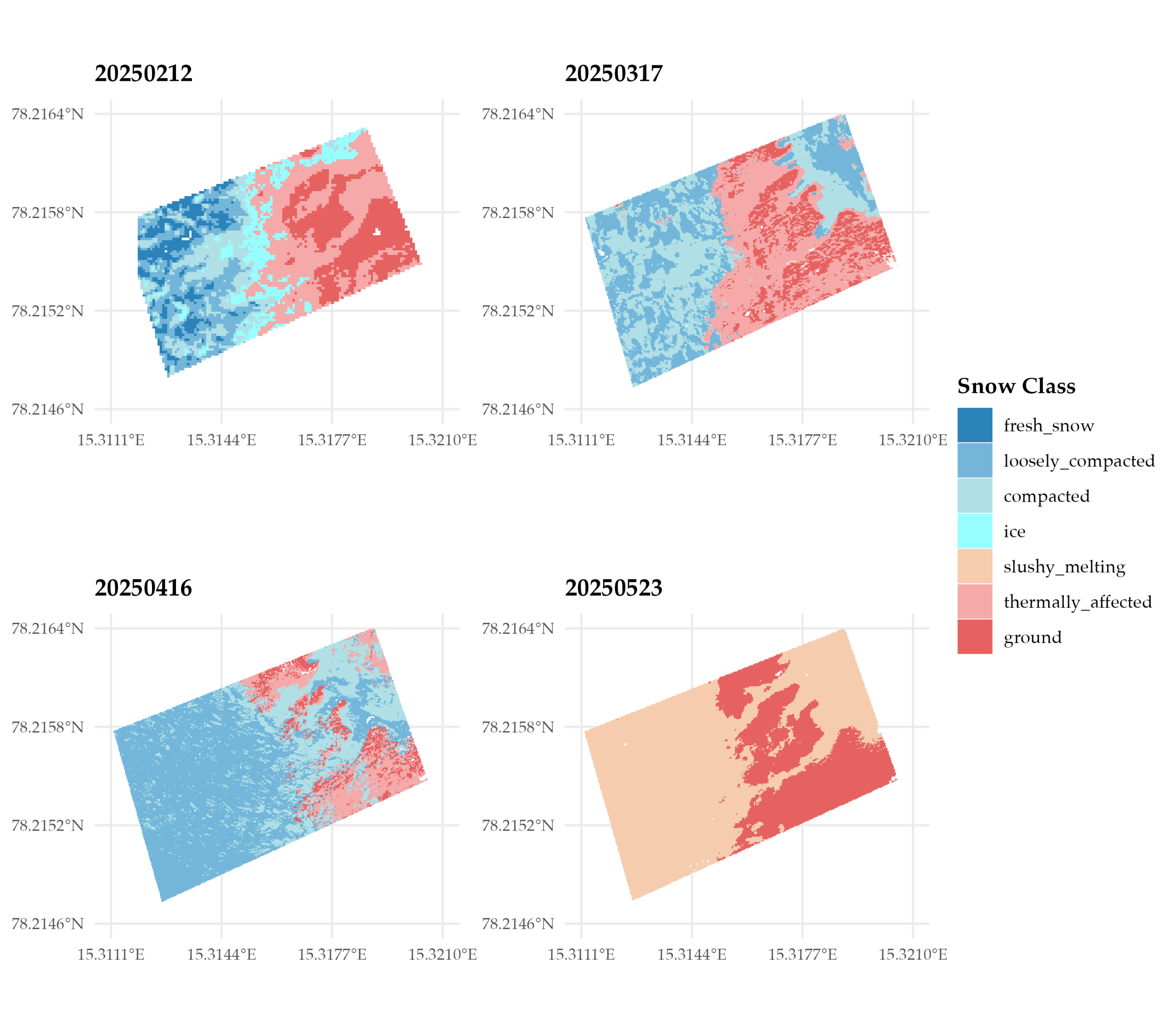
The Arctic is warming 2-4 times faster than the global average, with Svalbard among the fastest warming places on earth. Especially the winter months are affected by this warming with shorter snow-covered periods, increasing winter warm spells and rain. This in turn has far-reaching implications for Svalbard’s terrestrial environment. Despite the importance of snow however, critical knowledge gaps remain across disciplines – largely due to a lack of snow data on relevant spatial and temporal scales. This work addresses this lack of snow data by assessing the potential of thermal UAS for high-resolution spatio-temporal snow monitoring. Based on UAS and field data, collected during a field campaign in Bjørndalen, Svalbard from February to June 2025, the information content of thermal UAS and the relationship to in-situ measurements is analyzed. Correlation analysis and UAS-based snow products, including snow depth and local temperature variance (Delta T) maps, provided new insights into snowpack characteristics and their relationship to thermal drone imagery. A reproducible workflow for snow surface classification was developed and enabled spatio-temporal mapping of snow properties. The results show that thermal UAS reflect upper-layer snow characteristics without calibrating the thermal sensor beforehand. It is capable to produce ecologically relevant snow data on cm high spatial resolution. Limitations remain particularly regarding artifacts in the thermal imagery, difficulties of mapping old ice and snow processes happening within the snowpack. Overall, this study demonstrates the high potential of thermal UAS to complement snow research. While more research is needed to address remaining technical challenges, the possibility of high resolution mapping of drones provide novel insights in snow dynamics in Arctic ecosystem dynamics.
1st supervisors: Dr. Mirjana Bevanda
2nd supervisor: Prof. Dr. Larissa T. Beumer, University Centre Svalbard