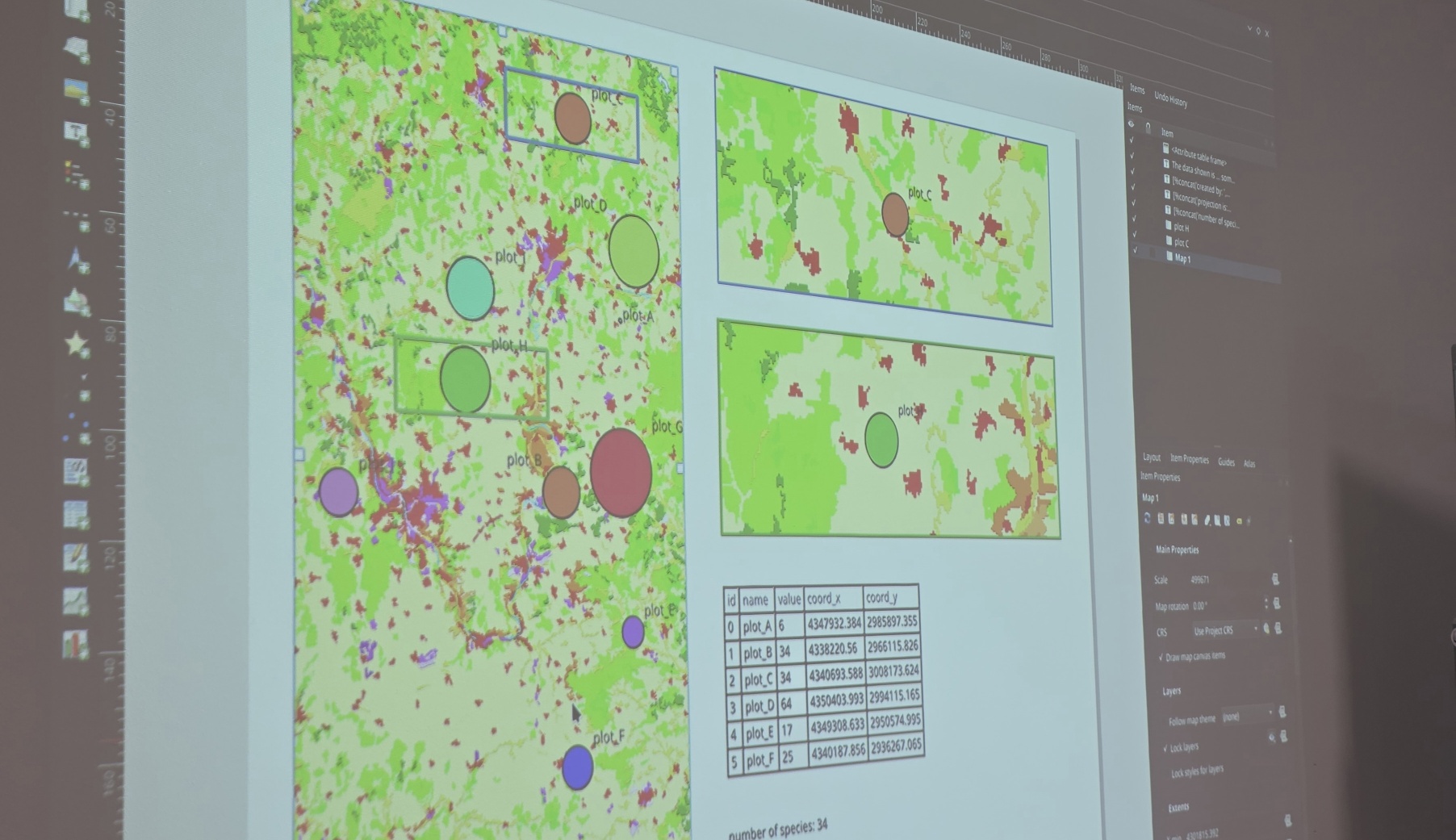

At EORC, we believe that spatial thinking and geodata literacy are becoming essential skills across scientific disciplines. This semester, we had the pleasure of contributing to the Biology MSc programs MERGE and other study tracks at the Biology Institute through a voluntary teaching initiative focused on spatial data handling using open-source tools.
Bridging Disciplines Through Geospatial Skills
Students in biology increasingly work with spatial data—whether tracking species movement or distributions, analyzing environmental gradients, or modeling ecosystem dynamics. Our goal was to provide a practical introduction to these tools, enabling students to confidently explore, analyze, and visualize geospatial information in their own research.
Hands-On Learning with QGIS
The sessions were centered around QGIS, a powerful and widely used open-source Geographic Information System. Rather than focusing on theory alone, we emphasized hands-on exercises that allowed students to directly engage with real-world datasets.
Participants learned how to:
-
Work with spatial vector data (points, lines, polygons) and raster data (grids, satellite products)
-
Perform basic data exploration and visualization
-
Apply expression functions to manipulate attributes and create dynamic outputs
-
Understand coordinate systems, file formats and data structure fundamentals
From Analysis to Automation
Beyond the basics, students explored more advanced capabilities within QGIS:
-
Graphical Modeler: Students were introduced to building reproducible workflows by chaining geoprocessing tools together. This not only improves efficiency but also ensures transparency and repeatability in scientific analysis.
-
Expression-based styling: By using expressions, participants created dynamic symbology and labels that respond to data attributes in real time.
Creating Meaningful Maps
A key highlight of the training was map design and production. Students learned about different types of maps and how to tailor them for scientific communication:
-
Designing clear and informative layouts
-
Using data-driven (dynamic) map generation with expressions
-
Leveraging the Atlas feature in QGIS to automatically generate map series for multiple features (e.g., sampling sites or regions)
These skills are particularly valuable for producing publication-ready figures or communicating results to stakeholders.
Open Source, Open Opportunities
One of the core messages of the workshop was the power of open-source software in science. Tools like QGIS lower barriers to entry, promote reproducibility, and enable collaboration across institutions and disciplines.
Looking Ahead
We were impressed by the enthusiasm and curiosity of the students, many of whom were encountering geospatial tools for the first time. Their engagement highlighted the growing importance of spatial data skills in biology and environmental sciences. Empowering students with geospatial tools not only enhances their research capabilities but also strengthens the bridge between biology and remote sensing.