
EORC Talk Recap: From Data to Insight – Rethinking Machine Learning for Earth Observation

EORC Talk Recap: From Data to Insight – Rethinking Machine Learning for Earth Observation

m

October 29, 2026

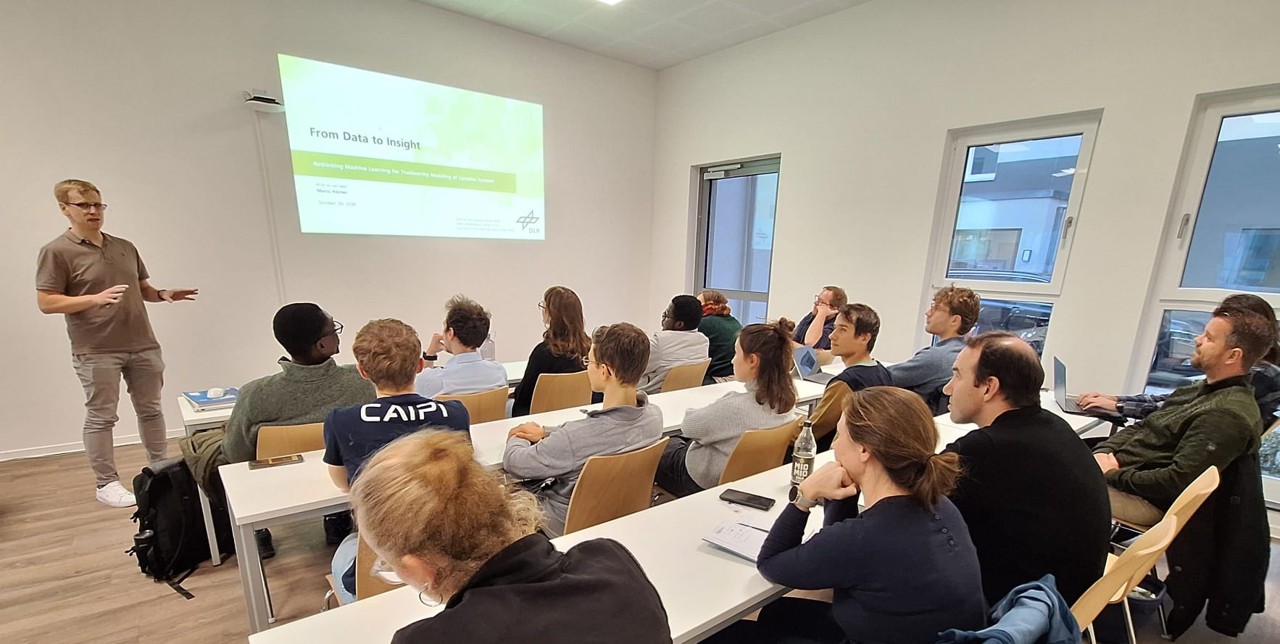
On October 29, 2026, we had the pleasure of welcoming Prof. Dr. Marco Körner from the Earth Observation Center (EOC) of the German Remote Sensing Data Center at the DLR to the Earth Observation Research Cluster (EORC) at the University of Würzburg for an inspiring talk.

Under the title “From Data to Insight: Rethinking Machine Learning for Trustworthy Modeling of Complex Systems”, Marco explored the challenges and opportunities of applying machine learning to complex environmental and urban systems.

A central message of the talk was that reliable scientific insights require more than powerful AI models and large datasets. Earth observation data are often incomplete, noisy, or biased, while the underlying environmental processes remain only partially understood. Addressing these challenges requires approaches that combine machine learning with domain expertise, physical understanding, and knowledge of sensor and data limitations.

The presentation highlighted the importance of process-consistent and data-efficient learning approaches, with applications ranging from land-use and crop-type mapping to vegetation and hydrological dynamics. It also emphasized the need to move beyond pattern recognition towards scientifically meaningful, robust, and trustworthy modeling.

A big thank you to Marco Körner for sharing his research and perspectives with us, and to everyone who joined the talk and contributed to the scientific exchange!

We look forward to continuing the discussions and exploring opportunities for collaboration at the intersection of Earth observation, machine learning, and environmental research.


Our EORC Talk series will continue with more exciting topics and speakers in the future. Everyone interested in Earth observation and related research is warmly invited to join our upcoming talks – we look forward to welcoming you!



follow us and share it on:

you may also like:

Setting Up for the 2nd EO4CAM Nutzerworkshop

Setting Up for the 2nd EO4CAM Nutzerworkshop

Right now our staff are busy hauling cases, mounting displays and testing every cable for the 2nd EO4CAM Nutzerworkshop, “Erdbeobachtung für die Klimaanpassung, behördliche Akteure in Bayern”. The doors open tomorrow, and the exhibition...

A dashboard for multi-UAS thermal data

A dashboard for multi-UAS thermal data

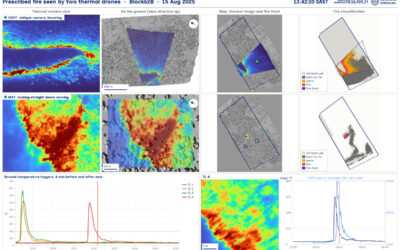
Mapping an active fire with various drones flying in parallel is hard enough. But getting the data processed, evaluated and turned into research datasets is a different story. The publication is on its way, and for now we’d like to share a dashboard by Antonio José...

Have you ever wondered how many trees there are on our campus?

Have you ever wondered how many trees there are on our campus?

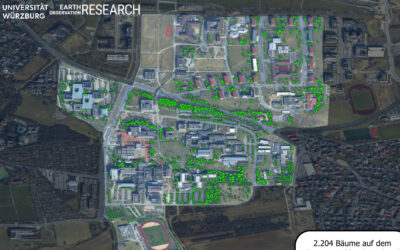
Sometimes a chat during a formal event like the one for the Urban:Pulse funding celebration, results in something totally different. Following a discussion with the vice-president of our University, we promised to look into the research by one of our PhD students...

Earth Observation at the DFG BETAFOR workshop

Earth Observation at the DFG BETAFOR workshop

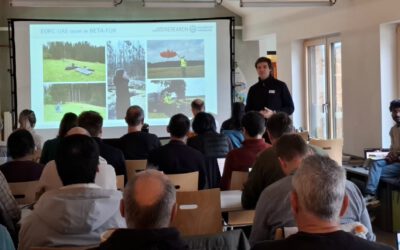
Jakob Schwalb-Willmann represented our team at the DFG BETAFOR workshop in the Bavarian Forest National Park. The room was full of biologists, which is the whole point of an interdisciplinary project, and our UAS multisensor time series drew a lot of interest from the...

Thermal Drone Data Acquisitions: CalVal project with Informatics

Thermal Drone Data Acquisitions: CalVal project with Informatics

Thermal cameras on drones look very good - visually. They show us temperature of our study objects be it stressed trees, warm patches in a city or active fires. But we do not yet know for sure how far we can trust the temperature values they deliver especially when...

bzgl. Art. 50 Verordnung (EU) 2024/1689 (AI Act):

Überwiegend werden eigene originäre Texte und Bilder des EORC genutzt, jedoch sind einige Inhalte von blog post Texten teilweise mit Hilfe von KI überarbeitet worden und einige Bilder sind ganz mit KI erstellt, die jedoch deutlich keine photorealistische Darstellungen abbilden. Aussnahmen sind KI generierte fernerkundliche Datensätze, die explizit für Forschungszwecke mit KI erstellt wurden, hier wird aber durch den assoziierten Text der wissenschaftliche Grund der KI generierten Bilder erläutert.

Share This