
EUSI meets GZS

EUSI meets GZS

January 15, 2025

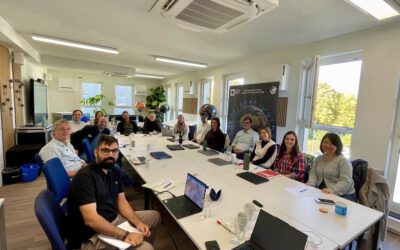
Following the European Space Imaging Conference (EUSI) in December 2024 (DLR and EORC contributed to the conference. We reported on this – please see here: https://remote-sensing.org/keynote-presentation-at-eusi-conference-2024/), the long-standing partners met again in Oberpfaffenhofen to explore joint projects. Anica Huck and Silvester Fischer from EUSI (https://www.euspaceimaging.com/) visited the ‘Georisks and Civil Security (GZS)’ department at the German Remote Sensing Data Center (DFD) on the 14th of January 2025 and discussed existing and future projects.


 

follow us and share it on:

you may also like:

Würzburger Förderpreis awarded to our URBAN:Pulse project

Würzburger Förderpreis awarded to our URBAN:Pulse project

“A remote sensing scientist, a social geographer, an informatics researcher, a sports researcher, a psychologist, a linguist and an economist meet ... what sounds like the start of a joke, was the start of a great interdisciplinary research project.” That’s how Hannes...
Annual Meeting of the NetCDA consortium

Annual Meeting of the NetCDA consortium

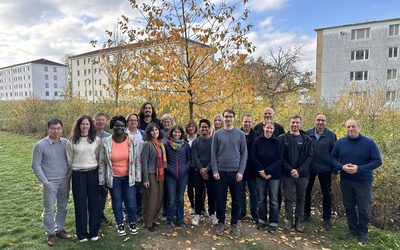
On November 3-4, 2026, the NetCDA II (European Academic Network for Capacity Development in Climate Change Adaptions in Africa) project network of 12 German academic partners met at the EORC for their annual meeting. We welcomed our new German research institutions on...

GLS-team visits Planetary Health exhibition

GLS-team visits Planetary Health exhibition

One of the aims of Geolingual Studies Geolingual Studies - Geolingual Studies is to ensure effective science communication beyond the scientific community and into the wider society. The Geolingual Studies team was given the opportunity to look at concepts and methods...

bzgl. Art. 50 Verordnung (EU) 2024/1689 (AI Act):

Überwiegend werden eigene originäre Texte und Bilder des EORC genutzt, jedoch sind einige Inhalte von blog post Texten teilweise mit Hilfe von KI überarbeitet worden und einige Bilder sind ganz mit KI erstellt, die jedoch deutlich keine photorealistische Darstellungen abbilden. Aussnahmen sind KI generierte fernerkundliche Datensätze, die explizit für Forschungszwecke mit KI erstellt wurden, hier wird aber durch den assoziierten Text der wissenschaftliche Grund der KI generierten Bilder erläutert.

Share This