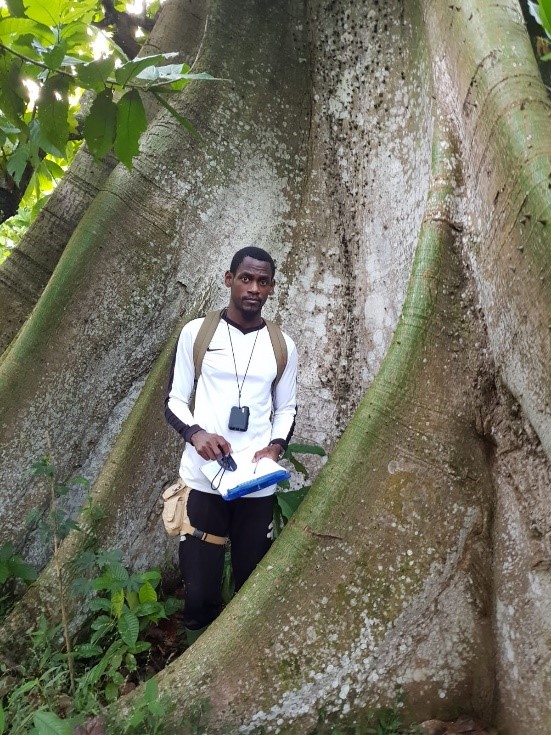

In November 2021, Dan Kanmegne Tamga, a Ph.D. student within the WASCAL-DE-Coop project at the Department of Remote Sensing at the University of Würzburg, went for a field campaign to Côte d’Ivoire, West Africa. Dan Kanmegne Tamga is working on estimating carbon sequestration in agroforestry systems.
The objective of his field campaign was to collect biometric parameters of trees. Using allometric equations, the parameters collected by him in situ (e.g., diameter and height) are used to derive the aboveground biomass (AGB).
Côte d’Ivoire is the world’s largest producer of cocoa beans, where cocoa plantations are established at the expense of forest. Because of the contribution of deforestation and forest degradation to climate change, AGB needs to be monitored in Côte d’Ivoire.
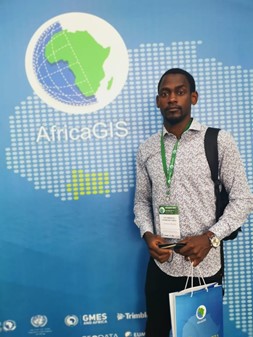
In the same period, Dan Kanmegne Tamga attended the AfricaGIS (EIS-AFRICA) conference held in Abidjan between 22 – 26 November. He presented the results of his study on modeling the spatial distribution of the classification error in agroforestry systems in Côte d’Ivoire. This research was funded by the German Federal Ministry of Education and Research (BMBF) with the technical support of the World Agroforestry Centre (ICRAF, Côte d’Ivoire).