
Mapping Fire from the Sky – Anna Bischof’s MSc Thesis on Savanna Fire Patterns

Mapping Fire from the Sky – Anna Bischof’s MSc Thesis on Savanna Fire Patterns

m

August 11, 2025

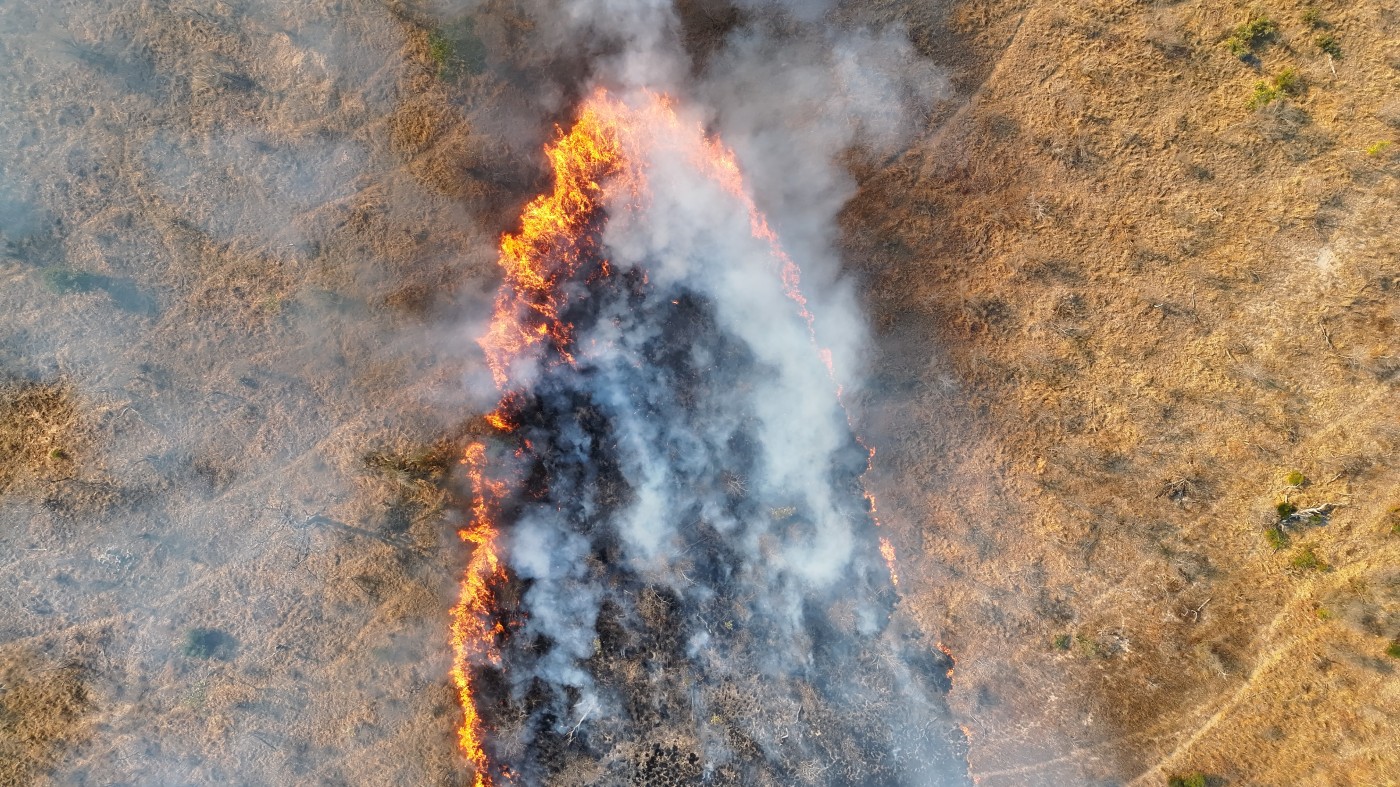
Wildfires are an essential ecological process in African savannas, shaping landscapes, influencing biodiversity, and playing a key role in nutrient cycling. Understanding their dynamics is crucial for both science and management – and this is where EAGLE MSc student Anna Bischof steps in.

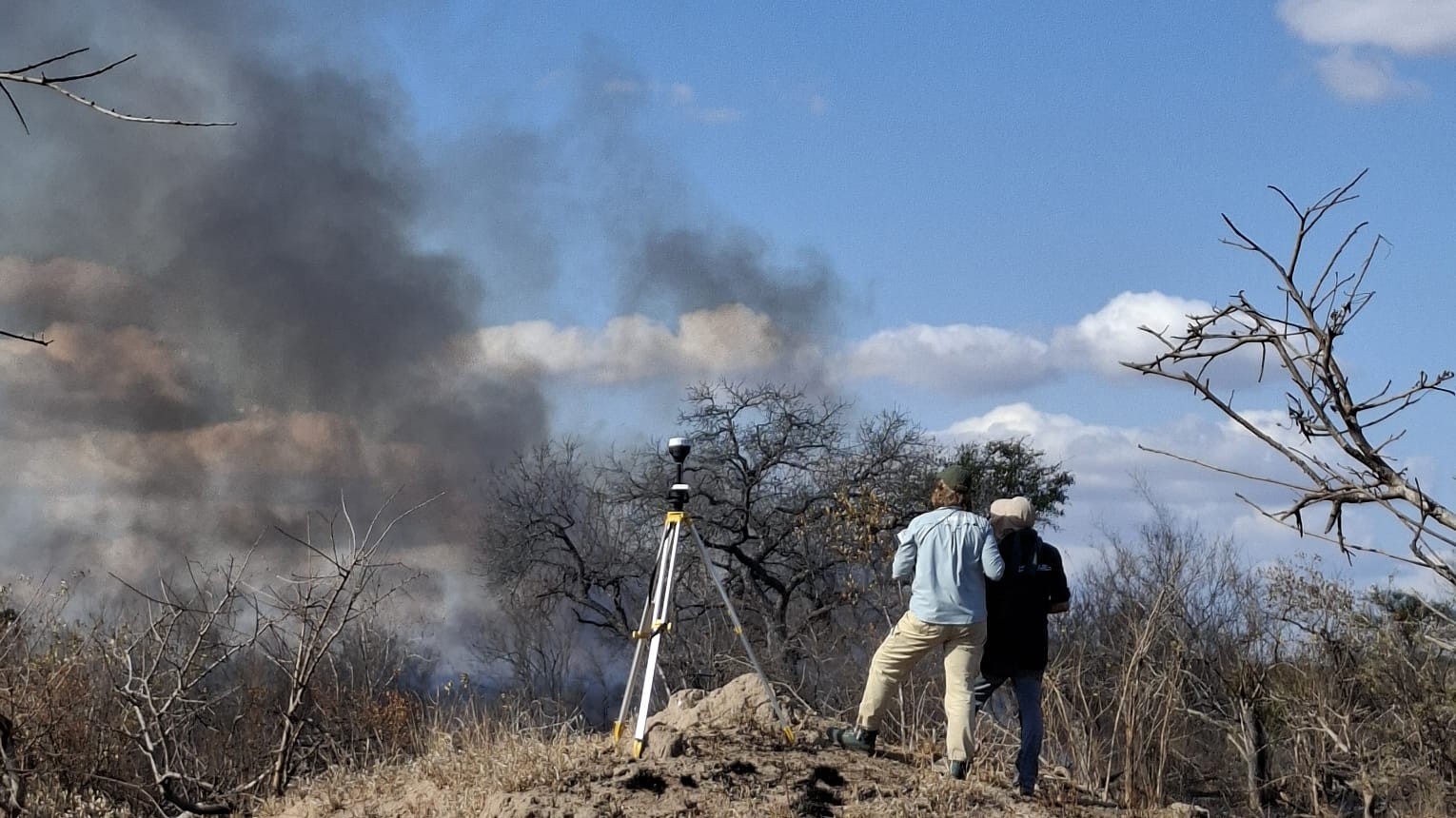
As part of her master’s thesis, Anna is analysing spatio-temporal fire patterns in African savannas using multi-sensor unoccupied aerial systems (UAS). Her work is ambitious: three thermal UAS platforms fly in parallel, monitoring fires from different positions, angles, and perspectives. This setup captures a wealth of data, offering a unique 3D view of fire spread and intensity as they evolve over time.

The real challenge begins after the flights. Anna is developing algorithms to correct and align these multi-perspective datasets into a consistent, plane raster format with homogeneous pixels – each containing reliable information about fire properties. Achieving this requires a mix of remote sensing expertise, mathematical modelling, and careful algorithm design, balancing scientific rigour with the unpredictable nature of field data.

Her goal: to create tools that can track how fires move and how intense they burn, ultimately providing new insights into savanna fire behaviour and helping improve monitoring strategies.

Anna’s thesis is supervised by Antonio Castañeda and Dr. Mirjana Bevanda, whose guidance supports the project’s blend of advanced UAS technology, thermal remote sensing, and spatial data science.

With her innovative approach, Anna is not only pushing the boundaries of UAS-based fire mapping, but also contributing to the broader understanding of one of Earth’s most dynamic ecosystems.
    

follow us and share it on:

you may also like:

Presentation at the Geo-Colloquium of the University of Graz

Presentation at the Geo-Colloquium of the University of Graz

Our researcher Dr. Ariane Droin was invited to present her PhD work at the Geo-Colloquium of the University of Graz. The event brought together geographers of a variety of disciplines. Under the title "Erreichbarkeit lokaler Nachbarschaften im urbanen Kontext",...

When Snow Disappears Too Early

When Snow Disappears Too Early

Fieldwork during the winter season in Svalbard usually comes with a built-in advantage: snow. It acts as a natural transport layer, making it possible to move efficiently across large distances with snowmobiles and sleds. You plan your campaign around that mobility:...

Advancing Agriculture with UAS Multi-Sensor Research

Advancing Agriculture with UAS Multi-Sensor Research

Understanding how agriculture can adapt to a changing climate is one of the key challenges of our time. At EORC, we are pleased to share that our researchers are currently collaborating with the Bavarian State Research Center for Agriculture (LfL) on an innovative...

New roll-up shows Urban Collaboration and Research

New roll-up shows Urban Collaboration and Research

Remote sensing thrives on collaboration as shown (by a few selected ones) on our most recent roll-up. Many of today’s most pressing urban and environmental challenges—rapid urbanization, climate change, landcover change, migration, inequality, and economic...

Hackathon within the Super-Test-Site Project

Hackathon within the Super-Test-Site Project

What happens when researchers and developers sit down together to explore a multidisciplinary urban dataset? Our researchers from the EORC joined a hackathon that took place within the Super-Test-Site Project, organised by Prof. Dr. Gunther Gust from the Chair of...

Share This