
Exploring Drought and Fire Impacts on African Savanna Vegetation

Exploring Drought and Fire Impacts on African Savanna Vegetation

m

August 10, 2025

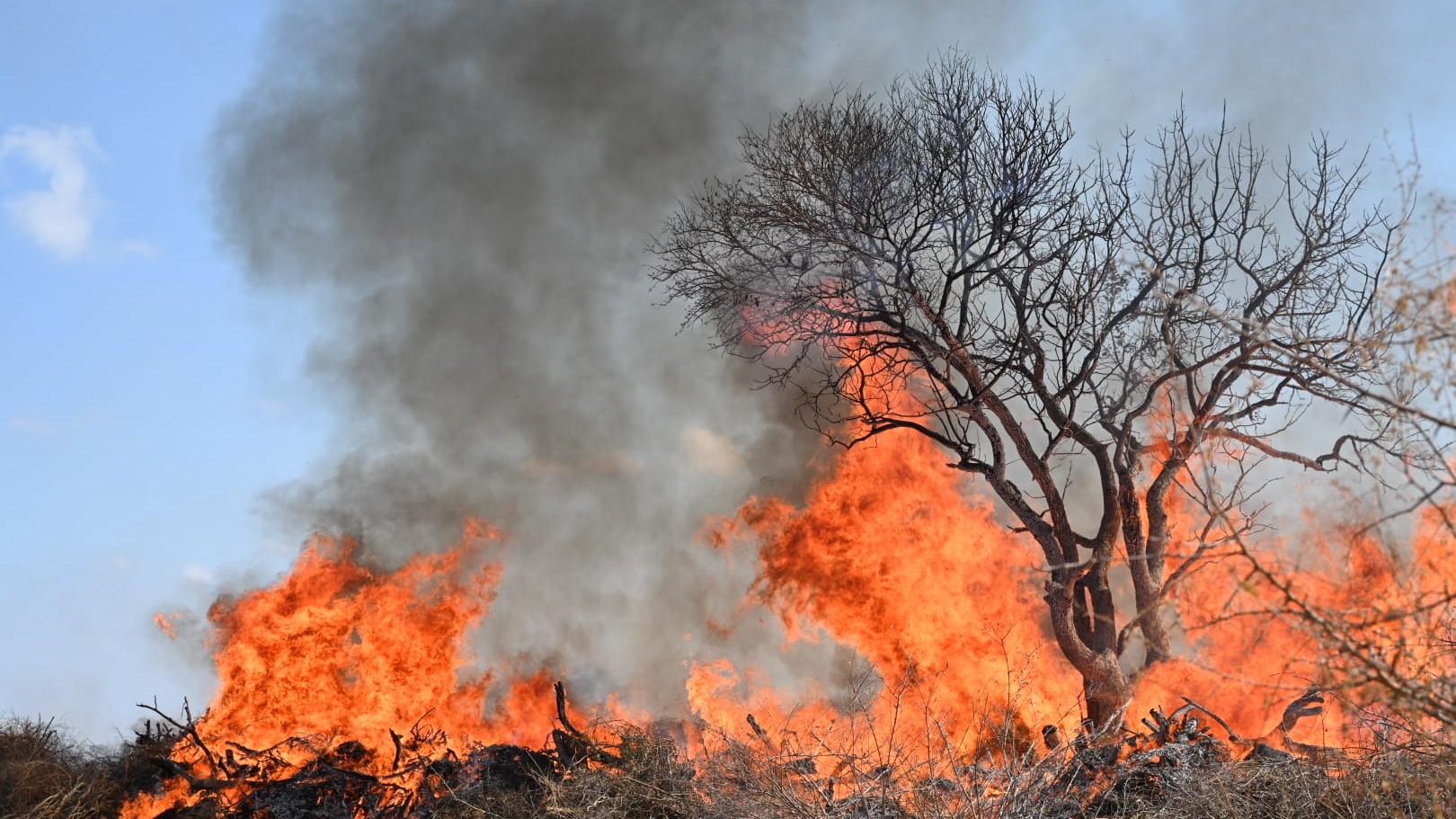
In the past weeks, our research team has been preparing for a unique field experiment investigating how drought and fire influence African savanna vegetation. The work is part of the PhD by Luisa Pflumm, she is supported by our PhD student Antonio Castaneda and his MSc student Anna Bischof. The research is under the supervision of Dr. Mirjana Bevanda who gives Luisa a high degree of freedom for her research while keeping the project goals in mind.

The team has been running a series of test flights to refine their approach. By simulating different ignition points, wind speeds, and wind directions, they aim to ensure optimal conditions for acquiring high-quality UAS thermal imagery during the upcoming fire event. This thermal data will provide critical insight into fire behavior under varying environmental conditions.

To complement the thermal observations, LiDAR and multispectral imagery have been collected both before and after the fire. These datasets will allow the researchers to analyze the spatio-temporal changes in vegetation structure and composition — from the immediate effects of burning to the recovery process in the weeks and months that follow.

This integrated approach will help advance our understanding of how drought and fire interact to shape savanna ecosystems, informing better management and conservation strategies in these fire-prone landscapes.

follow us and share it on:

you may also like:

Presentation at the Geo-Colloquium of the University of Graz

Presentation at the Geo-Colloquium of the University of Graz

Our researcher Dr. Ariane Droin was invited to present her PhD work at the Geo-Colloquium of the University of Graz. The event brought together geographers of a variety of disciplines. Under the title "Erreichbarkeit lokaler Nachbarschaften im urbanen Kontext",...

When Snow Disappears Too Early

When Snow Disappears Too Early

Fieldwork during the winter season in Svalbard usually comes with a built-in advantage: snow. It acts as a natural transport layer, making it possible to move efficiently across large distances with snowmobiles and sleds. You plan your campaign around that mobility:...

Advancing Agriculture with UAS Multi-Sensor Research

Advancing Agriculture with UAS Multi-Sensor Research

Understanding how agriculture can adapt to a changing climate is one of the key challenges of our time. At EORC, we are pleased to share that our researchers are currently collaborating with the Bavarian State Research Center for Agriculture (LfL) on an innovative...

New roll-up shows Urban Collaboration and Research

New roll-up shows Urban Collaboration and Research

Remote sensing thrives on collaboration as shown (by a few selected ones) on our most recent roll-up. Many of today’s most pressing urban and environmental challenges—rapid urbanization, climate change, landcover change, migration, inequality, and economic...

Hackathon within the Super-Test-Site Project

Hackathon within the Super-Test-Site Project

What happens when researchers and developers sit down together to explore a multidisciplinary urban dataset? Our researchers from the EORC joined a hackathon that took place within the Super-Test-Site Project, organised by Prof. Dr. Gunther Gust from the Chair of...

Privacy Policy

Lehrstuhl für Fernerkundung & Lehrstuhl für Urbane Fernerkundung

Erdbeobachtung an der Universität Würzburg

Share This