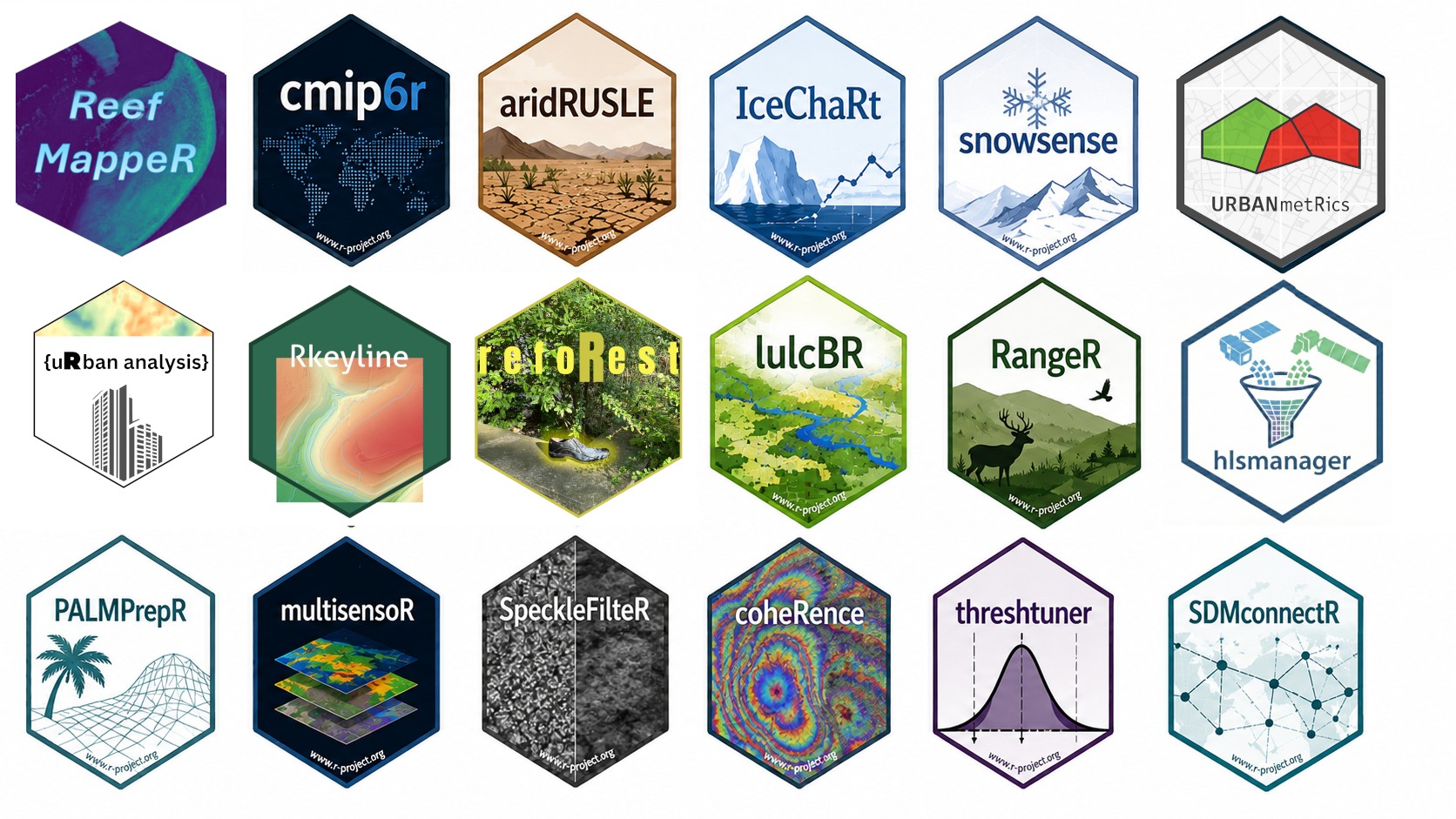

One of the most encouraging signs of a strong Earth Observation curriculum is when students move beyond learning existing tools and start building their own. In their very first semester of the EAGLE MSc program, our students did exactly that: developing a diverse and technically sophisticated set of R packages spanning different Earth Observation applications covering cryosphere science, biodiversity, hydrology, urban analytics, remote sensing workflows, and environmental modeling.
This week we had the showcase of these projects, each one a fully fledged R package designed for real-world geospatial and Earth system applications. The breadth and ambition are remarkable for such an early stage of our young EO scientists.
🌊 Marine and coastal systems
Coastal and marine environments were a clear inspiration for one project.
- ReefMappeR – ReefMappeR repository
A package focused on reef mapping workflows, bringing together spatial analysis tools for marine habitat assessment and visualization.
🌍 Climate and Earth system modelling
Two students engaged directly with large-scale climate datasets and modeling workflows.
- cmip6r – cmip6r repository
Designed to simplify access and handling of CMIP6 climate model outputs for downstream analysis in R. - aridRUSLE – aridRUSLE repository
Implements workflows related to soil erosion modeling in arid environments using the RUSLE framework.
🧊 Cryosphere and snow research
- IceChaRt – IceChaRt repository
A visualization-focused package supporting ice and cryosphere data exploration and charting. - snowsense – snowsense repository
Tools for analyzing snow-related datasets and deriving meaningful indicators from snow observations.
🌆 Urban environments and human-environment systems
Urban remote sensing and environmental analytics formed another strong cluster.
- urbanMetRics – urbanMetRics repository
A toolkit for quantifying urban environmental metrics and spatial indicators. - uRban.analysis – uRban.analysis repository
Focused on structured workflows for urban spatial analysis in R. - Rkeyline – Rkeyline repository
Implements keyline-based landscape and terrain analysis methods relevant for land management.
🌱 Vegetation, forestry, and land cover
- refoRest – refoRest repository
A forest-focused package supporting reforestation and vegetation analysis workflows. - lulcBR – lulcBR repository
Tools for land use / land cover classification and analysis, with a strong remote sensing orientation. - RangeR – RangeR repository
Supports ecological range analysis and spatial distribution assessments.
🛰️ Remote sensing, preprocessing, and EO workflows
A particularly strong theme across projects was the structuring of remote sensing workflows and data pipelines.
- hlsmanager – hlsmanager repository
Facilitates handling of Harmonized Landsat and Sentinel (HLS) datasets. - PALMPrepR – PALMPrepR repository
Preprocessing tools designed to prepare inputs for the PALM model system. - multisensoR – multisensoR repository
Integrates multisensor Earth observation datasets into unified analytical workflows. - SpeckleFilteR – SpeckleFilteR repository
Implements speckle filtering methods for SAR imagery enhancement. - coheRence – coheRence repository
Tools for coherence analysis in radar-based Earth observation data.
📊 Methods, statistics, and model support tools
Some projects focused on methodological foundations and statistical or modeling support.
- threshtuner – threshtuner repository
A utility for optimizing thresholds in classification and detection problems. - spatialtestR – spatialtestR repository
Implements statistical testing workflows tailored for spatial datasets. - SDMconnectR – SDMconnectR repository
Supports species distribution modelling workflows and connectivity analysis. - MineralMappeR – MineralMappeR repository
Designed for mineral mapping using geospatial and spectral data.
🧭 A cohort already building tools for the EO community
Taken together, these projects demonstrate something important: even at the start of their studies, our students, our young scientists are already thinking like EO builders rather than just users of existing functions. The packages span multiple domains but share a common thread; turning complex Earth observation datasets into reproducible, accessible, and analyzable workflows in R.
For a first semester, this is not just impressive, it is exactly the kind of foundation that advances both scientific practice and open-source geospatial ecosystems. And build the basis for a strong EO science career.
The EAGLE Earth Observation cohort is clearly off to a strong start.