
The Quiet Ones and the Strange Career of “Experts” in Research
After enough years teaching MSc and PhD students, running courses, sitting through conference talks, workshops, and the very scientific ritual of coffee breaks, some of us started noticing a type.
Maybe you know the one as well. The person who arrives in a course or workshop already convinced they know what’s going on. Usually because they can code. Or processed a lot of Sentinel data once. Or survived one field campaign and now mention it every third sentence. Or trained a U-Net after two YouTube videos and half a Medium post. And somehow everybody knows they’re an expert before introductions are even over.
We only got a name for it later, from colleagues in polar science:
Arctic Hero Syndrome.
In polar science, it’s the person who comes back from one (one!) Arctic campaign and walks into a course already acting like they’re above it.
In Earth observation, we realized that it shows up in different costumes and we finally have a name for it:
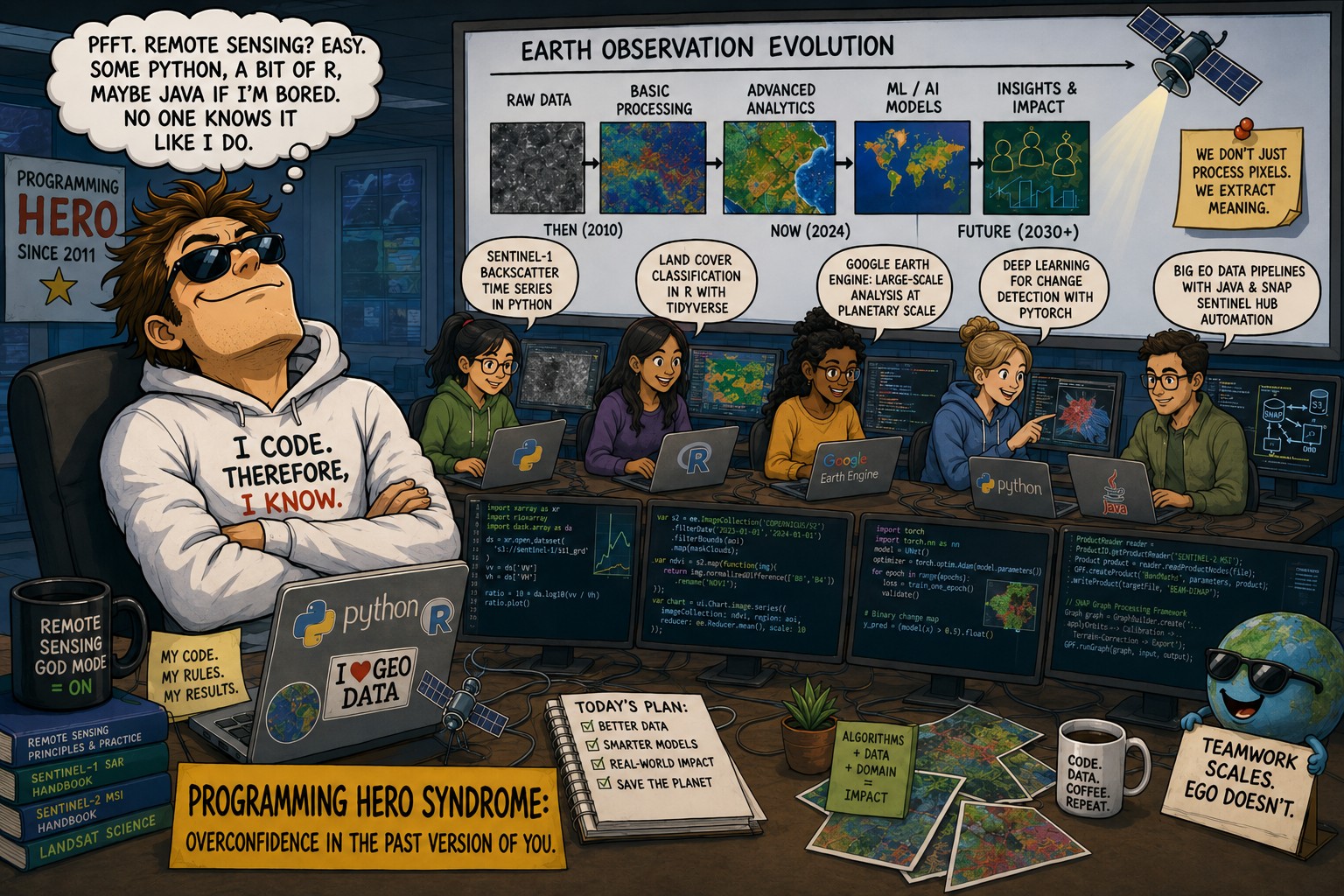
The coding or programming hero.
The AI hero.
The fieldwork hero.
The publication hero.
Probably soon: the foundation model hero. Different tools but the same story. The “programming heros” are usually easy to spot. They define their expertise by a program or code they mastered. Sometimes there’s also a half-finished GitHub empire and a range of ok-ish Python packages. Confidence isn’t their problem. Confidence is useful. The problem comes later. Sometimes, after early success, learning (and as well the fire, spark, curiosity for science) also quietly stops. And that is or rather – will be – the problem. And then there’s the opposite type: The quiet expert. Often – though not always – a woman.
The person sitting in the second row who says very little, asks careful questions, and quietly assumes everybody else understands things better than she does (programming, EO theory, radar processing, …). Meanwhile, she has usually read more, thought more carefully, and built more solid work than the loudest person in the room. We have seen this surprisingly often:
someone who genuinely does not yet realize how good they are. Their code is cleaner. Their thinking sharper. Their questions better. But because they are not announcing their expertise, people overlook them at first. Including, if we are honest, sometimes us.
Then a few semester or years pass. The self-declared expert is still explaining the same thing they already knew in the beginning. The quiet one has become frighteningly good. Not because she announced it but because she never stopped learning (and did not loose the spark, hunger for science and of course especially Earth Observation).
One final caveat.
This is, obviously, a very subjective observation. A pattern we think we have seen after years of courses, supervision, workshops, meetings, and conference coffee.
And like all patterns in academia, it comes (of course) with plenty of exceptions. Programming heros sometimes realize their mistake and start learning again, fieldwork heros acknowledge that they are not knowing all skills yet and so on – and that requires a lot of confidence to admit it!
Still, sitting in rooms that were mostly men versus rooms that were mostly women (what happens in many EAGLE MSc generations in the last years), we have often had the feeling that confidence and competence do not always travel together in quite the same way. We have repeatedly met exceptionally capable people who underestimated their own expertise long after others would already have declared themselves specialists. And we have seen the reverse too: early confidence hardening into identity before deeper expertise had time to catch up.
But that is probably a bigger conversation, and slightly beyond the scope of Hero Syndrome.
The point here is simpler:
science has a strange habit of rewarding the people who stay curious longer than everybody else.