
What are the main drivers and global patterns of farmland abandonment? How can remote sensing help address the challenges of studying farmland abandonment? In what ways might abandoned farmland contribute to biodiversity conservation and carbon reduction?
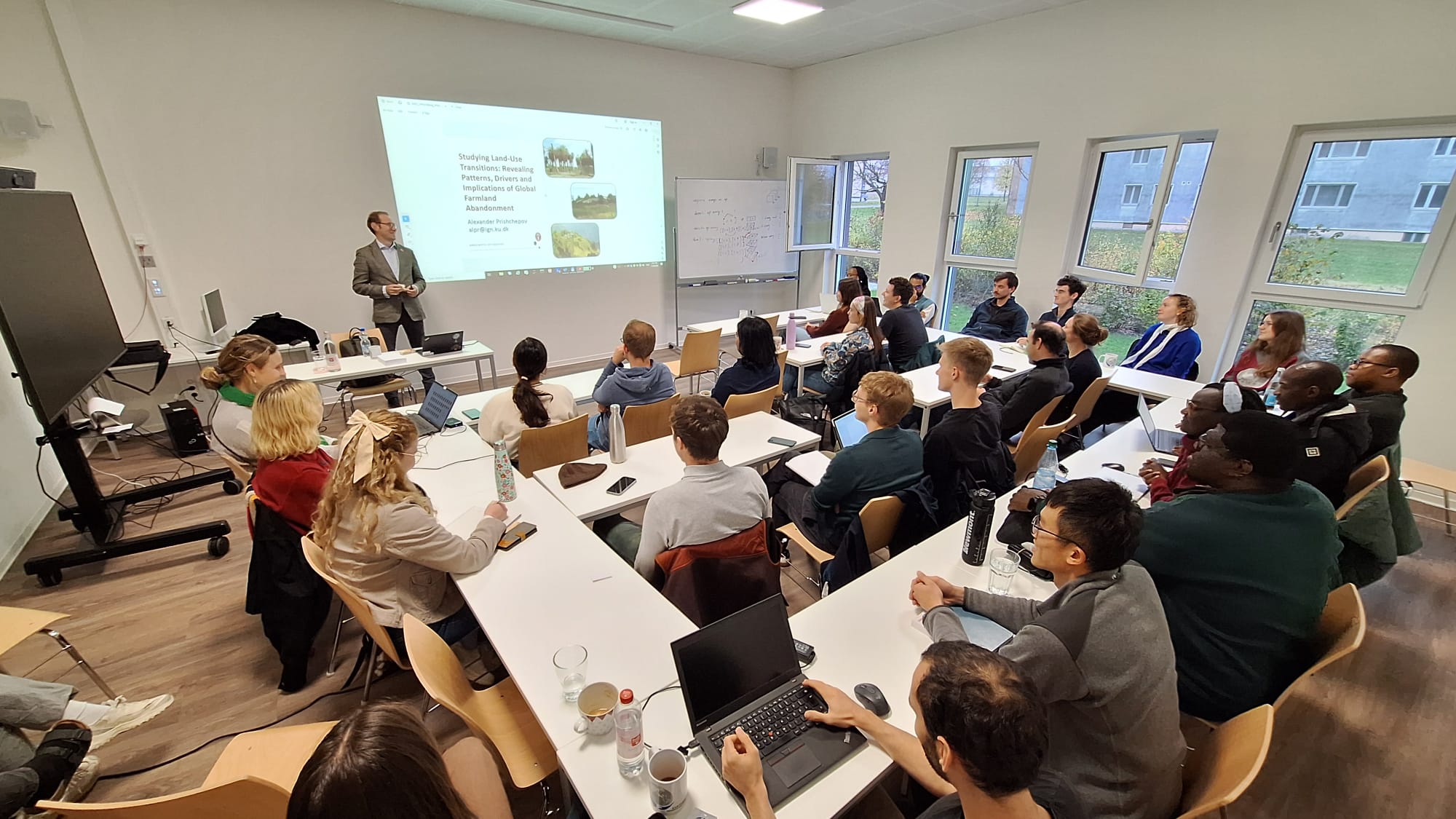
These thought-provoking questions were at the heart of the recent EORC Talk by Alexander V. Prishchepov, who delivered a truly inspiring and insightful presentation on the global phenomenon of farmland abandonment.
Alexander Prishchepov, Associate Professor at the University of Copenhagen’s Section of Geography (Land, Environment and Society, Land Use, Earth Observation, and Sustainability Research Group), shared his expertise in remote sensing and land-use modeling to shed light on the complex dynamics driving the abandonment of agricultural land worldwide. Drawing from many years of research, he discussed how this process, while often overlooked, carries profound implications for the environment, rural societies, and future land management strategies.
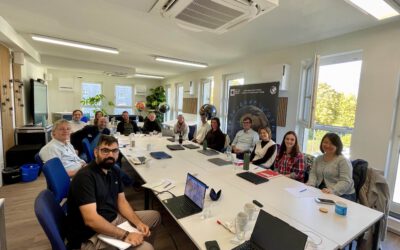
The EORC Talk was very well attended, attracting researchers and students eager to learn more about this important topic. The audience actively engaged with Alexander’s presentation, and students raised many meaningful questions, reflecting the high level of interest and relevance of his work.
With a background that includes a Ph.D. from the University of Wisconsin–Madison supported by NASA’s Land-Cover/Land-Use Change program, and research appointments in Germany and the United States, Alexander brings a rich international perspective to his work. His research, encompassing more than 80 peer-reviewed publications, examines the global patterns and consequences of land-use change, from agricultural expansion to farmland abandonment.
In his talk, he emphasized the power of remote sensing to monitor land transitions across scales, highlighting how such technologies help uncover both challenges and opportunities, particularly in identifying where abandoned farmland might act as a potential ally such as in biodiversity conservation.
As a Scientific Steering Committee member of the Global Land Program and leader of its interdisciplinary working group on global farmland abandonment, Alexander advanced our understanding of how land-use change interacts with environmental and societal systems.
After the talk, Alexander remained available for questions and informal exchange, which provided an excellent opportunity for attendees to discuss research ideas, methods, and potential collaborations.
We sincerely thank Alexander V. Prishchepov for his visit to the EORC and for sharing his valuable insights with our community. It was our pleasure and honor to host him..