The drought of 2026 has once again highlighted the challenges that increasingly frequent dry periods and heat waves pose to agriculture. Against this background, the Bavarian State Research Center for Agriculture (LfL) organized a field day in Schwarzenau on 10 September 2026. Hosted by the Bayerische Staatsgüter (BaySG), the event focused on future crops and farming practices for dry regions such as Lower Franconia, while also demonstrating drone-based monitoring can support climate adaptation in agriculture.
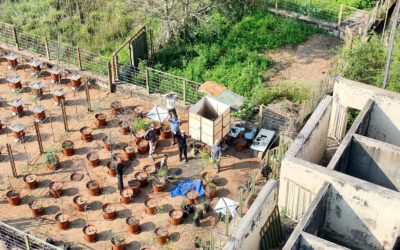
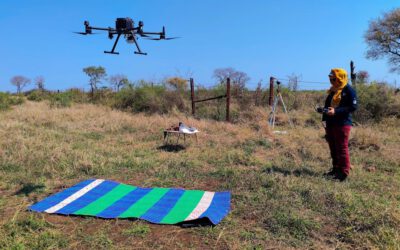
Field trials showcased drought-resistant crops such as cowpea (Vigna unguiculata) and pearl millet (Pennisetum glaucum), which may provide more robust options under water-limited conditions. Trials on relay intercropping, including combinations of millet and maize, illustrated additional approaches to adapting cropping systems to increasingly dry conditions. The field program was complemented by live demonstrations of direct-seeding and drone-based monitoring, providing an opportunity to discuss both their practical application and their potential contribution to climate adaptation.
For the Earth Observation Research Cluster (EORC) at the University of Würzburg, the field day provided another valuable link to ongoing activities in Schwarzenau. The cooperation between the EORC and the LfL Research Centre for Agriculture in Dry Regions in Schwarzenau has already established a valuable framework for joint fieldwork, teaching, and scientific exchange. This includes the use of multisensor UAS data to investigate crop responses to drought, as well as the integration of remote sensing into the EAGLE block course “Linking Science and Practice in Earth Observation for Climate Adaptation.”
The event underlined that adapting agriculture to drought cannot rely on a single crop, cultivation method, or technology. Instead, progress depends on combining agronomic field trials, practical experience, and spatial monitoring and Earth observation. Continued cooperation between the LfL and the University of Würzburg therefore provides an important basis for evaluating how remote sensing can contribute to more climate-resilient agricultural systems.