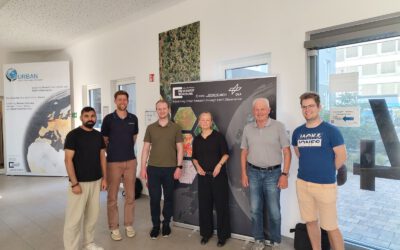


We are very pleased to announce the successful acquisition of the third-party funded BMFTR project HABITRACK. The proposal was led on the EORC side by Ariane Droin and Hannes Taubenböck, together with strong partners from research, medicine, and public health:
-
University Hospital of Munich, Munich
-
Fraunhofer-Gesellschaft for the Advancement of Applied Research e.V., Munich
-
Bavarian Health and Food Safety Authority, Erlangen
-
Institute of Microbiology of the German Armed Forces (IMB), Munich
Why HABITRACK?
Pandemics demand decisive and well-informed political action. Governments often rely on non-pharmaceutical measures—ranging from voluntary social distancing to legally mandated restrictions—to slow down infection waves and protect healthcare systems. These decisions are supported by model-based infection analyses, whose accuracy depends heavily on the availability of precise and granular data.
While existing models primarily focus on human-to-human transmission of respiratory diseases, vector-borne diseases—such as those transmitted by ticks—change the dynamics fundamentally. For these diseases, suitable data, targeted models, and connected information networks are often still lacking.
The aim of HABITRACK
HABITRACK addresses these challenges by developing integrated datasets and innovative spatio-temporal models to better understand and predict vector-borne diseases.
The project focuses on:
-
Tick-borne encephalitis virus (TBEV)
-
Lyme borreliosis
These serve as model diseases to strengthen preparedness for future tick-borne health risks.
Innovative methods: From drone imagery to serological studies
Unlike traditional approaches, HABITRACK uses drone imagery to automatically identify potential tick habitats. These data feed into models that can predict localised infection hotspots. Here, we build on the strong expertise of our well-established UAS research team, which collects and analyses these high-resolution observations.
Working closely with entomologists, the project also advances our understanding of how vectors and pathogens spread, thereby improving model accuracy.
A serological study in a model region further enhances the quality of existing prevalence data and helps reveal previously undetected infections. Predictions of potential micro-hotspots for TBEV and Borrelia will then be validated through field studies.
To enable realistic forecasts of future infection dynamics, the project develops deterministic models that integrate both the newly generated data and available weather predictions.
A step towards better pandemic preparedness
HABITRACK is creating a novel and comprehensive tool for analysing and forecasting vector-borne diseases. By combining Earth observation, drone technology, entomology, and epidemiological modelling, the project provides a forward-looking foundation to support public health and political decision-making in the face of increasing climate-related changes.