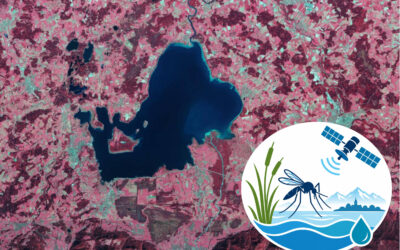

Tick-borne diseases such as Lyme disease and tick-borne encephalitis (TBE/FSME) are becoming an increasing concern in many regions of Germany. A new interdisciplinary research project, MONID HABITRACK (Habitat Prediction and Surveillance of Tick-borne Diseases using Modelling and Imaging Technology), aims to improve the understanding and prediction of disease risks using a combination of remote sensing, drone data, epidemiology and artificial intelligence.
The project started in early 2026 and is coordinated by the Data Science Unit at the Institute of Infectious Diseases and Tropical Medicine at the LMU University Hospital Munich. Researchers from different disciplines including mathematical modelling, virology, entomology, epidemiology and remote sensing work together to better understand the environmental conditions that influence the spread of tick-borne diseases.
From the Earth Observation Research Cluster (EORC) side, Dr. Ariane Droin and Prof. Hannes Taubenböck contribute expertise in Earth observation and drone-based remote sensing. High-resolution drone imagery and geospatial analyses are used to characterise environmental conditions and identify indicators of habitats where ticks and associated pathogens may occur. These data are integrated with weather, epidemiological and biological information to support predictive risk modelling.
The project focuses initially on the Bavarian districts of Amberg-Sulzbach and Schwandorf, regions with particularly high TBE incidence. The long-term goal is to improve early warning, better understand local disease dynamics and support preventive strategies for vector-borne diseases. The project is funded by the German Federal Ministry for Research, Technology and Space (BMFTR) and is part of the MONID research network on severe infectious diseases.
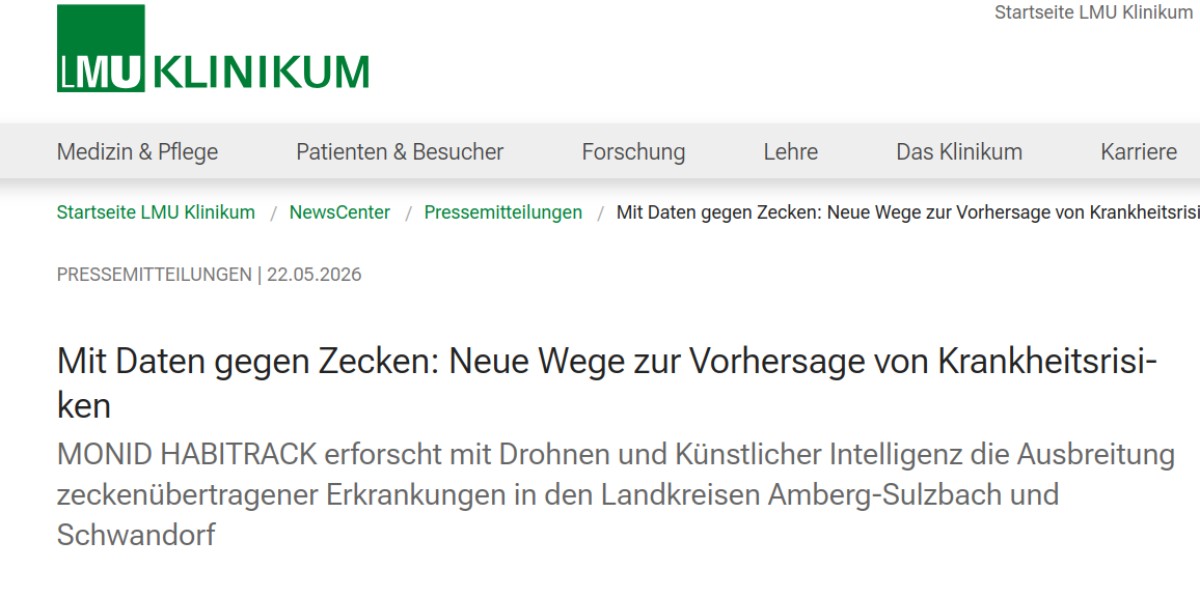
Further details can be found in the press release by the LMU Klinikum:
LMU Klinikum press release on MONID HABITRACK