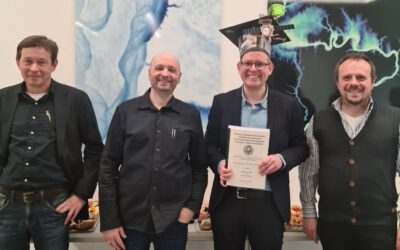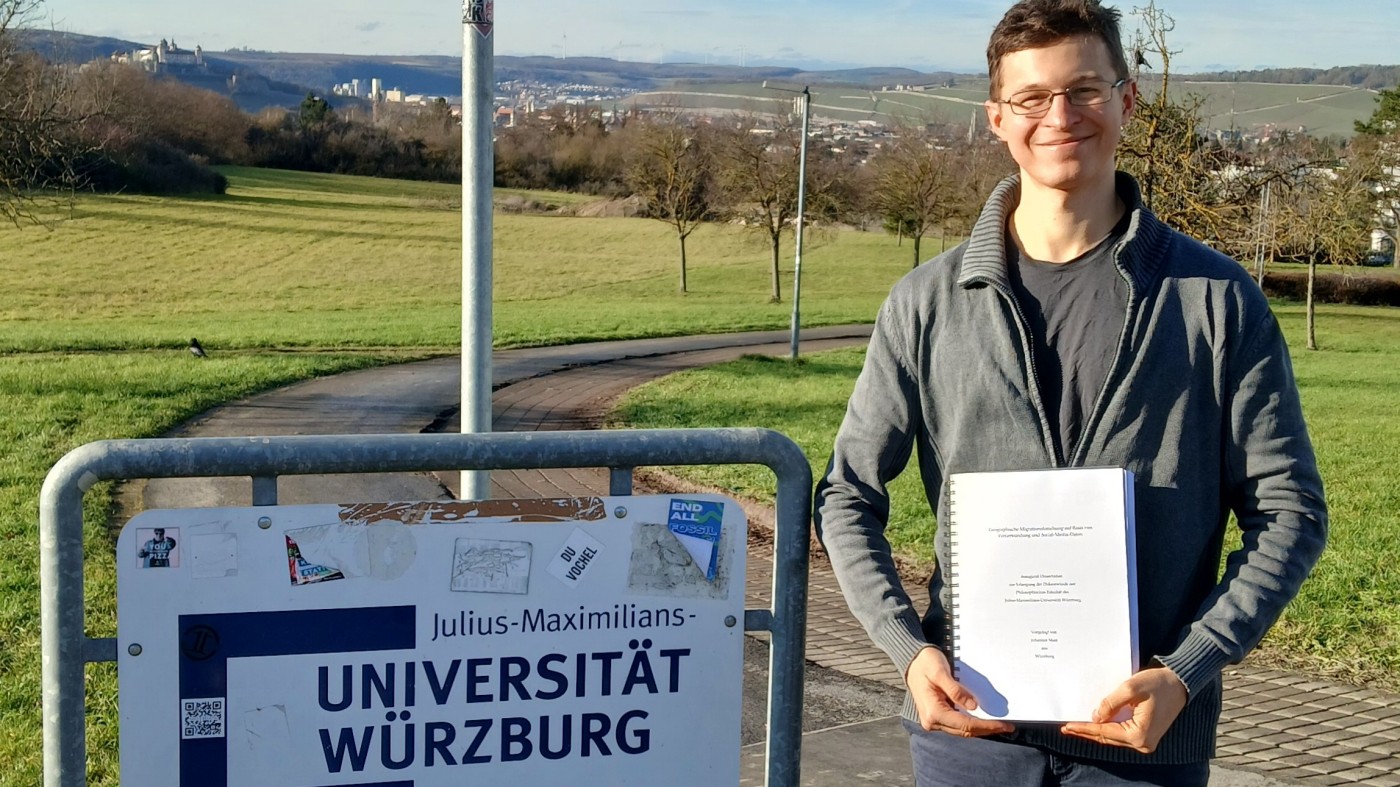

We are proud to celebrate a major milestone of EAGLE MSc alumnus and EORC PhD student Johannes Mast, who has successfully submitted his PhD thesis titled “Geographical Migration Research Based on Remote Sensing and Social Media Data.” His work represents an exciting example of how geospatial technologies and unconventional data sources can be combined to better understand complex human dynamics.
from the abstract:
Human migration is a phenomenon of great significance for our world. Both our environment and society interact constantly with the movements of people. Among environments, cities are especially relevant as they are the destination of most migrants. Further, humanity as a whole is on a long-term shift from predominantly rural to predominantly urban regions. In 2025, the scale of migration is greater than ever, and urban population growth in Africa in particular is progressing at a rapid pace.
When researching our world and its global change, it is essential to take these important processes into account. The necessary geographical research requires the large-scale measurement of migration factors. While remote sensing data can measure many physical aspects on a large scale and consistently, the socio-economic, cultural and individual migration factors can only be measured indirectly with image data. In this respect, there is a data gap that could be filled by web data and specifically by geo-referenced social media data (GSM). This data is largely text data that can be localized using geotags or geoparsing and thus spatially analyzed as geodata. A joint analysis with remote sensing data in the context of human migration has not yet been carried out.
Against this background, this dissertation aims to provide evidence that such a joint analysis is possible and useful. The potential of GSM is discussed and critically scrutinized with regard to coverage and bias. Due to the dynamic nature of the research subject and the interdisciplinary nature of migration research, methods are developed that are flexible and modular. In this respect, the dissertation sets itself apart from the optimization of processes for inferring specific characteristics. Six studies are carried out as part of the dissertation, which can be divided into three thematic parts:
Part A deals with the combination of remote sensing and GSM in urban areas. Study A1 combines remotely sensed mappings of building construction years with geo-referenced texts from the platform Twitter. This reveals a hitherto unknown digital disparity in many African cities, which manifests itself in a higher density of geotweets in older neighborhoods. Furthermore, it can be shown that this disparity is related to the degree of planning and the structure of the settlements, even if the underlying causalities still need to be worked out in more in-depth studies. Study A2 contributes to such in-depth studies in urban space by demonstrating a novel method for subdividing urban space into study areas. By rasterizing text embeddings, GSM can be used together with remote sensing data in spatial clustering procedures to create spatial units that show both physical and textual coherence and can be interpreted as a variation of neighborhoods, blocks, or urban districts. Aggregate statistics at the level of these units can support data visualization and interactive applications in mixed-method studies and improve the communication of content and results.
Part B tests the derivation of mobility characteristics from GSM and demonstrates their applicability in the context of text content. Numerous studies deal with the derivation of mobility information from digital traces of Internet users. However, the joint evaluation of mobility information and text content still leaves great and as yet untapped potential in the context of migration. Study B1 therefore proves that mobility types derived from GSM can be linked to information about the text content. For Twitter users with a Nigerian background, this combination shows that international mobility in particular is associated with a higher interest in certain topics such as entertainment and technology. Furthermore, study B2 demonstrates that lexical features of local language can also be identified algorithmically and related to mobility information of GSM users. In particular, it reveals a tendency that the use of Nigerian-local lexical items of English is less frequent among emigrants than among Nigerians in Nigeria, and that both mobility and language variation are related to the topics of the text.
Part C explores possible content biases that GSMs are subject to when using topics, due to the usefulness of themes as a structure for analysis. The tendency of topics to contain geographical references is explored in study C1. Across a large web corpus of data from Twitter, Reddit, Nairaland, Stackexchange, web news and American journals, it can be shown that the topics of the texts influence their probability to contain localizable place mentions. Study C2 further demonstrates that the influence of topics can differ depending on whether geotags or geoparsing approaches are used to localize the text content.
Overall, the studies show that there are numerous methods for the algorithmic analysis of digital content that can also be used in the context of migration. Modern machine learning methods in particular enable algorithmic analysis of large volumes of text content. The results generated in this way can be spatially linked to mobility characteristics and remote sensing data, providing considerable added value for geographical research. As studies C1 and C2 demonstrate, there are additional distortions in the geographical evaluation of text content, which must be considered in addition to the frequently documented demographic distortions. The representativeness of GSM data must therefore be critically scrutinized and, together with limitations of data access, represents the main limitation of the approaches explored in the dissertation. For these reasons, traditional methods such as in-situ surveys, census data, and qualitative evaluations can by no means be replaced by the methods demonstrated in this dissertation. Rather, the interaction of these methods can lead to a more comprehensive and complete understanding of migration and migration factors. The perspectives of remote sensing and social media prove to be highly complementary in this respect. Despite the challenges, their combination can make valuable and unique contributions to the study of global migration and urbanization.