
Monitoring Urban Heat with Multi-Sensor Earth Observation: The SMART-TWIN Project

Monitoring Urban Heat with Multi-Sensor Earth Observation: The SMART-TWIN Project

March 3, 2026

Urban areas are increasingly exposed to heat stress, making climate-sensitive planning more important than ever. As part of this effort, our team has recently started a new project focused on urban heat monitoring using multi-sensor Earth Observation approaches.

The research is embedded within SMART-TWIN, a project aimed at developing an AI-supported planning tool for climate-adapted urban development in Bavaria. Our work contributes to improving the data foundation for understanding and modelling urban heat dynamics, combining satellite-based observations with complementary sensor data to better capture spatial and temporal variability.

The remote sensing research in this project is covered by Antonio Castaneda-Gomez, who is working on thermal Earth Observation data integration and analysis and lead by Prof. Tobias Ullmann.

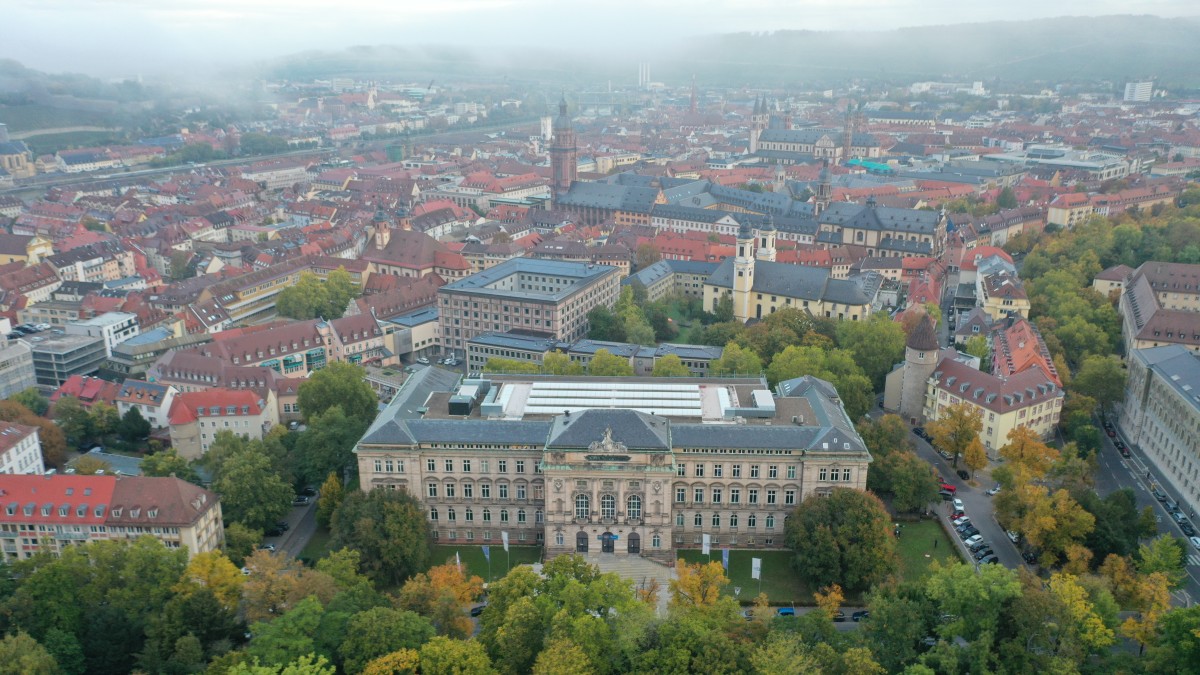
At the core of SMART-TWIN is the enhancement of an existing digital twin for the city of Würzburg by integrating the urban climate model PALM-4U through climatology approaches. This enables simulations of different urban planning scenarios, including changes in green and blue infrastructure, and their impacts on urban climate under present and future extreme weather conditions.

Würzburg serves as an ideal pilot site due to its warm and dry climate, dense urban structure, and relatively limited green spaces—factors that contribute to a pronounced urban heat island effect. Insights gained here are expected to be transferable to other cities across Bavaria with similar environmental and data conditions.

The SMART-TWIN project ultimately aims to support more informed, efficient, and climate-resilient urban planning. By combining advanced modelling with multi-sensor Earth Observation, we hope to contribute to practical tools that help cities better adapt to a warming climate.

The project is funded by the European Regional Development Fund (EFRE).

follow us and share it on:

you may also like:

Henri Debray Successfully Defends PhD on Global Urban Morphology

Henri Debray Successfully Defends PhD on Global Urban Morphology

We are delighted to announce that our PhD student Henri Debray has successfully defended his doctoral thesis, “Characterizing Urban Morphology at a Global Scale: Geospatial Perspectives,”. Henri’s thesis builds on a series of his scientific publications investigating...

EOCap4Africa Training in Kinshasa

EOCap4Africa Training in Kinshasa

This week, 14 students are attending a test run of our Remote Sensing module on Remote Sensing for Biodiversity Conservation at the University of Kinshasa. This module is part of the EOCap4Africa project (funded by the Federal Agency for Nature Conservation, lead Dr....

KI4Stereo – Hybrid kick-off meeting at DLR

KI4Stereo – Hybrid kick-off meeting at DLR

KI4Stereo – Hybrid kick-off meeting at DLR: AI-based analysis of stereo image data for tree monitoringOn January 23rd, 2026, a hybrid kick-off meeting was held at DLR to officially launch the research project KI4Stereo (funded under the KMU-innovativ programme,...

EORC researchers teaching drone remote sensing at UNIS, Svalbard

EORC researchers teaching drone remote sensing at UNIS, Svalbard

During their current visit to Svalbard, EORC researchers have been teaching UNIS students from all over Europe on how drones can be used for remote sensing in the high Arctic. Invited by our UNIS collaborators Prof. Dr. Simone Lang (UNIS) and Prof. Dr. Eero Rinne...

Urban Earth Observation Lecture: Understanding Cities from Above

Urban Earth Observation Lecture: Understanding Cities from Above

As part of the EAGLE M.Sc. programme, our international students attended this winter term the Urban Earth Observation lecture by EORC professor Hannes Taubenböck. The session offered a comprehensive overview of how remote sensing has evolved into a central tool for...

PhD submission by Henri Debray

PhD submission by Henri Debray

Shortly before the end of the year, while many of us were preparing for the Christmas break, our colleague Henri Debray submitted his doctoral thesis, “Characterizing Urban Morphology at a Global Scale: Geospatial Perspectives,” to the Technical University of Munich,...

Privacy Policy

Lehrstuhl für Fernerkundung & Lehrstuhl für Urbane Fernerkundung

Erdbeobachtung an der Universität Würzburg

Share This