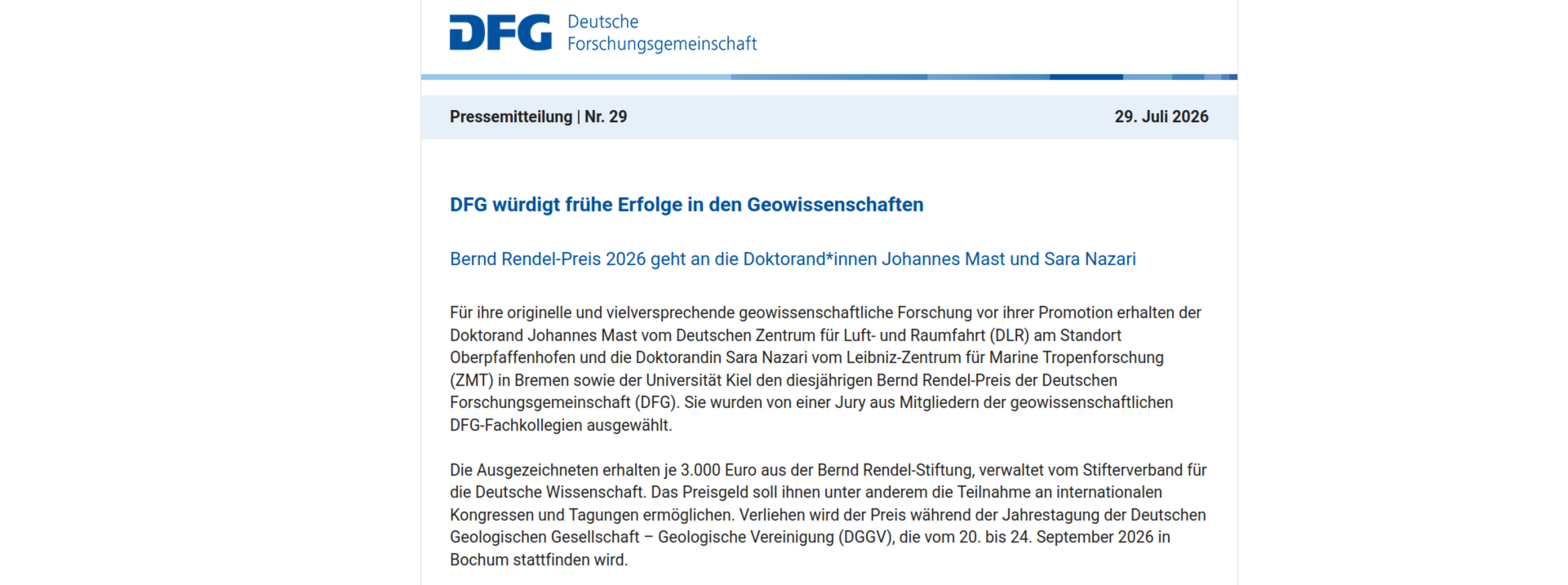

Johannes Mast, who finished his PhD earlier this year, supervised by Hannes Taubenböck, has been awarded the Bernd Rendel Prize 2026, one of two young researchers honored this year (the other is Sara Nazari, who works on global groundwater at ZMT Bremen and Kiel University). The prize goes to geoscience PhD students for original, promising work done in their doctorate, and it comes with 3,000 euros meant to help them get out to international conferences. It’ll be handed out in September at the DGGV annual meeting in Bochum.
Johannes is working on something that sits right at the intersection of remote sensing and social science, and it’s a genuinely clever idea. The usual story with satellite data is that it shows you the physical world changing, cities sprawling, land use shifting, and so on, but it doesn’t tell you much about the human, social side of why that’s happening. Johannes is trying to close that gap by pulling in a totally different kind of geodata: text. Specifically, public text from social media and news articles.
The trick is that he links where people are and how they move with what they’re actually writing about. Put those together and you get a way to read physical changes on the land surface through a socioeconomic lens, not just a spectral one.
One example he points to is genuinely striking. In a lot of African cities, the density of tweets in newly built districts is much lower than in the older, established parts of town. That’s not just a quirk of who has Twitter. Johannes reads it as a sign that a city’s digital footprint often lags behind its physical growth, which points to real digital inequality baked into how cities expand. It’s the kind of finding that only shows up once you start treating social media data as seriously as satellite imagery, and putting the two side by side.
Congratulations, Johannes. Well deserved.
german press release by DFG here: https://news.dfg.de/a/a.aspx?AysD20iqHlte2rT9o68wySg0hQ2