
LASmoons license granted for a M.Sc candidate

LASmoons license granted for a M.Sc candidate

August 20, 2015

Recently, the M.Sc student Bastian Schumann applied for a 3-month sull license of LAStools to be applied in the course of his M.Sc thesis “Explaining over- and understory canopy coved by leaf-off and leaf-on LiDAR data”. LAStools consists of highly efficient, batch-scriptable, multicore command line tools to classify, tile, convert, filter, raster, triangulate, contour, clip, and polygonize LiDAR data. By submitting an appllication supported by a proposal,  limited number of underfunded academics who have no budget for a full academic LAStools license qualify for a few LASmoons of full LAStools functionality. These complimentary licenses typically last three full months.
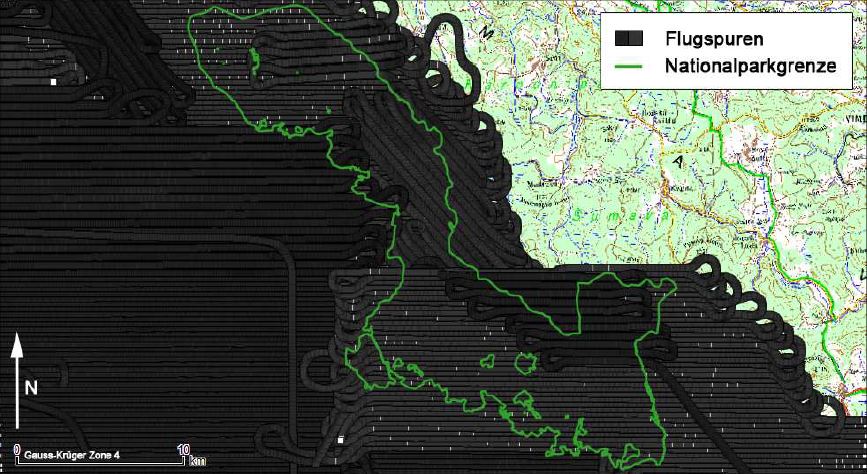
Example of LiDAR flight strips over the entire Bavarian Forest National Park

Example of LiDAR flight strips over the entire Bavarian Forest National Park

Supervised by Dr. Hooman Latifi from Dept. of remote sensing in Würzburg, Bastian Schumann will extract statistical and density metrics from two sets of leaf-off and leaf-on LiDAR data to make an accurate and unbiased estimation of canopy density in tree, shrub and herbal layers within the Bavarian Forest National Park. LAStools will be used here to initially process the raw point cloud data and create DTMs, DSMs and CHMs and to derive LiDAR metrics from normalized LiDAR points. The full version of LAStools is needed to assure timely processing of the vast amount of raw data.The results of this study will be used as a benchmark to compare with those previously achieved by Latifi et al. (2015) using leaf-on data across the same study area.

Further informaiton on this project can be found in the LASmoons blog which will also cover further updates on the opurtcomes of this work.

follow us and share it on:

you may also like:

Geometric calibration study of our thermal UAS sensor

Geometric calibration study of our thermal UAS sensor

At the EORC we deploy a range of space-borne and UAS-based sensors for environmental research. While many systems come with established calibration procedures, some of our UAS sensors require dedicated validation and characterization to ensure scientifically reliable...

EORC researchers teaching drone remote sensing at UNIS, Svalbard

EORC researchers teaching drone remote sensing at UNIS, Svalbard

During their current visit to Svalbard, EORC researchers have been teaching UNIS students from all over Europe on how drones can be used for remote sensing in the high Arctic. Invited by our UNIS collaborators Prof. Dr. Simone Lang (UNIS) and Prof. Dr. Eero Rinne...

Upcoming PhD Defense by Sebastian Buchelt on 11th February

Upcoming PhD Defense by Sebastian Buchelt on 11th February

We are happy to announce that our colleague Sebastian Buchelt will defend his PhD thesis "Potential of Synthetic Aperture Radar time series for mapping and monitoring of small-scale periglacial processes in alpine environments" on February 11th at 12 pm at...

Talk by Dr. Philipp on AI at Airbus

Talk by Dr. Philipp on AI at Airbus

Our former EAGLE M.Sc. graduate and EORC PhD graduate Dr. Marius Philipp will give talk about AI, ML and NLP within his current work at Airbus. The talk will take place next Wednesday, 11th of Feb., at 2pm in John-Skilton Str. 4a. It will take place either in seminar...

Urban Earth Observation Lecture: Understanding Cities from Above

Urban Earth Observation Lecture: Understanding Cities from Above

As part of the EAGLE M.Sc. programme, our international students attended this winter term the Urban Earth Observation lecture by EORC professor Hannes Taubenböck. The session offered a comprehensive overview of how remote sensing has evolved into a central tool for...

Share This