
Linking Science and Practice: Exploring Earth Observation for Water Management

Linking Science and Practice: Exploring Earth Observation for Water Management

m

July 22, 2026

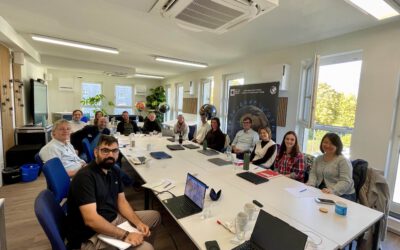
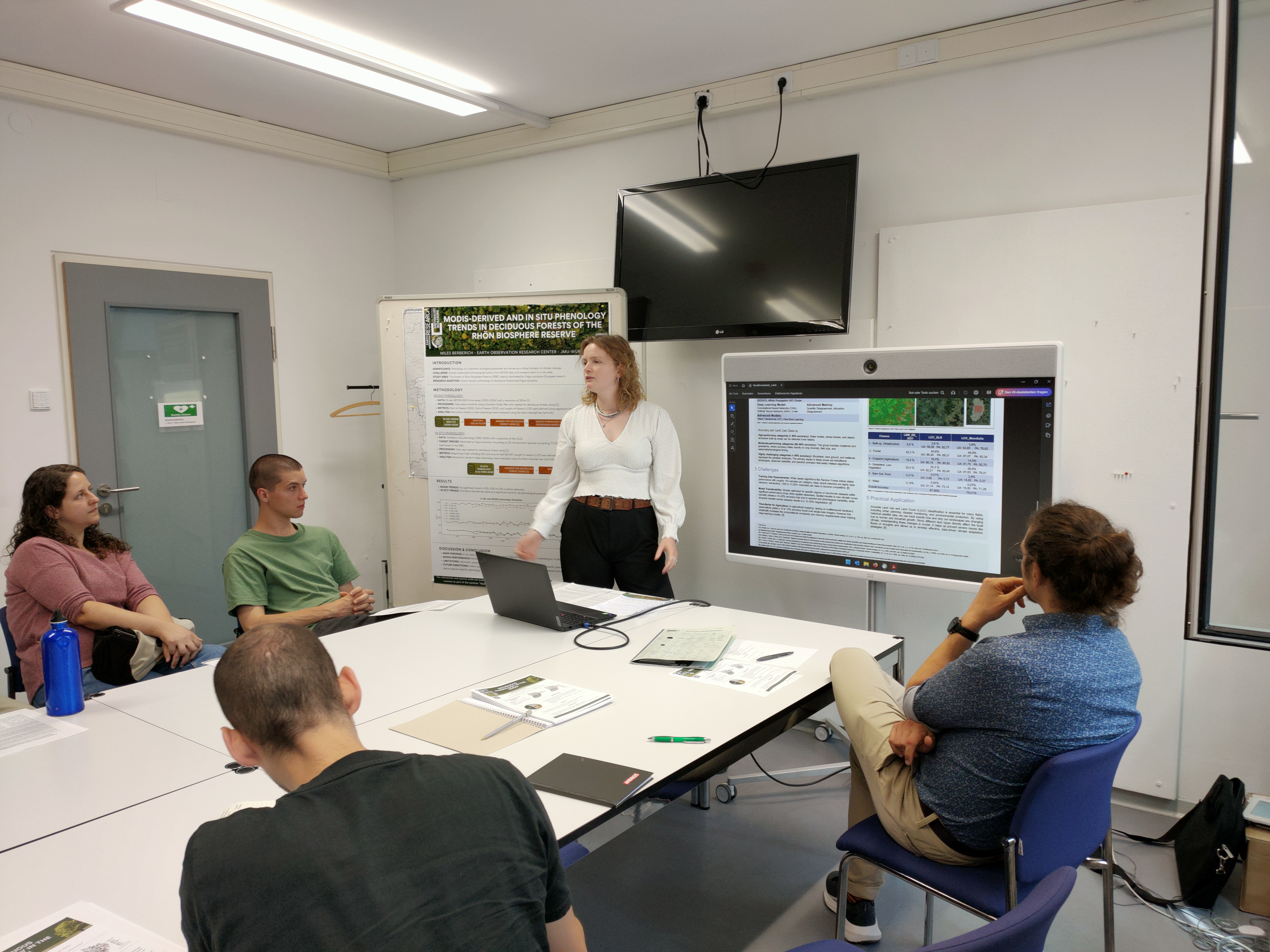
How can Earth observation support sustainable water management in times of climate change? This question was at the center of a recent visit by participants of the EAGLE block course “Linking Science and Practice in Earth Observation for Climate Adaptation” to the Department of Water Management at the Government of Lower Franconia. The visit offered a valuable opportunity to connect scientific approaches with real-world challenges in public administration. As part of the course, led by EORC staff Dr. Julian Fäth and Dr. Sarah Schönbrodt-Stitt, students presented posters showcasing different applications of remote sensing for climate adaptation. The first focused on land use classification as a basis for identifying and planning adaptation measures. The second explored the use of satellite data to analyze the phenology of deciduous forests in the Rhön region. The third demonstrated how remote sensing can be used to detect dried or intermittently flowing streams, an important aspect of hydrological change. The subsequent discussion with representatives of the Government of Lower Franconia focused on current challenges in water management, including groundwater monitoring, declining groundwater levels, and the impacts of climate change on regional water resources. The exchange underlined both the potential and the limitations of remote sensing in supporting environmental decision-making. We sincerely thank the Government of Lower Franconia and the Department of Water Management for their warm welcome, open discussion, and for sharing their practical perspectives.

follow us and share it on:

you may also like:

DBU scholar Josipa Subotic

DBU scholar Josipa Subotic

Almost a year ago, Josipa Subotic showed up at EORC as a DBU scholar, and now her stay with us is coming to an end. Josipa spent her time digging into snow cover properties around the Zugspitze, working with Sentinel-2 time series data. Multispectral imagery, lots of...

GLS-team visits Planetary Health exhibition

GLS-team visits Planetary Health exhibition

One of the aims of Geolingual Studies Geolingual Studies - Geolingual Studies is to ensure effective science communication beyond the scientific community and into the wider society. The Geolingual Studies team was given the opportunity to look at concepts and methods...

University press covered our anniversaries

University press covered our anniversaries

Einblick, the University of Würzburg's press medium, published an article on our double anniversary, 25 years of Earth observation research and 10 years of EAGLE M.Sc. program, today. Recently, they has visited us at our EORC to hear about our research and teaching...

Mapping Lava Tubes on Mauritius with iPhone Pro LiDAR

Mapping Lava Tubes on Mauritius with iPhone Pro LiDAR

Lava tube structures on Mauritius are quite hard to survey - tight, dark, and largely inaccessible to classical scanning equipment. As part of ongoing research by Dr. Kim Lea Holzmann (Chair of Animal Ecology and Tropical Biology, University of Würzburg), we're...

Johannes Mast wins Bernd Rendel Prize

Johannes Mast wins Bernd Rendel Prize

Johannes Mast is awarded the 2026 Bernd Rendel Prize for Geosciences by the Deutsche Forschungsgemeinschaft (DFG) for outstanding research as part of his dissertation. Johannes’s highly interdisciplinary work bridges the Geosciences, Linguistics, Data Science, and...

Share This