
Our Postdoc Dr. Julian Fäth from the Earth Observation Research Cluster (EORC) recently published a paper titled “Multi‑method soil moisture monitoring at two temperate forest stands in Germany” together with our colleague Prof. Dr. Christof Kneisel from the Department of Physical Geography.
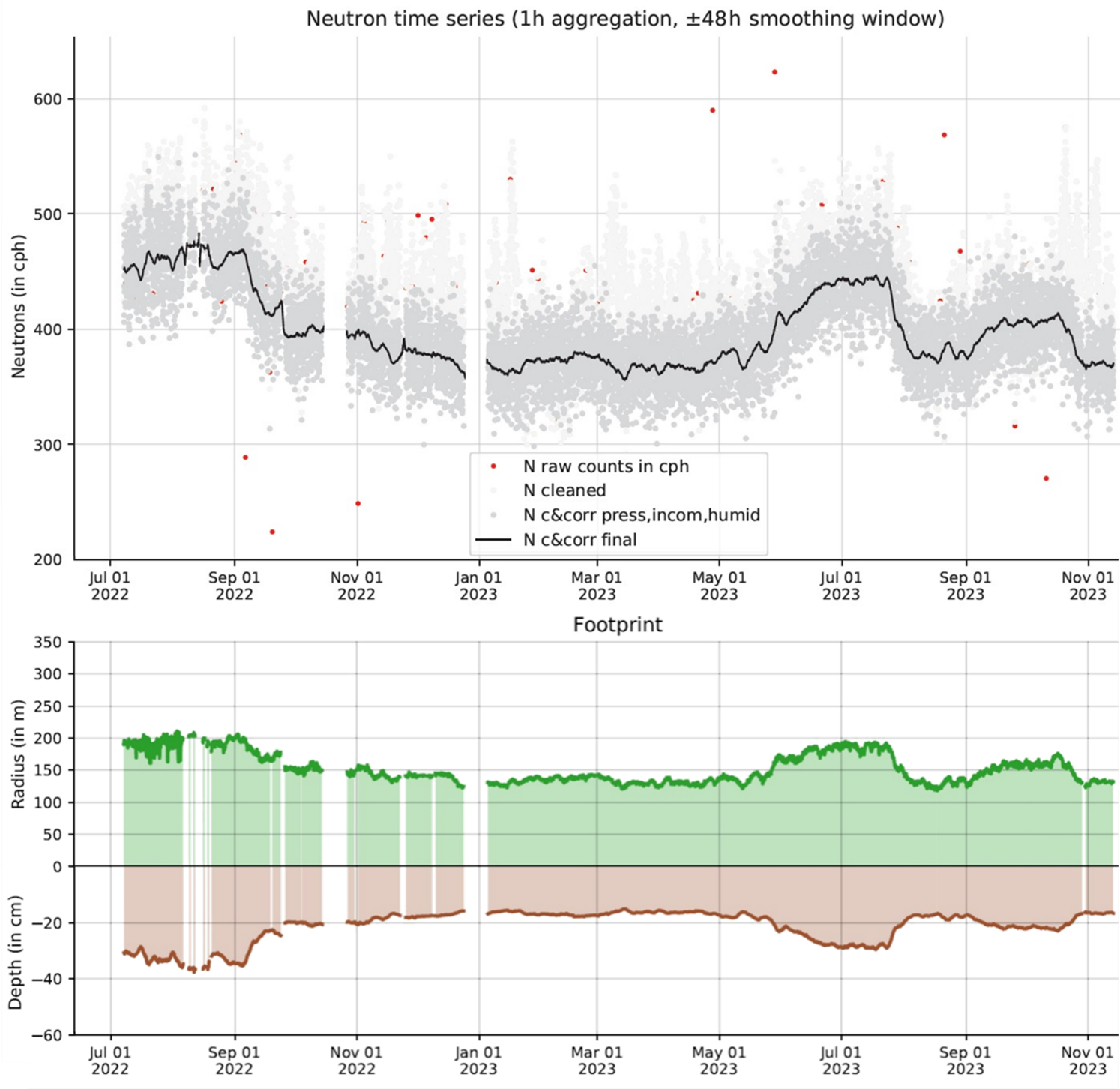
The study, inter alia, addresses the use of Cosmic Ray Neutron Sensing (CRNS) for monitoring the soil water content in a temperate forest. During the last two decades, the spatial limitations of traditional in-situ methods for measuring soil moisture, like TDR or FDR probes, have led to an increasing importance of CRNS, whose measuring signal is integrated over a large area, covering a radius of up to 200 m in forests. This also makes it a potentially relevant method for verifying remote sensing and hydrological modelling products, especially in the context of monitoring disturbed or bare forest areas.
The paper is published in the Special Issue “Earth and Environmental Sciences: Advancements in Monitoring Soil Water and Plant Conditions in a Changing Climate” of the Springer Journal Discover Applied Sciences.
Read the full article (open access) here: https://link.springer.com/article/10.1007/s42452-024-06262-w