
Our EO4CAM staff member Julia Rieder from the Earth Observation Research Cluster (EORC) has just published an exciting new study in Forest Ecology and Management, based on the BeechDecline project coordinated by TU Dresden, in collaboration with colleagues from the University of Göttingen and HSWT Weihenstephan.
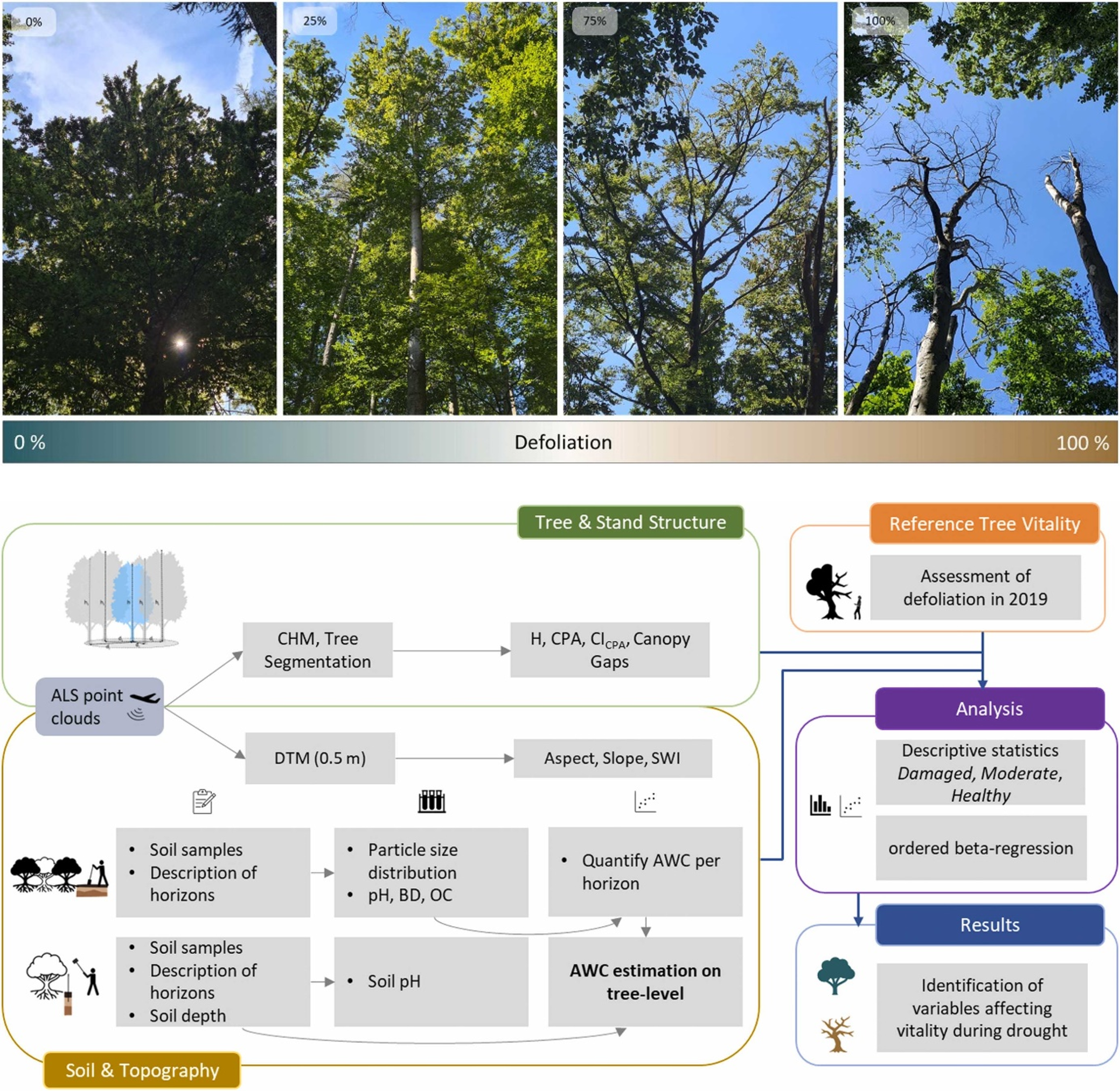
The study dives deep into the drivers of European beech vitality after extreme drought, combining an exceptionally comprehensive dataset of soil properties (including detailed lab analyses of soil physics and chemistry), topography, and forest structure using LiDAR-derived tree metrics, with all parameters examined at both the stand and individual tree level. Using the R package TreeCompR, competition effects were additionally compared with defoliation.
The result: a data-rich, multi-scale view on how tree size, neighborhood composition, and stand structure shape the resilience of Fagus sylvatica in a changing climate.
Key findings
- Tall beech trees with high growth rates showed highest defoliation rates.
- Large pre-existing canopy gaps improved beech vitality during extreme drought.
- Observed effect of soil water availability across sites was not confirmed within sites.
- Selective thinning of large beech trees in non-drought years may improve resilience.
- Mixing species with contrasting hydraulic strategies deserves further testing.
From the abstract: The severe drought of 2018/19 caused widespread early discoloration, defoliation and tree mortality in European beech (Fagus sylvatica L.), although local drought responses varied strongly among coexisting trees. To identify potential drivers, we investigated 520 mature beech trees across 20 forest sites dominated by European beech in Southern Germany, Central Europe. We recorded crown health conditions and described the small-scale variability in the topographic, edaphic, structural and competitional status of individual trees, complemented by dendrochronological sampling. Overall, tall trees growing on sites with more available soil water and higher pre-drought growth showed highest defoliation rates, supporting global findings that larger trees are more susceptible to drought-induced tree mortality. In the ordered beta-regression model, including forest sites as random effect, pre-existing canopy gaps significantly improved vitality during drought and beech tended to show lower defoliation in mixed stands with Scots pine. These findings highlight canopy and neighbourhood structure as a possible buffer against drought stress. By contrast, the influence of tree size and soil water availability could not be detected in the model due to a large variability across sites. A substantial portion of the remaining small-scale variation in defoliation could not be explained by our fixed effects, but rather by site effects, underlining the complexity of drought responses in beech forests. We conclude that for future-proofing our forests, selective thinning of large European beech trees in non-drought years appears to be an appropriate silvicultural measure to strengthen the drought resilience of neighbouring trees, which deserves further testing. Furthermore, silvicultural management actions should account for species mixtures while explicitly considering species-specific drought response strategies, for example by combining species with contrasting hydraulic strategies or rooting systems.
Read the full text: https://doi.org/10.1016/j.foreco.2025.123293
Publication on TreeCompR: https://doi.org/10.1111/2041-210X.14414