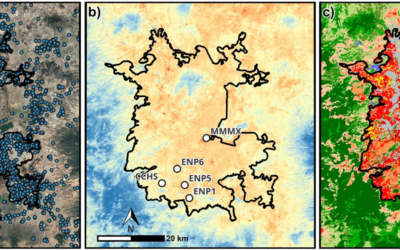

Researchers from the Technical University of Munich (TUM), the Munich Center for Machine Learning, the German Remote Sensing Data Center (DFD) of the German Aerospace Center and our Earth Observation Research Cluster (EORC) of the University of Würzburg teamed up for a study titled “Identification of the potential for roof greening using remote sensing and deep learning“. The paper was just published in the journal Cities by Qingyu Li, Hannes Taubenböck and Xiao Xiang Zhu.
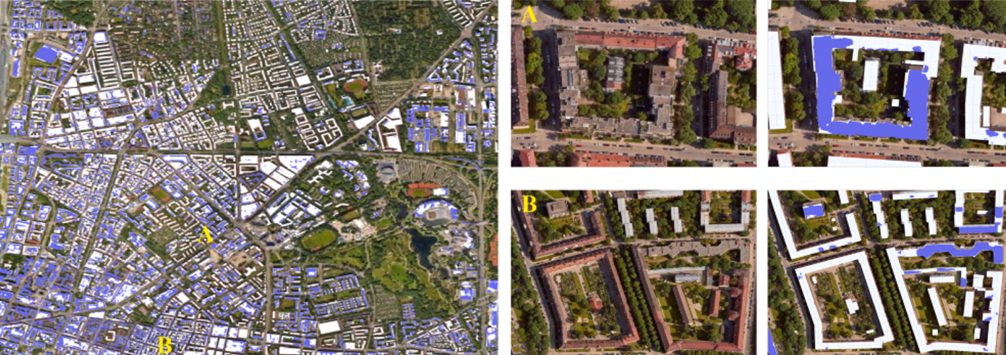
Here is the abstract of the paper: Under the mounting pressure from global warming, green roofs emerge as a valuable source for climate adaptation, particularly in compact metropolises where green space is limited. Consequently, there is a need to quantitatively evaluate the potential for roof greening where it is most needed and suitable. Despite the increasing importance of this issue, there have been limited studies on the effectiveness of remote sensing and deep learning in identifying the potential for roof greening in many cities. To address this, we have created a GreenRoof dataset, comprising approximately 6400 pairs of remote sensing images and corresponding masks of
roofs with high greening potential in four European cities. Afterward, we exploit the capabilities of deep learning methods to identify roofs that are suitable for greening from remote sensing images. Using 15 German cities as a case study for future urban rooftop planning, we estimate the spatial potential for retrofitting green roofs. Structural parameters for prioritizing green roof implementation include vegetation coverage, thermal environment, and building density. Results indicate that the total area suitable for green roof retrofitting exceeds 20 % of the roof area in the 15 German cities examined. The spatial analysis effectively reflects variation in demand and suitability for green roof retrofitting across different cities. In conclusion, this study provides a versatile screening approach utilizing remote sensing, deep learning, and spatial analysis, which can be readily adapted to inform municipal policies in other cities aiming to promote green roofs and enhance sustainable urban development.
Here is the link to the full paper: https://www.sciencedirect.com/science/article/pii/S0264275125000824