
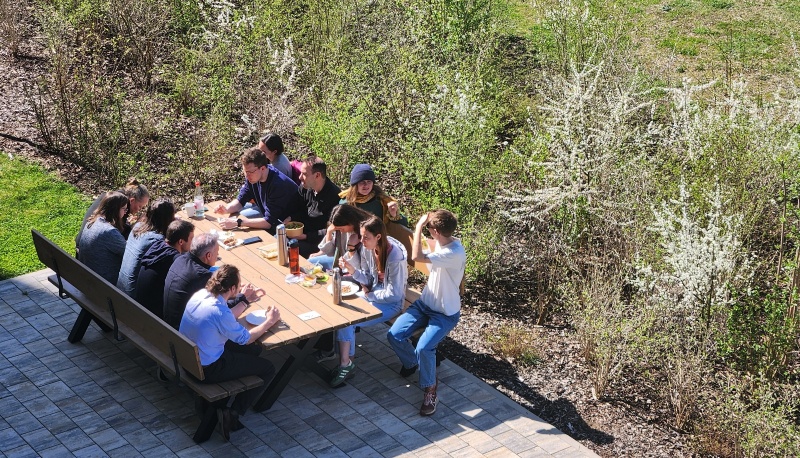

With the first warm days of spring finally arriving, a small fraction of our team already took full advantage of the sunshine during lunch break—gathering outside to soak up the mild weather and enjoy a few well-earned moments of relaxation.
Some of us have just returned from snowshoe-based field work in the Alps, where icy winds and deep snow were the daily norm. The contrast makes these gentle spring breezes and sunny skies feel even more special. It’s a welcome change and a great reminder of the seasonal transitions that shape both our research and daily lives.
Here’s to many more sunny breaks ahead
follow us and share it on:

you may also like:
Teaching activities in the Arctic: EORC at UNIS on Svalbard
It started a few years ago, when Mirjana Bevanda built up a collaboration with partners at UNIS, the University Centre in Svalbard. Jakob Schwalb-Willmann joined soon after, and today a growing group from EORC heads north to teach there, including Antonio...

A First Get-Together with the New EAGLE Generation 🦅
A new EAGLE generation means new faces, new ideas, and the start of another journey in Earth Observation. And what better way to kick things off than with a relaxed evening at the pub? Our first social event brought together the new students, older EAGLE generations,...
River and Rock Glacier Monitoring: EORC at the German Geomorphology Meeting
Sebastian Buchelt and Florian Betz from the Earth Observation Research Cluster (EORC) at the University of Würzburg presented their latest research at the annual meeting of the German Society for Geomorphology (DGGM). Both contributions highlighted the growing...
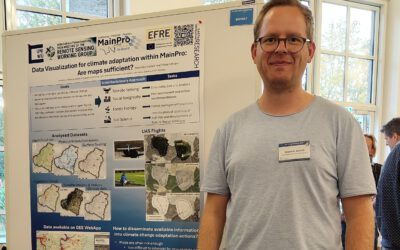
EFRE-Project MainPro presented WebApp at AK Fernerkundung 2026 – Are maps sufficient?
Last week, Sebastian Buchelt presented recent advances of the EFRE project MainPro at the AK Fernerkundung in Braunschweig, particularly about the WebApp, which is freely available online. His poster „Data Visualization for climate adaptation within MainPro“ asked the...
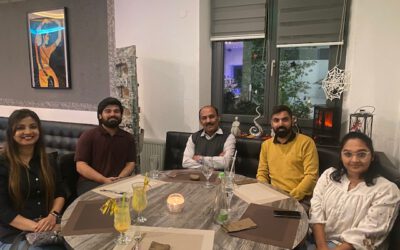
An Evening with Professor Jarugu Narasimha Moorthy
It was a pleasure to have dinner with Professor Jarugu Narasimha Moorthy, who received an honorary doctorate from the Faculty of Chemistry and Pharmacy in recognition of his achievements. The ceremony took place on 29 September 2026 in the Chemistry Central Building....
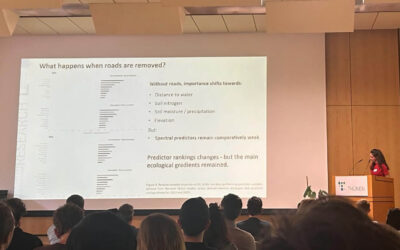
Ecology or Sampling Bias? A Roadside Perspective on Invasion Risk
At the 2026 annual meeting of the AK Fernerkundung (German Working Group on Remote Sensing), which was hosted by the Thünen Institute in Braunschweig, our EORC team member Dr. Insa Otte presented research results on sampling bias in species distribution models in...
bzgl. Art. 50 Verordnung (EU) 2024/1689 (AI Act):
Überwiegend werden eigene originäre Texte und Bilder des EORC genutzt, jedoch sind einige Inhalte von blog post Texten teilweise mit Hilfe von KI überarbeitet worden und einige Bilder sind ganz mit KI erstellt, die jedoch deutlich keine photorealistische Darstellungen abbilden. Aussnahmen sind KI generierte fernerkundliche Datensätze, die explizit für Forschungszwecke mit KI erstellt wurden, hier wird aber durch den assoziierten Text der wissenschaftliche Grund der KI generierten Bilder erläutert.